
What Exactly Is a Micro-City
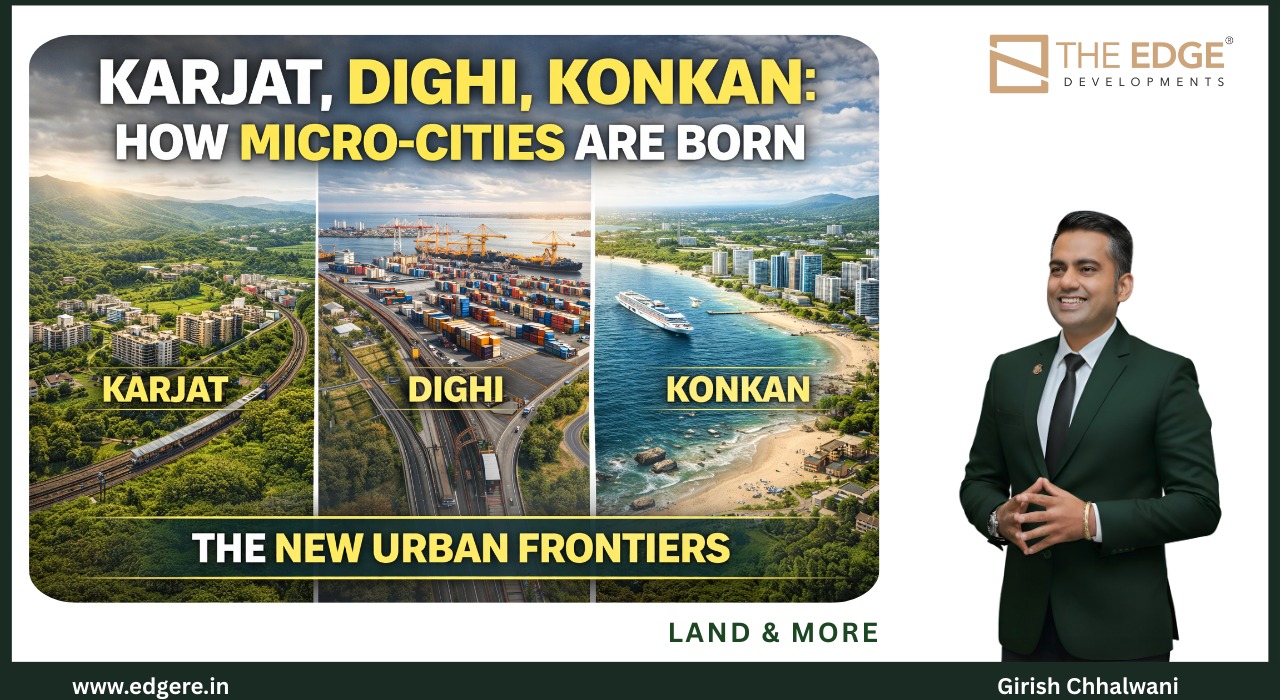
Karjat, Dighi, Konkan: How Micro-Cities Are Born
Micro-cities are born when infrastructure, land availability, livability, and economic purpose align at the right moment. Regions like Karjat, Dighi Port, and the Konkan exemplify how small geographies evolve into self-sustaining urban ecosystems—quietly, structurally, and irreversibly.
This is not rapid urbanisation.
It is measured emergence.
What Exactly Is a Micro-City?
Direct answer:
A micro-city is a compact, connected, and purpose-driven urban node that offers employment access, livability, and services without the congestion of a mega metro.
Micro-cities are not suburbs.
They are independent urban organisms.
They typically feature:
-
Proximity to major infrastructure (ports, airports, highways, rail)
-
Available land for planned growth
-
Lower density and better environmental quality
-
A clear economic role (logistics, tourism, education, wellness, industry)
-
Strong connectivity to larger metros
Why Micro-Cities Are Replacing the Old Growth Model
Large metros don’t fail—they overload.
As cities mature:
-
Infrastructure lags
-
Land fragments
-
Commutes lengthen
-
AQI worsens
-
Quality of life erodes
Micro-cities emerge as pressure valves—absorbing growth that the core can no longer handle sustainably.
This is not decentralisation by abandonment.
It is decentralisation by design.
Karjat: From Getaway to Growth Node
Karjat is a textbook example of micro-city formation.
Why Karjat fits the pattern:
-
Strong rail and road connectivity
-
Proximity to major employment zones
-
Abundant land for low-density planning
-
Natural buffers that protect AQI
-
Rising demand for permanent and hybrid living
Karjat didn’t grow because of marketing.
It grew because people chose it—for space, health, and balance.
That choice created:
-
Residential demand
-
Education and hospitality services
-
Local employment
-
Stable, end-user-led growth
This is how micro-cities solidify.
Dighi: When Ports Seed Urban Ecosystems
Ports don’t just move goods.
They anchor economies.
Dighi Port illustrates how industrial and logistics infrastructure triggers micro-city dynamics.
The sequence is predictable:
-
Port operations expand
-
Logistics and warehousing cluster
-
Employment rises
-
Support housing and services follow
-
Nearby towns urbanise organically
This growth is not speculative.
It is employment-backed—the most resilient form of urban expansion.
Konkan: The Quiet Geography of the Future
The Konkan region represents a broader micro-city canvas.
Its advantages are structural:
-
Coastline-driven trade and tourism
-
Cleaner air and lower density
-
Expanding road and port connectivity
-
Cultural continuity and livability
-
Large land parcels suitable for planned development
Konkan won’t become one mega city.
It will evolve into a network of micro-cities—each with a distinct role, connected but not congested.
That is modern urban resilience.
How Micro-Cities Actually Form (The Real Sequence)
Answer-first clarity:
Micro-cities do not begin with housing.
They begin with function.
The typical sequence:
-
Infrastructure arrives
-
Economic activity anchors
-
People migrate by choice
-
Housing follows demand
-
Social infrastructure matures
-
Identity forms
When this sequence is respected, cities grow with stability.
When it’s reversed, cities struggle.
Why Micro-Cities Attract Long-Term Capital
Capital seeks predictability, not noise.
Micro-cities offer:
-
Lower entry costs
-
Longer growth runways
-
End-user demand
-
Policy alignment
-
Environmental resilience
They don’t promise overnight returns.
They promise durability.
This is why patient capital enters early—and stays.
What This Means for India’s Urban Future
India doesn’t need more megacities.
It needs many well-designed micro-cities.
Cities that:
-
Breathe
-
Scale
-
Adapt
-
Absorb growth without collapsing
Karjat, Dighi, and the Konkan belt are not exceptions.
They are prototypes.
Final Thought
Cities are no longer born in one dramatic moment.
They form quietly—through movement, choice, and alignment.
The future belongs to places that grow small before they grow big.
That is how micro-cities are born.
And that is how India’s next urban chapter will be written