
Aerial view of a dense small-town district in India with mixed rooftops and tree cover at golden hour
CategoriesLand Investment

Property Tax on Land and Plots in Maharashtra: Complete 2026 Guide

THE EDGE — Direct Answer

Property tax in Maharashtra is a recurring annual (or semi-annual) charge levied by the local body — Municipal Corporation, Municipal Council, or Gram Panchayat — where the land is situated, and it is entirely separate from the one-time stamp duty paid at registration. Unlike stamp duty, there is no single statewide rate: each local body sets its own tax structure, and vacant land is typically taxed differently (often at a lower rate) than built-up property until construction begins. Most Municipal Corporations, including areas within the Mumbai Metropolitan Region, use a Capital Value System based on the government’s Ready Reckoner Rate, while smaller Gram Panchayats often apply simpler, lower flat-rate structures on vacant plots. Buyers should confirm the specific local body’s rate and payment portal for their exact survey number before assuming a figure.

TL;DR — KEY TAKEAWAYS

  • Property tax is recurring (annual/semi-annual), unlike stamp duty which is a one-time charge at registration — budget for both separately.
  • Rates are set locally, not statewide — Municipal Corporations, Municipal Councils, and Gram Panchayats each have different structures.
  • Vacant land is usually taxed lower than built property, but the exact treatment varies significantly by local body classification.
  • Non-payment accrues penalties and interest and can eventually lead to attachment — always factor ongoing property tax into your total holding cost, not just the purchase price.

Land investors routinely budget for stamp duty and registration but overlook property tax entirely — a recurring cost that continues every year you hold the land, whether or not you’ve built on it. This guide explains how property tax works across Maharashtra’s different local body classifications and what it means for your total cost of ownership.

Reading time: 9 minutes | Last updated: July 2026 | Author: Girish Chhalwani, Founder & CEO, THE EDGE Developments

How is property tax different from stamp duty?

Parameter Stamp Duty Property Tax
Frequency One-time, at registration Recurring — annual or semi-annual
Authority State government (IGR Maharashtra) Local body (Municipal Corporation/Council/Gram Panchayat)
Basis Higher of agreement value or Ready Reckoner Rate Varies by local body — often capital value or a flat structure for vacant land
Applies to The transaction itself Ongoing ownership, every year

Which local body determines the property tax rate?

Maharashtra land falls under one of three local body classifications, and each sets its own property tax structure:

  • Municipal Corporation (e.g., areas within larger cities): Typically uses a Capital Value System, calculating tax based on the government Ready Reckoner Rate for the property multiplied by factors including usage category, construction type, and age — vacant land is generally assessed at a lower capital value factor than built property.
  • Municipal Council / Nagar Parishad (smaller towns, e.g., parts of Karjat, Khopoli town limits): Generally applies a simpler rate structure, often lower than Municipal Corporation rates for comparable land.
  • Gram Panchayat (rural/village areas): Typically the lowest property tax burden, often a modest flat or area-based charge, though this increases if the area urbanises and the local body classification changes.

Because THE EDGE’s core investment corridors (Karjat, Khopoli, and similar peri-urban zones) span multiple local body classifications, two plots of similar size and value in different villages can carry meaningfully different annual property tax obligations — always confirm which local body governs the specific survey number.

How is property tax calculated on vacant land specifically?

Vacant, undeveloped land is generally taxed at a lower rate than built property under most local body structures, since the “capital value” or assessed value of bare land without construction is lower. However, the specific mechanism varies:

  • Some Municipal Corporations apply a reduced capital value multiplier to vacant land compared to constructed property.
  • Once construction begins or a building permission is obtained, the assessment typically shifts toward the higher built-property structure, even before construction completes in some jurisdictions.
  • Gram Panchayats often apply a simple area-based flat rate for vacant plots that is minimal compared to urban Municipal Corporation rates.

How and where do you pay property tax in Maharashtra?

Most Municipal Corporations and larger Municipal Councils in Maharashtra now offer online property tax payment portals, where you can look up your property using the property/assessment number and pay directly. Smaller Gram Panchayats may still require in-person payment at the local Panchayat office. Payment is typically due annually, with many local bodies offering an early-payment discount and levying a penalty with interest for late payment.

What happens if property tax goes unpaid?

Unpaid property tax accrues penalty interest, and persistent non-payment can eventually lead to the local body issuing a demand notice and, in serious cases, attachment proceedings against the property. Beyond the direct financial cost, unpaid property tax dues can also complicate a future sale — buyers and their advocates routinely check for outstanding dues as part of due diligence, and unresolved dues can delay or derail a transaction.

Frequently Asked Questions

Do I have to pay property tax on vacant land I haven’t built on?

Yes, in most local body jurisdictions across Maharashtra, though vacant land is generally assessed at a lower rate than built property. The exact structure depends on whether the land falls under a Municipal Corporation, Municipal Council, or Gram Panchayat.

Is property tax the same across all of Maharashtra?

No. Property tax is set locally by each Municipal Corporation, Municipal Council, and Gram Panchayat individually — there is no single statewide rate or structure, unlike stamp duty which follows a more uniform state framework.

How often do I need to pay property tax?

Most local bodies in Maharashtra bill property tax annually, with some offering a semi-annual payment option. Many also offer a discount for early or lump-sum annual payment.

Does property tax increase after I build on my plot?

Generally yes. Once construction begins or a building permission is granted, most local bodies reassess the property at a higher capital value or rate structure than applied to vacant land.

Can unpaid property tax affect my ability to sell the land later?

Yes. Outstanding property tax dues are a standard due-diligence check for buyers and their advocates, and unresolved dues can delay registration or require settlement before a sale can proceed cleanly.

Citations & Sources

  1. Maharashtra Municipal Corporations Act, 1949
  2. Maharashtra Municipal Councils, Nagar Panchayats and Industrial Townships Act, 1965
  3. Bombay Municipal Corporation — Capital Value System guidelines

Understand Your Full Cost of Ownership Before You Buy

THE EDGE Developments helps investors model total holding costs — including property tax — before committing to a land purchase in the Karjat–MMR corridor.

Contact: connect@theedgedevelopments.com | +91-9664662938 | edgere.in

This article is general information, not tax advice. Confirm exact rates with the relevant local body for your specific property.


Aerial view of a winding road and boundary line dividing two adjoining agricultural land parcels
CategoriesLand Investment

Common Land Disputes in Maharashtra: Patterns, Causes & How to Avoid Them

THE EDGE — Direct Answer

The most common land disputes in Maharashtra fall into six recurring patterns: unclear inheritance among multiple legal heirs, boundary and encroachment conflicts with neighbouring parcels, undisclosed prior sales or mortgages not reflected in the current 7/12, fraudulent or expired Power of Attorney used to execute a sale, protected-tenant claims under Maharashtra’s tenancy laws on agricultural land, and government reservation of the land for a public purpose under the Development Plan. Nearly every pattern is preventable with the same core discipline: a full 30-year title search, independent verification of the seller’s identity and authority, and cross-checking the land against government project maps before signing anything.

TL;DR — KEY TAKEAWAYS

  • Inheritance disputes among multiple legal heirs are the single most common cause of unclear title in Maharashtra land transactions.
  • Boundary and encroachment disputes often surface only after purchase, when a survey reveals the plot doesn’t match what was represented.
  • Power of Attorney fraud — selling through an expired, revoked, or forged POA — remains a recurring scam pattern, especially with NRI-owned or absentee-owner land.
  • Tenancy rights and government reservations can encumber land in ways a simple 7/12 check won’t reveal — always cross-check against Development Plan maps.

Most land disputes in Maharashtra are not the result of bad luck — they follow a small number of recurring, well-understood patterns that a properly structured due diligence process catches before money changes hands. This guide covers the six patterns THE EDGE’s advisory work sees most often, illustrated with composite scenarios drawn from common transaction structures rather than any single real case.

Reading time: 11 minutes | Last updated: July 2026 | Author: Girish Chhalwani, Founder & CEO, THE EDGE Developments

Pattern 1: Unclear inheritance and succession disputes

Land held by a joint family or passed down through generations often has multiple legal heirs with a claim to it, even if only one family member’s name appears prominently on documents shown to a buyer. A common scenario: a seller presents a 7/12 extract showing their name, but the land was inherited jointly with siblings or cousins who never formally partitioned it — meaning the seller does not have unilateral authority to sell the entire parcel.

How to avoid it: Request a full succession/family tree disclosure from the seller, verify against the 8-A extract and mutation history, and confirm whether a registered partition deed exists. If the land came through inheritance, get written consent from all legal heirs, not just the named seller.

Pattern 2: Boundary and encroachment disputes

A plot’s boundaries as described on paper (survey number, area) can differ from what’s physically demarcated on the ground — sometimes due to informal historical encroachment by a neighbouring landowner, sometimes due to outdated survey records that were never updated after a road or drain was built through the area.

How to avoid it: Commission a fresh boundary survey (Mojani) by a licensed surveyor before purchase, and physically walk the boundary with the seller and, where possible, adjoining landowners present to confirm no disputed overlap.

Pattern 3: Undisclosed prior sale, mortgage, or encumbrance

A seller may fail to disclose — deliberately or through incomplete records — that the land was previously mortgaged to raise a loan, or that a portion was already sold to someone else in a transaction not yet reflected in the current 7/12 mutation entries.

How to avoid it: A 30-year title search through the Sub-Registrar’s Index II records is the single most effective check here — it reveals every registered transaction against the property, not just the current snapshot. Also check the CERSAI database for registered mortgages.

Pattern 4: Power of Attorney fraud

Land owned by an NRI, an elderly or absentee owner, or someone living far from the property is sometimes sold by a third party holding a Power of Attorney (POA) that has since been revoked, expired, or was never validly executed in the first place. Buyers who don’t independently verify the POA’s current validity can end up in a transaction the actual owner later disputes.

How to avoid it: Independently contact the actual titled owner (not just through the POA holder) to confirm the POA is current and was knowingly granted. Verify the POA is registered, and check its specific scope — a POA limited to “management” does not necessarily authorise a sale.

Pattern 5: Protected tenancy claims on agricultural land

Maharashtra’s tenancy laws grant certain long-term cultivators of agricultural land statutory protection and, in some circumstances, a right to purchase the land they’ve tilled. Land that appears to have a clean single-owner 7/12 can still carry an undisclosed tenancy claim if someone has cultivated it for an extended period under an informal arrangement.

How to avoid it: Ask directly whether any tenant has cultivated the land, check the 7/12’s “Other Rights” column for any tenancy entries, and consult a local advocate familiar with the specific taluka’s tenancy history before finalising agricultural land purchases.

Pattern 6: Government reservation under the Development Plan

A parcel can be privately owned with clean title yet still be reserved by the local planning authority for a public purpose — a road widening, a garden, a school site — under the applicable Development Plan or Town Planning Scheme. This doesn’t always block a sale, but it can severely restrict what the buyer is actually permitted to build.

How to avoid it: Obtain a Zone Certificate / Development Plan remark for the specific survey number from the Town Planning department before purchase, confirming there’s no reservation affecting the parcel.

Frequently Asked Questions

What is the most common cause of land disputes in Maharashtra?

Unclear inheritance among multiple legal heirs is the most frequently encountered pattern — a seller with an apparently clean 7/12 may not actually have sole authority to sell if the land was jointly inherited and never formally partitioned.

How can I check if land has an undisclosed tenancy claim?

Check the “Other Rights” (Itar Hakk) column of the 7/12 extract for any tenancy entries, and directly ask the seller and, where possible, neighbouring landholders whether anyone has cultivated the land under a long-term informal arrangement.

Can I trust a seller’s Power of Attorney without further verification?

No. Independently contact the titled owner to confirm the POA is current, was knowingly executed, and specifically authorises a sale — not just property management. Verify it is registered.

Does a clean 7/12 extract guarantee the land has no disputes?

No. The 7/12 shows current recorded ownership and classification but won’t reveal government reservations under the Development Plan, unregistered tenancy claims, or disputes not yet reflected in mutation entries — a full title search and Development Plan check are both necessary.

What should I do if I discover a dispute after signing an agreement but before registration?

Do not proceed to registration. Consult a property advocate immediately to assess whether the agreement can be rescinded and any advance payment recovered before the transaction becomes legally binding through registration.

Citations & Sources

  1. Maharashtra Land Revenue Code, 1966
  2. Maharashtra Tenancy and Agricultural Lands Act, 1948
  3. Registration Act, 1908

Buy Land That’s Already Cleared Every One of These Checks

THE EDGE Developments conducts full title verification, boundary surveys, and Development Plan checks on every plot before it’s offered to investors.

Contact: connect@theedgedevelopments.com | +91-9664662938 | edgere.in


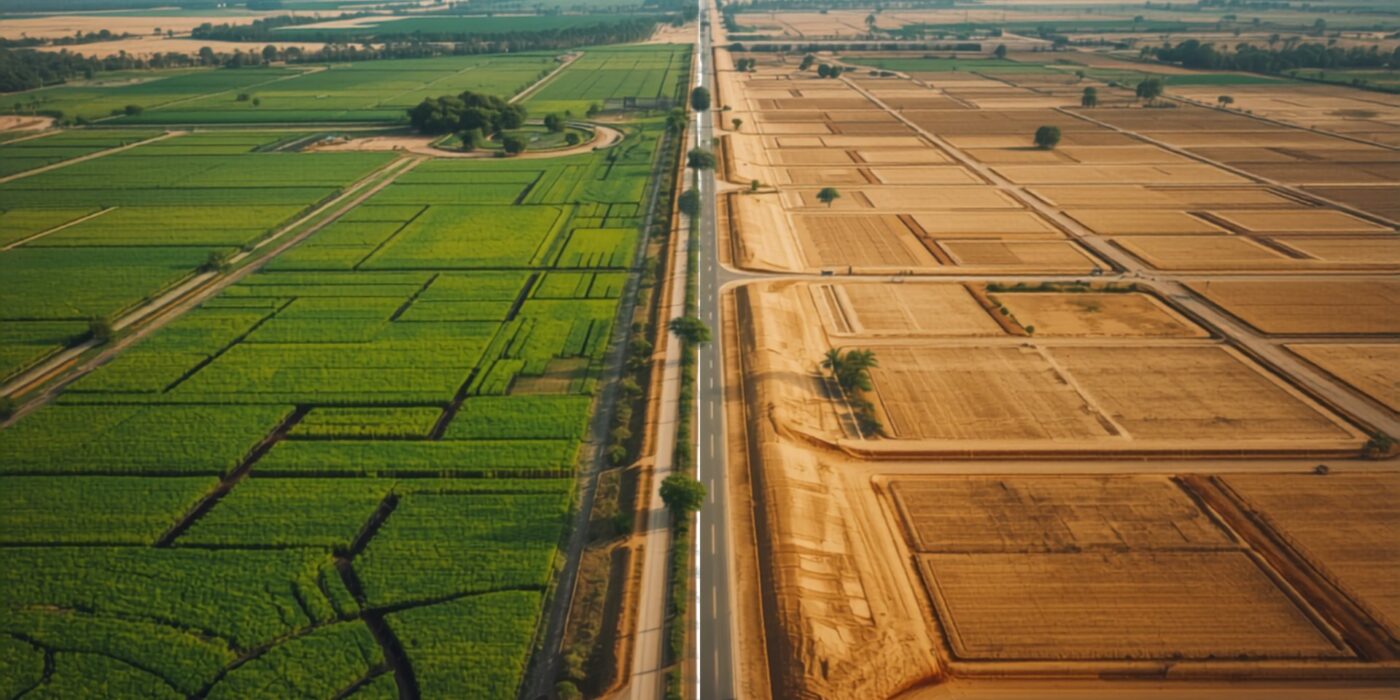
Aerial view of a road cutting through green agricultural fields divided into rectangular plots at sunset
CategoriesLand Investment

NA Conversion Process in Maharashtra: Cost, Timeline & Step-by-Step Guide 2026

THE EDGE — Direct Answer

Converting agricultural land to Non-Agricultural (NA) status in Maharashtra involves filing an application with the District Collector (or delegated Tehsildar) under Sections 42/44 of the Maharashtra Land Revenue Code 1966, along with the 7/12 extract, survey map, and proof of zoning compatibility. Processing typically takes 3–6 months for straightforward applications with no title disputes, forest, or CRZ complications — longer if any exist. The cost has two components: the NA conversion premium (a one-time government charge, typically ₹50–300 per sq.m depending on location and applicable rate), plus legal/documentation fees. Once approved, the NA order updates the 7/12 extract via a mutation entry, after which the land can be legally sold to non-farmers, developed, and bank-financed.

TL;DR — KEY TAKEAWAYS

  • NA conversion is filed under Sections 42/44 of the Maharashtra Land Revenue Code 1966 with the District Collector or delegated Tehsildar.
  • Typical timeline is 3–6 months for clean applications; complications (forest proximity, CRZ, title disputes) extend this significantly.
  • Cost = conversion premium (₹50–300/sq.m, location-dependent) + documentation/legal fees — budget accordingly before committing to a purchase price.
  • Maharashtra has a “deemed NA” provision — if the Collector doesn’t respond within the statutory period, conversion can be treated as granted, though this route carries more risk than an explicit order.

Buyers evaluating agricultural land often underestimate what NA conversion actually involves — treating it as a formality rather than a multi-month regulatory process with real cost and real risk of delay. This guide walks through the exact process, realistic timelines, and what determines whether your specific parcel converts smoothly or gets stuck.

Reading time: 11 minutes | Last updated: July 2026 | Author: Girish Chhalwani, Founder & CEO, THE EDGE Developments

Under Sections 42 and 44 of the Maharashtra Land Revenue Code, 1966, any occupant of agricultural land wishing to use it for a non-agricultural purpose must apply for and obtain permission from the Collector. Using agricultural land for non-agricultural purposes without such permission is itself a violation that can attract penalties and complicate future title transactions. — Source: Maharashtra Land Revenue Code 1966, Sections 42, 44

What is the legal basis for NA conversion in Maharashtra?

The Maharashtra Land Revenue Code, 1966 governs land classification statewide. By default, land is presumed agricultural unless formally converted. Section 42 covers the general power of the Collector to permit non-agricultural use; Section 44 sets out the application process a landholder must follow. The Collector’s power is often delegated to the Sub-Divisional Officer or Tehsildar for routine cases, which is typically the practical point of filing.

Step-by-step: how does the NA conversion process work?

  1. Obtain the current 7/12 extract for the survey number from mahabhulekh.maharashtra.gov.in, confirming current agricultural classification and ownership.
  2. Prepare supporting documents: ownership proof, measurement/survey map (from the Land Records department), no-dues certificate for land revenue, and — where applicable — a layout plan if the conversion is for a plotted development.
  3. File the application (Form as prescribed) with the Tehsildar or Sub-Divisional Officer having jurisdiction, along with the prescribed application fee.
  4. Site inspection: revenue department officials verify the land’s actual condition, boundaries, and confirm no encroachment or ongoing disputes.
  5. Zoning and compatibility check: confirmation the intended non-agricultural use (residential, commercial, industrial) aligns with the applicable Development Plan or Regional Plan zoning for that area.
  6. Payment of the NA conversion premium: a one-time charge calculated as a percentage of the land’s Ready Reckoner value, varying by district and zone.
  7. Issuance of the NA order: the Collector’s formal order granting non-agricultural status, specifying the permitted use (residential/commercial/industrial).
  8. Mutation entry: the 7/12 extract is updated to reflect the NA order, which is the final, checkable proof of conversion.

How long does NA conversion actually take?

Scenario Realistic timeline
Clean title, no encroachment, straightforward residential zoning 3–6 months
Land near forest boundary requiring Forest Department NOC 6–12 months or longer
Land within Coastal Regulation Zone (CRZ) Significantly longer; may require Coastal Zone Management Authority clearance
Disputed title or unclear succession Indefinite until the underlying title issue is resolved first

Maharashtra also has statutory provisions under which, if the Collector fails to respond within a prescribed period from a complete application, the conversion can be treated as deemed granted. In practice, buyers and developers still prefer to secure an explicit written NA order — a deemed conversion, while legally provided for, is harder to prove definitively to a future buyer, bank, or RERA authority than a physical order with a reference number.

What does NA conversion cost?

Two components make up the real cost:

  • NA conversion premium: A government charge, typically in the range of ₹50–300 per square metre, varying significantly by district, zone classification, and the applicable Ready Reckoner Rate for that survey number — areas with higher RR rates generally carry a higher conversion premium.
  • Documentation and professional fees: Survey/measurement charges, application processing fees, and — where a landowner engages an advocate or liaison consultant to manage the filing — professional fees on top of the statutory premium.

For a 10,000 sq.ft (approximately 929 sq.m) plot, total NA conversion costs commonly fall in the ₹2–10 lakh range depending on location, though this can vary meaningfully — always get a location-specific estimate before finalising a purchase price that assumes conversion is “included” or trivial.

What can delay or block NA conversion?

  • Unclear or disputed title — the Collector will not process conversion on land with an unresolved ownership dispute.
  • Proximity to forest land — requires a No Objection Certificate from the Forest Department, which can take considerably longer than the standard process.
  • Coastal Regulation Zone restrictions — land near the coastline may face construction restrictions regardless of NA status, requiring separate CRZ clearance.
  • Zoning incompatibility — if the Development Plan designates the land for agricultural or no-development use, NA conversion for residential/commercial purposes may be refused outright.
  • Pending revenue dues — unpaid land revenue must be cleared before conversion is processed.

Frequently Asked Questions

Can I convert agricultural land to NA myself, or do I need a developer?

Any landowner can file an NA conversion application directly with the Collector/Tehsildar — a developer is not legally required, though many buyers engage an advocate or liaison consultant to navigate the process, particularly for larger or more complex parcels.

How much does NA conversion cost per acre in Maharashtra?

Cost scales with area and location-specific Ready Reckoner Rate. As a rough guide, the conversion premium alone (excluding professional fees) commonly ranges from ₹2–12 lakh per acre depending on district and zone, with significant variation between high-demand corridors and slower-moving rural areas.

Is NA conversion mandatory before selling agricultural land to a non-farmer?

Selling restrictions on agricultural land to non-farmers are separate from NA conversion, but land generally cannot be legally developed for residential or commercial use without NA status, and most buyers require NA conversion (or a clear commitment to it) before purchase.

What happens if I build on land without completing NA conversion?

Construction on land without NA conversion is a violation of the Maharashtra Land Revenue Code and can result in penalties, demolition orders, and significant complications when attempting to sell, mortgage, or register the property later.

Can NA conversion be denied?

Yes — if the land falls in a no-development zone, has unresolved title disputes, sits within protected forest or CRZ boundaries without the required clearances, or has outstanding revenue dues, the Collector can refuse conversion.

Citations & Sources

  1. Maharashtra Land Revenue Code, 1966 — Sections 42, 44
  2. Maharashtra Revenue and Forest Department — NA conversion procedural guidelines
  3. Maharashtra Coastal Zone Management Authority — CRZ clearance requirements

Skip the Conversion Wait — Buy Already-NA Land

THE EDGE Developments offers plots that are already NA-converted, RERA-registered, and title-verified — no multi-month conversion process, no uncertainty.

Contact: connect@theedgedevelopments.com | +91-9664662938 | edgere.in


Aerial view at golden hour showing a row of houses bordering an open green field, illustrating built property next to vacant land
CategoriesLand Investment

Home Loan vs Plot Loan in India 2026: Which Should You Choose?

THE EDGE — Direct Answer

Choose a home loan if you’re buying a ready or under-construction house/flat; choose a plot loan if you’re buying land (typically an NA-converted plot) with no immediate construction plan. Plot loans carry a lower loan-to-value ratio (usually 70–75% vs 80–90% for home loans), shorter tenure (often capped near 15 years vs up to 30), and slightly higher interest rates (roughly 0.5–1.5% above equivalent home loan rates) — because raw land is considered lower-quality collateral than a completed structure. Critically, plot loan interest and principal do not qualify for Section 24(b) or 80C tax deductions unless the land is later linked to an approved construction loan and building is completed within 5 years — a pure land purchase alone carries no income-tax benefit.

TL;DR — KEY TAKEAWAYS

  • Plot loans fund land only — typically 70–75% LTV, shorter tenure, and no tax benefit unless later combined with a construction loan.
  • Home loans fund a built or under-construction dwelling — higher LTV (80–90%), longer tenure up to 30 years, and full Section 24(b)/80C tax benefits.
  • Only NA-converted land qualifies for a plot loan — banks will not finance agricultural land under any circumstances.
  • A composite plot + construction loan structure is the most tax-efficient way to buy land and build, since interest becomes deductible once construction is complete.

Buyers planning to purchase land often assume a “plot loan” works exactly like a home loan with a different name — it doesn’t. The two products differ meaningfully in how much a bank will lend, how long you have to repay, what it costs, and — critically — whether you get any income tax benefit at all.

Reading time: 10 minutes | Last updated: July 2026 | Author: Girish Chhalwani, Founder & CEO, THE EDGE Developments

What is the core difference between a home loan and a plot loan?

A home loan finances the purchase or construction of a residential dwelling — a completed flat, an under-construction unit, or a self-construction project. A plot loan finances only the land itself, with no obligation (or in some structures, an obligation) to build within a defined period. Banks treat these as different risk categories because a built structure is more liquid, easier to value, and faster to resell than vacant land.

Parameter Home Loan Plot Loan
What it finances Ready or under-construction residential property NA-converted land only, no construction obligation
Typical Loan-to-Value (LTV) 80–90% of property value 70–75% of land value
Typical tenure Up to 30 years Usually capped at 15 years
Interest rate (indicative) ~8.35–9.25% ~9–10.5% (typically 0.5–1.5% higher)
Tax benefit — Section 24(b) interest deduction Available (up to ₹2 lakh/year for self-occupied) Not available for pure land purchase
Tax benefit — Section 80C principal deduction Available Not available for pure land purchase
Eligible land type N/A — structure already exists or is approved NA (Non-Agricultural) converted land only; agricultural land is never financed

Why do plot loans have a lower loan-to-value ratio?

Banks lend more conservatively against land because it’s harder to value precisely, slower to liquidate in a default scenario, and carries higher regulatory risk if NA status, layout approval, or title isn’t airtight. A completed home has an established market comparable and immediate resale value; raw land — even NA-converted, RERA-registered plotted land — is priced with more variance and requires deeper due diligence before a bank will lend against it.

Why don’t plot loans get the same tax benefits as home loans?

Income tax deductions under Section 24(b) (interest) and Section 80C (principal) are tied to the concept of a “residential house property” — the deduction exists to encourage home ownership, not land banking. A loan taken purely to buy vacant land, with no construction plan, does not create a residential house and therefore does not qualify.

The exception: if you take a plot loan and subsequently take (or convert to) a construction loan to build a home on that land, and construction completes within 5 years of the end of the financial year in which the loan was taken, the interest paid during construction becomes eligible for deduction — claimable in 5 equal instalments starting from the year construction completes. This is why banks increasingly offer combined “plot + construction” loan products rather than treating them as entirely separate applications.

How does a combined plot + construction loan work?

  1. Plot loan disbursed first — typically 70–75% of land value, to complete the land purchase.
  2. Construction loan sanctioned alongside or shortly after, often by the same lender, based on an approved building plan and cost estimate.
  3. Construction tranches disbursed against progress — banks typically release funds in stages (foundation, plinth, superstructure, finishing) verified by a bank-appointed engineer, similar to how developer construction finance is disbursed.
  4. Tax benefits activate once construction completes within the 5-year window, and the combined loan is then treated for tax purposes as a home loan from that point.

What do banks check before approving a plot loan?

  • NA conversion order — agricultural land is never eligible, regardless of intended use.
  • Approved layout plan and RERA registration (for plotted development projects above the regulatory threshold).
  • Clear title — typically a 13–30 year title search by the bank’s empanelled advocate.
  • Land use zoning — confirmation the plot is zoned for residential use under the applicable Development Plan.
  • Builder/project track record — for plots within a branded plotted development, banks assess the developer’s RERA compliance history.

Frequently Asked Questions

Can I get a home loan to just buy a plot of land?

No. A home loan specifically finances a residential structure. To buy land, you need a plot loan, which has different LTV, tenure, and tax treatment than a home loan.

Do plot loans qualify for any income tax deduction?

Not on their own. A pure plot loan gets no Section 24(b) or 80C benefit. If the land is later combined with a construction loan and building completes within 5 years, interest becomes deductible from that point.

Can I get a loan to buy agricultural land?

No. Banks do not finance agricultural land purchases under plot loan schemes. The land must be NA (Non-Agricultural) converted before it is loan-eligible.

What is the maximum tenure for a plot loan in India?

Most lenders cap plot loan tenure around 15 years, shorter than the up-to-30-year tenure typically available on home loans, reflecting the higher risk profile banks assign to land-only financing.

Is it cheaper to take a plot loan now and a construction loan later, or a combined loan upfront?

A combined plot + construction loan structured upfront with the same lender is generally more efficient — it avoids a second full underwriting process and positions the loan to qualify for tax benefits once construction completes, compared to treating the two as entirely separate, unrelated loans.

Citations & Sources

  1. Income Tax Act 1961 — Sections 24(b) and 80C
  2. Reserve Bank of India — Master Directions on Housing Finance
  3. National Housing Bank — Guidelines on Land/Plot Loans

Finance Your Land Purchase the Right Way

THE EDGE Developments’ plots are NA-converted, RERA-registered, and pre-approved by leading lenders for plot financing — making bank approval straightforward.

Contact: connect@theedgedevelopments.com | +91-9664662938 | edgere.in


Upward view of a modern glass and stone office building against a clear blue sky
CategoriesLand Investment

GST on Land and Plotted Development in India 2026: Complete Guide

THE EDGE — Direct Answer

The outright sale of land in India is not subject to GST — under Schedule III of the CGST Act 2017, “sale of land” is treated as neither a supply of goods nor a supply of services, so it falls entirely outside GST’s scope. This applies to plotted development plots too, provided what you are buying is genuinely land with a completed or non-existent construction component. GST becomes relevant only when a construction or works-contract element is bundled into the transaction — such as an under-construction villa, clubhouse, or internal infrastructure billed separately from the land itself, which can attract GST at rates typically between 1% and 18% depending on the exact structure. Stamp duty and registration charges are separate, state-level taxes that apply regardless of GST and are never replaced by it.

TL;DR — KEY TAKEAWAYS

  • Pure land sale is outside GST entirely — Schedule III of the CGST Act excludes it from being treated as a supply.
  • GST applies to construction/works-contract components, not to the land value — this matters for plotted developments with amenities or built structures.
  • Ready-to-move properties with an Occupancy Certificate are GST-exempt; only under-construction components attract GST.
  • Stamp duty and registration are unaffected by GST — they are separate state-level levies charged regardless.

One of the most common questions land buyers ask is whether GST applies on top of the price they’ve negotiated. For a straightforward plot purchase, the answer is usually no — but the moment a developer bundles construction, infrastructure development, or amenities into the sale, GST can enter the picture in ways that are easy to miss until the final invoice.

Reading time: 10 minutes | Last updated: July 2026 | Author: Girish Chhalwani, Founder & CEO, THE EDGE Developments

Schedule III of the Central Goods and Services Tax Act, 2017 lists activities or transactions that are treated as neither a supply of goods nor a supply of services — and therefore fall entirely outside the GST framework. Entry 5 of this schedule covers “sale of land and, subject to clause (b) of paragraph 5 of Schedule II, sale of building.” This is why a plain land transaction in India carries no GST component, regardless of the sale value. — Source: CGST Act 2017, Schedule III

Why doesn’t GST apply to land sales?

GST is a tax on the supply of goods and services. Land itself is immovable property — it is neither “goods” (which must be movable) nor a “service” under GST’s statutory definitions. Schedule III explicitly carves land sales out of the GST net, which is why registration of a plain sale deed for land does not generate a GST liability, no matter how large the transaction.

This is distinct from stamp duty, which is a state subject charged on the instrument of transfer (the sale deed itself) and has nothing to do with GST’s central framework. Every land transaction still attracts stamp duty and registration charges — GST exemption does not reduce or replace these.

When does GST become relevant in a plotted development purchase?

GST enters the picture the moment a construction or works-contract element is part of what you’re paying for — not the land itself, but something built on or for it.

Scenario GST treatment
Pure land/plot sale, no construction obligation No GST — outside Schedule III scope entirely
Ready-to-move property with Occupancy/Completion Certificate already issued No GST — sale of completed immovable property is exempt
Under-construction villa or built unit sold before completion certificate GST applicable on the construction value — typically 5% without input tax credit for standard residential, 1% for affordable housing category
Development/infrastructure charges billed as a separate works contract (roads, common amenities under construction) GST typically applicable on that specific component at works-contract rates

Rates and treatment reflect the GST Council’s 2019 restructuring of real estate GST rates and general CGST Act principles; specific project structuring can affect actual liability — always confirm the applicable rate with your developer’s GST invoice and, where material, a chartered accountant.

How do developers typically structure plotted developments to manage GST?

Most organised plotted-development projects structure the transaction as a sale of land with infrastructure already completed at the time of sale — internal roads, boundary walls, and utility connections built and paid for by the developer before individual plots are sold. When this is the case, the buyer is purchasing completed land, not commissioning ongoing construction, and the transaction falls under the land-sale exemption.

Where a project instead sells plots with infrastructure development ongoing or promised as part of the buyer’s payment obligation, tax authorities and various Advance Ruling decisions have taken the view that the development-charge component can be treated as a taxable supply, separate from the land value itself. This is an area where structuring matters — buyers should ask specifically whether infrastructure is complete at the time of booking, and whether any portion of the price is invoiced separately as a development or construction charge.

What about GST on brokerage and legal services?

Unlike the land itself, professional services connected to a land transaction — brokerage/agency commission, legal fees for title verification and drafting, and architect or surveyor fees — are standard taxable services under GST, typically at 18%. These are charged on the service fee, not on the land value, and are a routine, expected cost separate from the land-sale exemption discussed above.

Frequently Asked Questions

Do I have to pay GST when buying a plot of land in India?

No. The outright sale of land is excluded from GST under Schedule III of the CGST Act 2017. You will still pay stamp duty and registration charges, which are separate state-level taxes unaffected by GST.

Is GST applicable on plotted development projects?

Generally no, if what you’re buying is completed land with infrastructure already built. GST can apply if a construction or development-charge component is billed separately as an ongoing works contract rather than being part of a completed land sale.

What GST rate applies to under-construction property in India?

Following the GST Council’s 2019 restructuring, under-construction residential property typically attracts 5% GST without input tax credit for standard housing, and 1% for projects qualifying under the affordable housing category. Ready-to-move property with a completion certificate is GST-exempt.

Does GST replace stamp duty on a land purchase?

No. GST and stamp duty are entirely separate levies — GST is a central tax on supply of goods/services, while stamp duty is a state tax on the transfer instrument. Land sales are GST-exempt but always attract stamp duty and registration charges.

Is GST charged on brokerage fees for a land transaction?

Yes. Brokerage, legal, and professional service fees connected to a land transaction are standard taxable services, typically at 18% GST, charged on the service fee — this is separate from and unaffected by the land sale itself being GST-exempt.

Citations & Sources

  1. Central Goods and Services Tax Act, 2017 — Schedule III
  2. GST Council — 33rd & 34th GST Council Meeting decisions on real estate GST rates (2019)
  3. Central Board of Indirect Taxes and Customs (CBIC) — GST FAQs on real estate sector

Buy Clear-Title Land With No Hidden Tax Surprises

THE EDGE Developments sells completed, RERA-registered plotted land in the Karjat–MMR corridor — infrastructure built before sale, transparent pricing with no ambiguous development charges.

Contact: connect@theedgedevelopments.com | +91-9664662938 | edgere.in

This article is general information, not tax advice. Consult a qualified chartered accountant for your specific transaction.


Aerial view of subdivided green farmland plots in Maharashtra at golden hour, marked into rectangular parcels by roads and boundary lines
CategoriesLand Investment

Stamp Duty, Registration & Ready Reckoner Rate on Land in Maharashtra 2026

Reading time: 13 minutes | Last updated: July 2026 | Author: Girish Chhalwani, Founder & CEO, THE EDGE Developments

TL;DR — Key Takeaways

  • Stamp duty on land in Maharashtra is charged on the higher of the agreement value or the Ready Reckoner (RR) Rate — never on whichever figure is lower, so under-declaring the agreement price does not reduce your duty.
  • Standard stamp duty is 6% for male buyers in Mumbai (5% base + 1% metro cess) and 5% for female buyers; in Pune, Nagpur, and Thane it is 7% for male buyers and 6% for female buyers.
  • Registration charges are 1% of the property value, capped at ₹30,000 for properties valued above ₹30 lakh.
  • The Ready Reckoner Rate is revised every April by the Maharashtra government; 2026 saw an average 3–5% increase, with localities near new infrastructure — Metro Line 3, Coastal Road, and the Navi Mumbai International Airport (NMIA) — seeing up to 8–10% increases.
  • The applicable RR rate is looked up by district, taluka, village, and survey number on the state’s e-ASR portal (part of igrmaharashtra.gov.in) — not negotiated or estimated.
  • On a typical ₹50 lakh land purchase in an MMR growth corridor, total transaction cost (stamp duty + registration + legal) typically adds up to 6.5–8.5% on top of the purchase price — a cost every land investor must model before comparing “net returns” across markets.

Executive Summary

How much will I actually pay in stamp duty and registration when I buy land in Maharashtra? You will pay stamp duty (5–7% depending on city and buyer gender) plus registration charges (1%, capped at ₹30,000) — calculated on whichever is higher: your agreement price or the government’s Ready Reckoner Rate for that specific plot. This single rule is the most misunderstood part of Maharashtra land transactions, and it is the reason two buyers paying the same negotiated price for similar plots in different villages can end up with materially different total costs.

Introduction: The Cost Line Every Land Investor Underestimates

Land investment return calculations across MMR routinely account for purchase price, holding period, and expected CAGR — but frequently understate the acquisition cost stack, which is dominated by stamp duty and registration. Because Maharashtra calculates duty on the higher of the agreement value or the government Ready Reckoner Rate, an investor cannot simply negotiate a lower price to reduce this cost.

This matters even more in infrastructure-linked growth corridors — Karjat, Khopoli, Panvel, Uran, Boisar — because RR rates in these belts have been revised upward faster than the state average precisely because of the infrastructure projects driving investor demand in the first place.

What Is the Ready Reckoner Rate?

The Ready Reckoner (RR) Rate — officially the Annual Statement of Rates (ASR) — is the Maharashtra government’s minimum benchmark valuation for land and property in every village, taluka, and district in the state. It is published and revised annually (typically every April) by the Inspector General of Registration (IGR), Maharashtra, and serves two core purposes: it sets the floor value on which stamp duty is calculated, and it is used as a reference for property tax assessments and bank loan valuations.

Maharashtra Stamp Duty Rates 2026 — City-Wise Comparison

City / Region Stamp duty (Male buyer) Stamp duty (Female buyer) Registration charge
Mumbai (Municipal Corporation limits) 6% (5% base + 1% metro cess) 5% (4% base + 1% metro cess) 1%, capped at ₹30,000
Pune, Nagpur, Thane (Municipal Corporation) 7% 6% 1%, capped at ₹30,000
Municipal Council areas (e.g., Karjat, Khopoli town limits) ~4–5% ~3–4% 1%, capped at ₹30,000
Gram Panchayat / rural areas ~3–4% ~2–3% 1%, capped at ₹30,000

Rates are indicative and vary by local body classification — always confirm the exact applicable rate for the specific taluka before transacting. Sources: ClearTax, Godrej Capital, Bajaj Finserv Markets, 1acre.in stamp duty calculators (2026).

How Stamp Duty Is Actually Calculated: A Worked Example

Scenario Agreement price Applicable RR rate value Duty calculated on Stamp duty (at 6%)
A: Agreement price above RR rate ₹60,00,000 ₹50,00,000 ₹60,00,000 (agreement price, since it’s higher) ₹3,60,000
B: Agreement price below RR rate ₹40,00,000 ₹55,00,000 ₹55,00,000 (RR rate, since it’s higher) ₹3,30,000

Scenario B is the case that catches buyers off guard: even though the buyer negotiated and paid ₹40 lakh, they must pay stamp duty as though they paid ₹55 lakh, because that is the government’s minimum benchmark value for that plot.

Step-by-Step: How to Look Up the Ready Reckoner Rate for Any Plot

  1. Visit the Maharashtra IGR portal (igrmaharashtra.gov.in) and navigate to the e-ASR (Annual Statement of Rates) section.
  2. Select the district, taluka, and village where the plot is located.
  3. Select the property type — open land (NA or agricultural), residential, commercial, or industrial — since RR rates differ by land-use category.
  4. Enter the survey number / CTS number if prompted, or select the applicable zone within the village.
  5. Note the rate per square metre (for land) — this is the government’s minimum benchmark value for that specific parcel.
  6. Multiply by the plot area to arrive at the RR-based valuation, then compare against your negotiated agreement price — stamp duty applies to whichever figure is higher.

2026 Ready Reckoner Revision: What Changed

The Maharashtra government’s 2026 RR revision applied an average increase of 3–5% across most localities statewide. However, revisions were not uniform — villages and zones near completed or advancing infrastructure projects (Mumbai Metro Line 3, the Coastal Road, and the Navi Mumbai International Airport corridor) saw disproportionately higher revisions of up to 8–10%.

Total Transaction Cost Comparison Table

Cost component Typical rate Notes
Stamp duty 5–7% (varies by city/local body and buyer gender) Calculated on higher of agreement price or RR rate
Registration charge 1%, capped at ₹30,000 Applies above ₹30 lakh property value
Legal/documentation (title search, drafting) 0.5–1% Varies by advocate and complexity of title chain
Brokerage (if applicable) 1–2% Negotiable; not applicable on direct developer purchases
Typical total 6.5–8.5% (excluding brokerage) Must be added to purchase price when calculating net entry cost and CAGR

Documents Required at the Time of Registration

Document Purpose
7/12 extract (Satbara Utara) Confirms current ownership, area, and land classification
Sale agreement / sale deed draft The instrument being stamped and registered
PAN cards of buyer and seller Mandatory for property transactions above specified thresholds
Aadhaar cards of buyer and seller Identity verification at the sub-registrar’s office
NA order (if applicable) Confirms non-agricultural conversion status
Encumbrance certificate Confirms no pending mortgages or legal claims on the property
Proof of stamp duty payment (e-challan/GRAS receipt) Required before the sub-registrar will proceed with registration

Expert Opinion

“Buyers spend weeks negotiating the last two or three percent off a plot’s price, and then get blindsided by a stamp duty bill calculated on a Ready Reckoner Rate they never checked. The RR rate lookup takes five minutes and should happen before you make an offer, not after you sign the agreement.” — Girish Chhalwani, Founder & CEO, THE EDGE Developments

Risk Factors and Common Mistakes

  • Assuming stamp duty is calculated only on the agreement price — it is calculated on whichever is higher between agreement price and RR rate.
  • Using a generic online stamp duty calculator without checking the specific village’s RR rate — generic calculators frequently default to city-wide averages, not the exact survey number’s rate.
  • Not accounting for the April revision cycle — if you are close to finalising a purchase in March, confirm whether the current or upcoming RR rate will apply at your actual registration date.
  • Overlooking the female co-ownership discount — registering a property solely or jointly in a woman’s name can reduce the stamp duty rate by 1% in most Maharashtra cities.
  • Ignoring local body classification — the same village can straddle Municipal Council and Gram Panchayat jurisdiction with different applicable rates.

Actionable Insights

  1. Always check the e-ASR portal for the specific survey number before signing an agreement — never rely on a broker’s verbal estimate of the RR rate.
  2. Model total transaction cost at 6.5–8.5% of the higher of agreement price or RR value when calculating expected net returns.
  3. Consider registering jointly with a female family member where legally and practically appropriate, to access the 1% stamp duty discount.
  4. Time registration around the April RR revision cycle if a purchase is near finalisation and the current year’s rate is more favourable.
  5. Re-run the RR rate check for every parcel separately — even adjoining plots can carry different RR valuations.

Conclusion

Stamp duty and registration charges are not a rounding error in a Maharashtra land transaction — they are a 6.5–8.5% cost line that can shift meaningfully higher if the applicable Ready Reckoner Rate is not checked before the agreement is signed. For land investors and developers operating across MMR’s fast-moving growth corridors, a five-minute e-ASR lookup, done before every offer, is the single most cost-effective piece of due diligence available.

Frequently Asked Questions

What is the Ready Reckoner Rate in Maharashtra?

It is the state government’s minimum benchmark valuation for land and property in every village and taluka, published annually by the Inspector General of Registration and used to calculate stamp duty.

Is stamp duty calculated on the agreement price or the Ready Reckoner Rate?

On whichever is higher — if the RR rate for a plot exceeds the agreement price, stamp duty is charged on the RR rate, not the negotiated price.

What is the current stamp duty rate in Mumbai?

6% for male buyers (5% base plus 1% metro cess) and 5% for female buyers.

What are the registration charges in Maharashtra?

1% of the property value, capped at a maximum of ₹30,000 for properties valued above ₹30 lakh.

Does GST apply on top of stamp duty for a land purchase?

No. GST and stamp duty are entirely separate levies — pure land sales are exempt from GST under Schedule III of the CGST Act, while stamp duty always applies regardless. See THE EDGE’s complete guide to GST on land for the full breakdown.

How often is the Ready Reckoner Rate revised?

Typically every year in April, by the Maharashtra government.

Citations & Sources

  1. ClearTax — “Stamp Duty and Registration Charges in Maharashtra 2026”
  2. Godrej Capital — “Stamp Duty and Registration Charges in Maharashtra 2026”
  3. Bajaj Finserv Markets — “What is the Ready Reckoner Rate 2026 & How Does It Affect Property Value?”
  4. 1acre.in — Maharashtra Stamp Duty Calculator 2026
  5. Maharashtra IGR (Inspector General of Registration) — e-ASR portal, igrmaharashtra.gov.in

Model Your Total Acquisition Cost Correctly

THE EDGE Developments helps investors verify RR rates and calculate true transaction costs before committing to any land purchase in the Karjat–MMR corridor.

Contact: connect@theedgedevelopments.com | +91-9664662938 | edgere.in


Aerial view of a large container port at sunrise with rows of cargo cranes and stacked shipping containers along a coastline
CategoriesMumbai 3.0

Vadhavan Port & North MMR Land Values: Investment Analysis 2026–2034

Reading time: 14 minutes | Last updated: July 2026 | Author: Girish Chhalwani, Founder & CEO, THE EDGE Developments

TL;DR — Key Takeaways

  • Vadhavan Port, near Dahanu in Palghar district, is India’s largest greenfield deep-water port project — approved at a total build cost of ₹76,220 crore, with the first phase (~₹45,000 crore, including ₹25,000 crore for land reclamation) already under construction since the groundbreaking by PM Narendra Modi on 30 August 2024.
  • It will be built and owned through a joint venture — Jawaharlal Nehru Port Authority (74%) and Maharashtra Maritime Board (26%) — with a designed capacity of 23.2 million TEUs and 298 MMT of cargo a year, making it larger than JNPT at full build-out.
  • Four of nine container terminals are targeted for commissioning by 2029; full completion is expected by 2034.
  • Connectivity is being built in parallel: a ₹2,881 crore, ~25 km road link to NH48 via Tarapur–Boisar/Chinchani–Vangaon/Dahanu (Bharatmala Pariyojana), a 12 km rail spur to the Western Dedicated Freight Corridor at New Palghar, and a ₹2,528.90 crore, 104.89 km freight expressway connecting the port directly to the Samruddhi Mahamarg at Bharvir (Nashik district).
  • This converts Dahanu–Boisar–Palghar–Vangaon from a low-density coastal belt into a logistics-and-industrial growth corridor — the same infrastructure-first sequencing that repriced Karjat, Uran, and Panvel over the last decade.
  • Land in Boisar currently trades around ₹1,500–4,200/sq.ft; interior Palghar/Vangaon parcels are available from roughly ₹500/sq.ft — a wide entry-price band that will compress as construction milestones (terminal commissioning, expressway opening) land between 2026 and 2029.

Executive Summary

Does Vadhavan Port change the investment case for land in Palghar district? Yes — Vadhavan Port is a ₹76,220 crore deep-water mega-port under construction near Dahanu, designed to handle 23.2 million TEUs a year, and it is being built alongside a dedicated freight rail spur, a new NH48 link road, and a 105 km expressway to the Samruddhi Mahamarg. Together, these projects create the same “infrastructure precedes density” pattern that has already repriced Karjat, Panvel, and Uran in the Mumbai Metropolitan Region (MMR) — except this time the growth corridor runs north, through Boisar, Dahanu, Vangaon, and Palghar town, not south-east.

For THE EDGE’s readership — land investors, second-home buyers, and developers tracking Mumbai 3.0’s outward expansion — Vadhavan Port is the single largest infrastructure catalyst in the northern MMR that does not yet have a dedicated body of investment research. This article maps the project’s engineering scope, its connectivity build-out, its realistic timeline, and — most importantly — which micro-markets around it are positioned to benefit, and on what schedule.

Introduction: Why a Port 120 KM from Mumbai Matters to MMR Land Investors

Every prior wave of Mumbai’s outward growth has followed the same sequence: a transport or logistics anchor gets sanctioned, connectivity infrastructure follows within a few years, and land values in the surrounding villages re-rate long before the anchor project itself is operational. The Navi Mumbai International Airport (NMIA) did this for Panvel, Uran, and Karjat. The Virar–Alibaug Multimodal Corridor is doing it for Karjat and Khopoli. Vadhavan Port is now doing it for the Palghar coastal belt — a region that, until the environment and defence ministries cleared the project in early 2025, had almost no institutional land-investment coverage.

Vadhavan is not a small port expansion. At a designed capacity of 23.2 million TEUs, it would rank among the ten largest container ports in the world once fully built — larger than the existing Jawaharlal Nehru Port (JNPT) it is designed to relieve. Unlike JNPT, which sits inside the increasingly congested Navi Mumbai–Uran industrial belt, Vadhavan is being built on greenfield coastal land specifically because it offers natural deep draft (allowing the largest container vessels to dock without dredging) and space for large-scale reclamation.

What Is Vadhavan Port? Key Facts at a Glance

Attribute Detail
Location Vadhavan village, Dahanu taluka, Palghar district, Maharashtra
Project type Greenfield all-weather deep-water container port
Total build cost ₹76,220 crore (Phase 1 estimated at ~₹45,000 crore, including ₹25,000 crore for land reclamation)
Ownership structure Jawaharlal Nehru Port Authority (JNPA) — 74%; Maharashtra Maritime Board — 26% (public-private partnership)
Designed capacity 23.2 million TEUs/year; 298 MMT cumulative cargo/year
Groundbreaking 30 August 2024 (Prime Minister Narendra Modi)
Phase 1 terminals 4 of 9 container terminals targeted by 2029
Full completion 2034 (remaining 5 terminals)
Primary road link ~25 km, ₹2,881 crore link to NH48 via Tarapur–Boisar / Chinchani–Vangaon / Dahanu (Bharatmala Pariyojana)
Rail link 12 km spur connecting to the Western Dedicated Freight Corridor at the proposed New Palghar station
Expressway link 104.89 km, ₹2,528.90 crore high-speed freight corridor to the Samruddhi Mahamarg at Bharvir, Nashik district (targeted within 3 years of sanction)

Sources: JNPA official project page; Ministry of Ports, Shipping and Waterways approvals; NHAI Bharatmala sanctions; Maharashtra government expressway approval, reported via Maritime Gateway and Free Press Journal.

Vadhavan vs India’s Other Major Container Ports

Port State Status (2026) Approx. annual capacity Water depth
Jawaharlal Nehru Port (JNPT) Maharashtra Operational since 1989, near capacity ~10 million TEUs Requires dredging; draft-limited for largest vessels
Mundra Port Gujarat Operational, India’s largest private port ~10+ million TEUs (all cargo types) Natural deep draft
Vadhavan Port Maharashtra Under construction (Phase 1) 23.2 million TEUs (designed, full build-out) Natural deep draft — no dredging required

Mumbai 3.0’s Northern Extension: Positioning Palghar in the MMR Growth Story

THE EDGE’s Mumbai 3.0 framework has tracked the Mumbai Metropolitan Region’s outward expansion primarily along its south-eastern axis — Karjat, Khopoli, Panvel, and Uran — driven by the Navi Mumbai International Airport and the Virar–Alibaug Multimodal Corridor. Vadhavan Port introduces a second, largely independent axis: the northern coastal corridor through Vasai-Virar, Palghar, Boisar, and Dahanu. Industry commentary has already begun referring to this as “Mumbai 4.0” — a separate growth wave layered on top of Mumbai 3.0, driven by port logistics and freight economics rather than aviation and residential decongestion.

Who Should Consider This Corridor

Investor profile Fit for Vadhavan corridor Notes
Long-horizon land investor (7–10+ years) Strong fit Aligns with the project’s own 2029/2034 milestone structure
Industrial/warehousing developer Strong fit, near-term Tarapur MIDC base plus new freight links create early demand even before port commissioning
Short-horizon flipper (1–3 years) Weak fit Re-rating is likely to track construction milestones over several years, not months
NRI investor seeking a second home Weak-to-moderate fit This is fundamentally an industrial/logistics corridor, not a lifestyle or weekend-home destination like Karjat or Alibaug
First-time land buyer without local legal support Proceed with caution Coastal Konkan title verification (CRZ, fragmented holdings) requires stronger legal diligence than inland MMR corridors

Step-by-Step Due Diligence Checklist Before Buying Near Vadhavan Port

  1. Pull the 7/12 extract (Satbara Utara) for the specific survey number from the Mahabhulekh portal to confirm current ownership, area, and land-use classification.
  2. Confirm NA (Non-Agricultural) status or convertibility — agricultural land cannot be legally built on or easily financed until converted.
  3. Obtain CRZ classification from the Maharashtra Coastal Zone Management Authority for the exact plot — this determines what, if anything, can be built.
  4. Cross-check the plot against NHAI, MMRDA, and Palghar collector project maps to rule out overlap with the port, expressway, or rail acquisition boundaries.
  5. Request a 30-year title search through a local advocate to rule out inheritance disputes, which are common in fragmented Konkan coastal holdings.
  6. Verify encumbrances via the Index II record and CERSAI mortgage database.
  7. Physically inspect the plot and its road access — brochure “port-adjacent” claims should always be checked against the actual sanctioned road alignment, not assumed.

Micro-Market Impact Map: Where the Opportunity Sits

Micro-market Distance from port site Current land rate (approx.) Primary driver Investment horizon
Boisar ~15–20 km ₹1,500–4,200/sq.ft Existing MIDC industrial base + direct expressway link Near-term (2026–2029)
Dahanu / Vadhavan periphery 0–10 km Wide range; port-adjacent land largely under acquisition/CRZ restriction Direct port employment and ancillary logistics Medium-term, acquisition-sensitive
Vangaon ~10–15 km From ~₹500/sq.ft (interior parcels) Road alignment (Chinchani–Vangaon link) + rail spur Early-stage, higher risk/reward
Palghar town ~20–25 km Mid-range, town-core premium DFC rail station, district administrative hub Medium-term
Tarapur (MIDC) ~15 km Established industrial rates Existing chemical/industrial cluster + new freight link Near-term, industrial-only

Expert Opinion

“Every large Indian port has followed the same repricing curve — the land 15 to 25 kilometres out moves first, on the connectivity build-out, well before the port itself is operational. Vadhavan is at the stage Uran was in 2016: the sanction is real, the connectivity contracts are being awarded, and the land is still priced for a coastal fishing belt, not a logistics corridor. That gap is the opportunity — and it is also exactly where the risks of unclear title and premature ‘confirmed port-adjacent’ claims from local brokers are highest.” — Girish Chhalwani, Founder & CEO, THE EDGE Developments

Pros and Cons of Investing Near Vadhavan Port Today

Pros Cons / Risks
Confirmed central government approval and active construction (not a proposal stage) Full port completion is 2034 — this is a long-horizon thesis, not a 2–3 year flip
Three independent connectivity projects (road, rail, expressway) create multiple re-rating triggers, not just one CRZ (Coastal Regulation Zone) restrictions apply to large stretches of port-adjacent land, limiting buildability
Entry prices in Vangaon and interior Palghar remain low relative to comparable pre-infrastructure MMR corridors Land acquisition for the port and expressway has faced local opposition — creates local sentiment and delay risk
Existing Tarapur MIDC industrial base provides an established economic anchor Title verification is materially harder in coastal Konkan belts — always confirm NA status and CRZ classification before purchase

Risk Factors Investors Must Verify Before Buying

  • CRZ classification: Coastal Regulation Zone rules restrict construction close to the shoreline. Always obtain the CRZ classification of a specific plot before assuming buildability.
  • NA (Non-Agricultural) conversion status: As with any Maharashtra land purchase, agricultural land cannot be legally built on, sold to non-farmers in most cases, or bank-financed until converted to NA status.
  • Acquisition overlap: Confirm the specific plot is not inside a notified land-acquisition boundary for the port, expressway, or rail corridor.
  • Broker “port-adjacent” claims: Verify actual distance, road alignment, and CRZ status independently rather than relying on brochure maps.
  • Execution risk: Large infrastructure projects in India frequently see multi-year slippage. Treat the 2029/2034 dates as directional, not contractual.

Actionable Insights for Land Investors

  1. Prioritise the connectivity corridor over the port boundary. Land along the confirmed road alignment carries lower acquisition-overlap risk than land immediately adjacent to the port.
  2. Verify CRZ and NA status before any commitment — this single step eliminates the majority of coastal-belt land disputes.
  3. Treat 2026–2029 as the accumulation window, based on the JNPT-Uran precedent, where connectivity milestones drove the sharpest re-rating.
  4. Favour NA-converted or conversion-ready plots with clean title over speculative “future port-adjacent” agricultural parcels.
  5. Track the Samruddhi Mahamarg freight-link progress as a leading indicator of Vadhavan’s expanding industrial catchment.

Conclusion

Vadhavan Port is the largest and least-covered infrastructure catalyst currently reshaping Maharashtra’s coastal land map. It will not transform Palghar overnight — full commissioning stretches to 2034 — but the connectivity infrastructure being built in parallel is a near-term, verifiable, and already-funded trigger. For investors applying the same infrastructure-first discipline that has worked in Karjat, Uran, and Panvel, the Boisar–Vangaon–Palghar corridor deserves the same rigorous, document-first due diligence — and belongs on the watchlist for Mumbai 3.0’s next growth wave.

Frequently Asked Questions

What is Vadhavan Port and where is it located?

Vadhavan Port is a greenfield deep-water container port being built near Vadhavan village in Dahanu taluka, Palghar district, Maharashtra, roughly 120 km north of Mumbai.

How much does the Vadhavan Port project cost?

The full build-out is estimated at ₹76,220 crore, with the initial phase (including ₹25,000 crore for land reclamation) estimated around ₹45,000 crore.

When will Vadhavan Port be completed?

Four of nine planned container terminals are targeted for commissioning by 2029, with full completion of all nine terminals expected by 2034.

Which areas will benefit most from Vadhavan Port?

Boisar, Dahanu, Vangaon, Palghar town, and the existing Tarapur MIDC belt are the primary micro-markets positioned to benefit, largely along the confirmed road and rail alignments.

What are current land prices near Vadhavan Port?

Boisar land trades around ₹1,500–4,200/sq.ft; more interior parcels in areas like Vangaon are available from roughly ₹500/sq.ft, though prices vary widely by proximity to sanctioned infrastructure.

Should I buy land right next to the port, or further inland?

The more replicable, lower-risk opportunity — based on how JNPT and Uran actually repriced — lies 10–25 km out along the confirmed connectivity corridor, not directly at the port boundary.

What is the realistic investment horizon for this corridor?

Given the 2029/2034 milestone dates, this is a 7–10 year structural thesis, with the 2026–2029 window most relevant for entry based on connectivity-linked re-rating.

Citations & Sources

  1. Jawaharlal Nehru Port Authority — official Vadhavan Port project page (jnport.gov.in)
  2. The Week — “Unpacking Vadhavan port: How India’s new mega port is being built and financed” (September 2025)
  3. Upstox — “Centre approves ₹76,200 crore Vadhavan Port Project in Maharashtra”
  4. Maritime Gateway — “Last mile connectivity to Vadhavan Port”
  5. Free Press Journal — “NHAI Approves ₹2,360 Crore Vadhavan Port Expressway In Palghar”; “Mumbai 4.0 Takes Shape In Palghar”
  6. 99acres — Boisar, Palghar property rate trends 2026

Explore the Vadhavan Corridor with Local Expertise

THE EDGE Developments tracks infrastructure-led land opportunities across the Mumbai Metropolitan Region, including the emerging Palghar coastal corridor.

Contact: connect@theedgedevelopments.com | +91-9664662938 | edgere.in


Upward view of a glass high-rise residential building under construction, flanked by two tower cranes against a clear blue sky
CategoriesMarket Insights

Construction Finance for Real Estate Developers in India: Bank Loans, NBFCs & Structured Debt 2026

Reading time: 12 minutes | Last updated: July 2026 | Author: Girish Chhalwani, Founder & CEO, THE EDGE Developments

TL;DR — Key Takeaways

  • Real estate developers in India fund construction through three broad channels — scheduled bank project finance, NBFC/HFC construction finance, and structured debt (NCDs, mezzanine capital) — each with different cost, speed, and collateral trade-offs.
  • Under RERA, 70% of buyer receivables (booking amounts, installments) must be deposited into a designated escrow account and used only for construction-related expenses on that specific project — this now anchors how both banks and NBFCs underwrite developer loans.
  • Banks typically lend against unsold, RERA-registered inventory at a conservative loan-to-value (LTV) of 40–55% of current market value, with home loan-linked rates around 8.35–9.25%.
  • NBFCs and HFCs offer faster approvals (3–7 days vs 7–15 days for banks) and more flexible underwriting, but at a higher cost — real-estate-backed NBFC/HFC paper in the AA-to-A ratings band has recently priced in the 8.5–10.5% range, with weaker-credit or structured-debt tranches priced meaningfully higher.
  • NBFCs are required to verify all statutory approvals — building plans, layout sanctions, and RERA registration — before disbursing a single tranche; RERA registration itself is treated as a form of regulatory “permission” in lending circulars.
  • Developers who reach 5+ projects but fail to build institutional-grade financial systems (audited accounts, project-wise escrow discipline, transparent cost tracking) are the ones most likely to lose access to bank-priced capital and fall back on costlier NBFC or private debt.

Executive Summary

How do real estate developers in India actually fund construction, and which source should a growing developer prioritise? Developers primarily fund construction through bank project finance (cheapest, slowest, strictest), NBFC/HFC construction finance (faster, more flexible, costlier), and structured debt instruments like NCDs or mezzanine capital (fastest to access, most expensive, used for specific gaps). All three routes now operate inside a RERA-anchored underwriting framework where 70% of buyer receivables must sit in a project-specific escrow account — meaning a developer’s ability to raise capital is directly tied to RERA compliance discipline, not just brand or land bank size.

For developers scaling past their first few projects — a stage where THE EDGE’s advisory work sees most execution failures actually happen — understanding the real cost, timeline, and collateral requirements across bank, NBFC, and structured debt options is the difference between financing growth sustainably and financing it into a cash-flow trap.

Introduction: Why Construction Finance Is the Real Bottleneck for Growing Developers

Most developer failures in India are not caused by a lack of demand or a bad location — they are caused by a financing structure that cannot survive a delay. A developer who raises expensive short-term debt against the expectation of fast sales velocity, and then hits a slower sales quarter, can find debt-servicing costs outrunning cash inflows within two to three quarters. This is precisely why understanding the full construction finance landscape — not just “which bank offers the lowest rate” — is core developer advisory work, distinct from sales and marketing strategy.

The regulatory backdrop has also changed meaningfully since RERA (2016). Construction finance underwriting today is built around the escrow mechanism RERA mandates, which means a developer’s financing options are now inseparable from their RERA compliance record project-by-project — a first-time developer with a clean RERA history can often access better terms than an experienced developer with a patchy compliance record.

The Three Core Construction Finance Channels

Channel Typical cost Speed Collateral requirement Best suited for
Scheduled bank project finance Lowest — often linked to MCLR/repo-linked rates Slower (7–15 days minimum for decisioning, longer for full disbursal) Strict — RERA registration, approved layout, unsold inventory at 40–55% LTV Established developers with clean compliance history and strong balance sheets
NBFC / HFC construction finance Moderate-to-high — real-estate-backed paper often 8.5–10.5%+ depending on rating Faster (3–7 days for approval) More flexible; accepts a wider range of collateral and borrower profiles Mid-sized developers needing speed or with less conventional documentation
Structured debt / NCDs / mezzanine capital Highest — can run well above 14% for weaker-rated or subordinated tranches Fastest to access once structured, but requires more negotiation upfront Often against specific project cash flows or equity-like structures Bridging specific gaps — land acquisition, pre-launch capital, last-mile funding

Sources: Terkar Capital construction project financing guide; PNB Housing Finance developer loan terms; AU Small Finance Bank real estate project loans; Lexology analysis of NBFC real estate lending restrictions; GoldenPI and BondsIndia NBFC bond rate data (2026).

How RERA Escrow Rules Shape Every Financing Decision

Under RERA, developers must deposit 70% of all buyer receivables — booking amounts and installments — into a designated project-specific escrow account, to be used only for construction costs and land cost on that project. This structurally limits a developer’s ability to divert one project’s buyer collections to fund another project’s shortfall, which was a common (and often fatal) practice before RERA.

For lenders, this escrow mechanism is now a core underwriting input: banks and NBFCs increasingly structure disbursals to track directly against the escrow account’s construction-linked withdrawals, rather than relying solely on the developer’s general creditworthiness. A developer’s discipline in maintaining transparent, project-wise escrow accounting — rather than commingling funds across projects — has become one of the highest-leverage factors in securing better financing terms, second only to actual sales velocity.

Bank Financing: Requirements and Realistic Terms

Requirement Typical bank expectation
RERA registration Mandatory before any disbursement consideration
Approved building plan and layout Must be in place; banks will not fund pre-approval land banking
Loan-to-value on unsold inventory Typically 40–55% of current market value
Rate linkage Often tied to MCLR or repo-linked benchmarks, adjusting with RBI rate changes
Disbursement structure Staged, tied to construction milestones and escrow utilisation
Processing timeline 7–15 days for initial decisioning; full disbursal cycles longer

NBFC and HFC Financing: Where Flexibility Comes at a Cost

NBFCs and Housing Finance Companies have become a critical funding channel precisely because they can move faster and accept a broader range of developer profiles than scheduled banks — but this flexibility is priced in. Top-tier, highly-rated NBFCs (AAA/AA+, comparable to large diversified lenders) have recently issued paper in the 7.4–8.5% range, while housing-finance-focused NBFCs in the AA-to-A ratings band — closer to the profile of typical real-estate-backed construction finance — have priced in the 8.5–10.5% range. Weaker-rated or more deeply subordinated NBFC paper can price considerably higher, reflecting the additional risk lenders are compensated for.

Regulators require NBFCs to independently verify that a developer holds all requisite building-plan and layout approvals, and treat RERA project registration as a necessary form of regulatory “permission” before considering disbursal — meaning an NBFC’s flexibility on collateral and documentation does not extend to bypassing statutory compliance.

Structured Debt and Mezzanine Capital: The Highest-Cost, Highest-Speed Option

When a developer needs capital faster than a bank or NBFC underwriting cycle allows — most commonly for land acquisition ahead of formal project launch, or to bridge a short-term cash flow gap — structured debt instruments (NCDs, mezzanine tranches, or promoter-level debt against future project cash flows) fill that gap. These instruments can price well above 14% annually for weaker-rated or deeply subordinated tranches, reflecting both the speed of access and the higher risk lenders take on, often without the same RERA-escrow-linked disbursement discipline that governs bank and NBFC construction finance.

Case Study: How Escrow Discipline Determined Financing Access

Consider two mid-sized Maharashtra developers, each seeking construction finance for a second plotted-development project after a successful first launch. Developer A maintained strict project-wise escrow accounting, published audited project-level financials, and could demonstrate that 100% of buyer receivables from Project 1 had been used exclusively on Project 1’s construction and land costs. Developer B had, in practice, used a portion of Project 1’s buyer collections to fund pre-launch marketing on Project 2 — a common but RERA-non-compliant practice. Developer A secured bank project finance at a materially lower rate and faster decisioning; Developer B was declined by two banks and had to raise costlier NBFC and structured debt instead, compressing Project 2’s margins significantly. The differentiator was not project quality or land value — it was financial discipline and RERA-escrow compliance.

Expert Opinion

“The developers who scale past five or six projects are almost never the ones with the best land bank — they’re the ones who treated RERA escrow discipline as a financing asset from day one, not a compliance burden. Every bank and NBFC underwriting a construction loan today is effectively underwriting a developer’s project-wise financial transparency. Get that right early, and your cost of capital keeps falling as you grow. Get it wrong, and you get pushed into progressively more expensive NBFC and structured debt, which compounds against you exactly when margins are already tightest.” — Girish Chhalwani, Founder & CEO, THE EDGE Developments

Pros and Cons by Financing Channel

Channel Pros Cons
Bank project finance Lowest cost of capital; strong signal of institutional credibility to buyers and partners Slowest approval; strictest documentation and RERA compliance requirements; conservative LTV
NBFC / HFC construction finance Faster approval; more flexible on borrower profile and collateral type Meaningfully higher cost than bank finance; still requires full statutory approvals
Structured debt / NCDs / mezzanine Fastest access; useful for land acquisition and pre-launch gaps banks won’t fund Highest cost (often 14%+); can compress project margins if over-relied upon

Risk Factors Developers Must Manage

  • Commingling buyer receivables across projects — the single most common RERA violation that damages future financing access, beyond the immediate legal risk.
  • Over-reliance on high-cost structured debt to fund core construction (rather than only bridging specific short-term gaps) — this compounds financing costs across a project’s full construction cycle.
  • Underestimating documentation timelines — building plan approvals, layout sanctions, and RERA registration all need to be secured well ahead of the construction finance application, not concurrently.
  • Ignoring interest rate linkage — bank loans linked to MCLR/repo benchmarks can become materially more expensive if rates rise mid-construction; developers should model both current and stressed-rate scenarios.
  • Treating sales velocity assumptions as fixed — construction finance repayment schedules are frequently modelled against optimistic sales timelines; a market slowdown can turn serviceable debt into a cash-flow crisis quickly.

Actionable Insights for Developers

  1. Build project-wise escrow discipline from your very first project — this single practice is the highest-leverage lever for accessing cheaper bank finance as you scale.
  2. Sequence your capital stack deliberately: use bank finance for the bulk of construction cost, NBFC finance for speed-sensitive gaps, and structured debt only for short, clearly-bounded bridging needs — not as a substitute for bank finance.
  3. Secure all statutory approvals (building plan, layout, RERA registration) before initiating a financing conversation — this alone materially shortens bank and NBFC decisioning timelines.
  4. Model construction finance against a conservative, not optimistic, sales-velocity assumption — protects against the single most common cause of developer cash-flow failure.
  5. Maintain audited, project-level (not just company-level) financial statements — increasingly a baseline expectation for both bank and institutional NBFC underwriting.

Future Outlook

As RBI continues to tighten scrutiny on NBFC real estate exposure and RERA enforcement matures across states, expect underwriting for all three financing channels to increasingly converge around project-wise transparency and escrow discipline as the primary differentiator between developers who access institutional-grade capital and those pushed toward costlier structured debt. Developers who invest early in financial systems — audited project accounting, transparent escrow management, and realistic sales-velocity modelling — will be structurally advantaged as this underwriting discipline tightens further over the coming years.

Conclusion

Construction finance is not a single decision made once per project — it is a capital stack that must be sequenced deliberately across bank, NBFC, and structured debt sources, each suited to a different need and priced accordingly. For developers scaling past their first few projects, the single highest-leverage move is building RERA-escrow discipline and project-wise financial transparency early — because that discipline, more than land bank size or brand, determines whether growth is financed sustainably or financed into a cash-flow trap.

Frequently Asked Questions

What are the main sources of construction finance for real estate developers in India?

Scheduled bank project finance, NBFC/HFC construction finance, and structured debt instruments such as NCDs or mezzanine capital.

What does RERA require regarding buyer receivables?

70% of all buyer receivables — booking amounts and installments — must be deposited into a designated project-specific escrow account and used only for construction-related expenses on that project.

What loan-to-value do banks typically offer against unsold inventory?

Typically 40–55% of the current market value of RERA-registered unsold inventory.

Are NBFC construction finance rates higher than bank rates?

Generally yes — top-tier NBFC paper has recently priced around 7.4–8.5%, while housing-finance-focused, real-estate-backed NBFC paper in the AA-to-A band has priced around 8.5–10.5%, both above typical bank project finance rates.

How fast is NBFC financing compared to bank financing?

NBFCs typically approve in 3–7 days versus 7–15 days for banks, though full disbursal timelines depend on documentation and milestone structuring in both cases.

What is structured debt or mezzanine capital used for in real estate?

Primarily to bridge specific gaps — such as land acquisition ahead of formal launch or short-term cash flow needs — that banks and NBFCs are unwilling or unable to fund quickly.

Do NBFCs skip RERA and approval checks that banks require?

No — regulatory guidance requires NBFCs to verify building plan approvals, layout sanctions, and RERA registration before disbursing, treating RERA registration as a necessary form of regulatory permission.

Why do some experienced developers struggle to get bank financing?

Most commonly due to a weak or non-compliant RERA escrow track record — such as commingling buyer receivables across projects — rather than land bank size or brand strength.

Citations & Sources

  1. Terkar Capital — “Guide to Construction Project Financing in India”
  2. PNB Housing Finance — “Loan for Real Estate Developers” (up to 70% financing terms)
  3. AU Small Finance Bank — “Real Estate Project Loans”
  4. Lexology — “Analysis of lending restrictions on NBFCs in Real Estate Sector”
  5. National Housing Bank — Project Finance regulatory guidance
  6. GoldenPI — “What Are the Interest Rates Offered by NBFC Bonds?”
  7. Bondscanner — “NCD Interest Rates in India 2026: How They’re Set and What to Look For”

Structure Your Development Finance the Right Way

THE EDGE Developments advises growing developers on capital stack sequencing, RERA-escrow discipline, and institutional-grade financial systems.

Contact: connect@theedgedevelopments.com | +91-9664662938 | edgere.in


Dark hero image with the title 'Developer vs Land Aggregator, Who to Trust' overlaid; logo 'The Edge' bottom-right, conveys article topic.
CategoriesMarket Insights

Real Estate Developer vs Land Aggregator vs Broker: Who Should You Actually Trust?

THE EDGE — Direct Answer

In India’s land market, three entities sell property: a RERA-registered developer, a land aggregator, and a broker — each with fundamentally different accountability. A RERA developer is your safest option: they maintain a mandatory escrow account holding 70% of buyer payments, have a legally binding possession date, and are answerable to MahaRERA. A land aggregator operates in a regulatory grey zone — they pool parcels from multiple owners and often sell before NA conversion or RERA registration is complete, leaving your money unprotected. A broker is a commission-paid intermediary who works for the developer, not you — never rely on them for due diligence. The rule: only pay a developer with a valid MahaRERA registration number. Verify it independently on maharerait.maharashtra.gov.in before paying any amount, including a token.

TL;DR — KEY TAKEAWAYS

  • Three sellers exist: a RERA developer (full legal accountability), a land aggregator (grey zone, little protection), and a broker (commission-driven, no accountability).
  • Only a RERA-registered developer offers escrow, binding delivery dates, and MahaRERA recourse.
  • A broker works for the developer’s commission — never expect them to do your due diligence; hire your own advocate.
  • Never pay before RERA registration is complete and active — it is illegal for a developer to take bookings first.

In India’s land market, you will encounter three types of entities selling you plots: a RERA-registered developer, a land aggregator, and a broker. Each has a fundamentally different accountability structure, legal standing, and incentive system. Understanding who you are dealing with — and what that means for your protection — is the single most important buyer intelligence decision. This guide breaks down each role, what they can and cannot do for you, and who to trust with your money.

Reading time: 12 minutes | Last updated: July 2026 | Author: Girish Chhalwani, Founder & CEO, THE EDGE Developments

The land aggregator model is the grey zone of Indian real estate — not quite a developer, not quite a broker, not always RERA-registered, and often not legally accountable in the way a registered developer is. Buyers who confuse a land aggregator with a RERA developer consistently end up with the same problems: delayed possession, incomplete amenities, and no legal recourse. — Girish Chhalwani, THE EDGE Developments

What is the difference between a developer, aggregator, and broker?

A RERA developer builds and sells with full legal accountability and escrow; a land aggregator pools parcels and sells plots in a regulatory grey zone; a broker is a commission-paid intermediary with no accountability to you. The table shows how they differ.

Role What They Do RERA Registration Legal Accountability
RERA-Registered Developer Buys land, obtains all approvals (NA, layout sanction, RERA registration), develops and sells plots with full legal infrastructure Mandatory (for projects above threshold) Full — bound by RERA Act, escrow obligation, delivery commitments
Land Aggregator Pools together multiple private land parcels and sells them as a “project” — often without full development infrastructure or RERA registration Often absent or selective Limited — operates in regulatory grey zone; may or may not have RERA
Broker / Channel Partner Facilitates transactions between buyers and sellers or developer projects; earns commission from developer or seller Must be RERA-registered (RERA Agents) for registered projects None — broker is not a principal to the transaction

What does a RERA-registered developer actually guarantee?

A RERA-registered developer has verified land title, approvals in place, a mandatory escrow account, a legally binding possession date, quarterly progress reporting, and a MahaRERA grievance route. This is your gold standard.

  • Land ownership verified: MahaRERA verifies the developer has clear title or development rights over the project land
  • Approvals in place: Layout sanction, NA conversion, environmental clearance, and other approvals must be submitted at registration
  • Escrow account mandated: 70% of buyer payments go into a designated escrow — withdrawable only in proportion to construction completion
  • Possession date committed: A legally binding possession date with penalty for delay
  • Quarterly progress reporting: The developer must update MahaRERA quarterly on construction progress
  • Grievance mechanism: Buyers can file complaints with MahaRERA and seek compensation

Every plot you buy should be in a RERA-registered project from a developer with a verified track record.

Why is the land aggregator grey zone dangerous?

Land aggregators assemble parcels from multiple owners and often start selling before NA conversion, layout approval, or RERA registration are complete — funding the legal process with your money and leaving you without escrow protection or a binding delivery date.

How They Work

Land aggregators typically:

  • Identify agricultural or NA land from multiple village owners
  • Sign MOUs or option agreements with those landowners
  • Begin marketing and selling “plots” in the assembled parcel before completing all legal approvals
  • Use collected buyer funds to complete NA conversion, layout approvals, and other formalities — essentially funding the legal process with your money

Why This Is Risky

  • NA conversion not complete at booking: You pay for a “NA plot” that is still agricultural land
  • No RERA registration: Your money is not protected by escrow; there is no legally binding delivery date
  • Landowner disputes: The aggregator’s MOU with original landowners may not survive disputes — you could end up with a plot whose underlying ownership is contested
  • No legal recourse: Without RERA registration, you cannot file a MahaRERA complaint; you must approach civil courts (expensive and slow)

How to Identify a Land Aggregator (Not Developer)

  • Cannot provide a MahaRERA RERA registration number
  • Shows “under process” for NA conversion or layout approval
  • Agreement is an MOU or “Expression of Interest” rather than a registered Agreement for Sale
  • Multiple landowners’ names appearing in the title documentation for different plots
  • No mention of escrow account in payment terms

What can a broker do — and what can’t they?

A broker (Channel Partner) is a sales intermediary paid 1–3% commission by the developer or seller. Their incentive is to close the sale, not protect you — so never expect them to do your legal due diligence.

What a RERA-Registered Agent Can Do

  • Show you RERA-registered projects and provide accurate project information (as disclosed by developer on RERA portal)
  • Facilitate introductions, site visits, and documentation collection
  • Earn the developer’s agreed commission

What a Broker Cannot Do — and You Should Not Expect Them To

  • Guarantee the developer’s delivery — the broker has no legal accountability for that
  • Perform independent legal due diligence on your behalf — they are not your advocate
  • Represent your interests in a dispute — they work for the developer’s commission
  • Be held responsible if the project fails or the developer misrepresents

RERA Agent Registration

Under RERA, real estate agents who facilitate sales in RERA-registered projects must themselves register with MahaRERA. If a broker is selling a RERA project, verify their RERA agent registration number. Unregistered agents operating in RERA projects is itself a violation.

Who should actually get your money? The trust hierarchy

In order: a track-record RERA developer first; a clean-title private NA plot with independent verification second; a land aggregator only with deep legal scrutiny; and never a pre-RERA, pre-approval offer.

  1. RERA-registered developer, verified track record, MahaRERA-compliant project — Maximum trust, maximum protection. This is where your money belongs.
  2. Private NA plot with clear title, 30-year title search, independent advocate verification — Acceptable if legal process is rigorous. No RERA protection, but clean title reduces risk.
  3. Land aggregator with partial approvals, no RERA — High risk. Avoid unless you have deep independent legal verification and are comfortable with the regulatory exposure.
  4. Pre-launch, pre-RERA registration, pre-approval offers — Do not pay. Booking before RERA registration is a RERA violation by the developer and exposes you to full default risk.

What should you ask any land seller before paying?

Ask for the MahaRERA number, the committed possession date, the original NA order, the escrow account details, past delivery records, and whether you can appoint your own advocate. Verify each independently.

  1. What is your MahaRERA registration number? (Verify independently on maharerait.maharashtra.gov.in)
  2. What is the possession date committed on the RERA registration?
  3. Is the land NA-converted? Show me the original NA order.
  4. What is the escrow account number and which bank holds it?
  5. What are your previous completed projects? Can you show me delivery records?
  6. Who is your legal advocate for this project? Can I appoint my own?

Frequently Asked Questions

What is the difference between a developer and a land aggregator in India?

A RERA-registered developer has full legal approvals, mandatory escrow, binding delivery commitments, and regulatory accountability under RERA. A land aggregator assembles land from multiple owners and sells plots — often without complete approvals or RERA registration, operating in a legal grey zone with far less buyer protection.

Can I trust a real estate broker to do due diligence on my behalf?

No — a broker’s incentive is to earn their commission from the developer or seller. They are not your fiduciary. Always hire an independent property advocate who is paid by you alone for legal due diligence. Never rely on the developer’s or broker’s recommended advocate.

What is RERA agent registration and why does it matter?

Under RERA, real estate agents who facilitate sales in RERA-registered projects must themselves be registered with the state RERA authority. Verify your broker’s RERA agent number on maharerait.maharashtra.gov.in. An unregistered agent operating in RERA projects is violating RERA law.

Is it safe to book a plot before RERA registration is completed?

No — it is actually illegal for a developer to accept bookings before RERA registration is complete. Any payment before RERA registration gives you zero regulatory protection. If the project subsequently fails to register (or registers with different terms), you have only civil court recourse. Always verify RERA registration is complete and active before paying any amount, including token.

About the Author — Girish Chhalwani

Girish Chhalwani is the Founder & CEO of THE EDGE Developments, a RERA-registered plotted-development company in the Karjat–MMR corridor. With 20+ years in Maharashtra land acquisition, NA conversion, and infrastructure-led land investment, he advises HNI and NRI investors on land strategy near Mumbai.

· About THE EDGE Developments

Buy from a RERA-Registered Developer You Can Verify

THE EDGE Developments is a RERA-registered developer with NA-converted plots, escrow-backed payments, and full documentation in the Karjat corridor. Ask us for our MahaRERA number and delivery track record before you decide.

Verify & Book a Consultation →

Multigenerational wealthy Indian family on a vast land estate at sunset — how India's wealthiest build wealth through land
CategoriesMarket Insights

How India’s Wealthiest Families Build Wealth Through Land: The Playbook Most Miss

THE EDGE — Direct Answer

India’s wealthiest families build land wealth through five consistent moves: buy agricultural land in the future path of infrastructure (not where it currently exists), hold for 15–40 years with negligible carrying cost, wait for government-funded roads, metro lines, or ports to arrive, then develop via a Joint Development Agreement or sell at peak infrastructure premium. The critical differentiators are patience and legal discipline — impeccable, undisputed title maintained across generations is non-negotiable. A family that bought in Kharghar in the 1980s at ₹50/sq.ft now holds land worth ₹12,000–18,000/sq.ft — a 240–360x return over 40 years. The same logic applies at any budget: a ₹50 lakh plot in today’s VAMC corridor is positioned exactly the same way. Buy ahead of infrastructure, not after it arrives.

TL;DR — KEY TAKEAWAYS

  • The wealthy buy in the future path of infrastructure, not where it already exists — that is the whole edge.
  • They never sell under compulsion — only at infrastructure-completion peaks — and hold across 2–3 generations.
  • Impeccable, undisputed legal title is non-negotiable; title disputes are the biggest land-wealth destroyer.
  • Joint Development Agreements (JDAs) let landowners develop without deploying capital — the least-understood lever.

India’s wealthiest families — from the Birlas and Ambanis to lesser-known regional dynasties — share one asset in common: large, strategically held land banks. The land wealth playbook is not taught in business schools, rarely discussed publicly, and almost never visible to outsiders — until a project is announced and a family’s land holding suddenly becomes a headline. This is that playbook, decoded.

Reading time: 14 minutes | Last updated: July 2026 | Author: Girish Chhalwani, Founder & CEO, THE EDGE Developments

In India, land is not just an asset — it is a ledger of patience. The families that own the most valuable urban land in India today bought most of it 40–60 years ago, when it was agricultural periphery that “nobody wanted.” What changed was not the land — it was the city that moved toward the land. The playbook is simply this: buy where the city is going, not where it already is. — Girish Chhalwani, THE EDGE Developments

How is multi-generational land wealth actually built?

The same five-move pattern repeats across India’s richest families: enter early at agricultural prices, hold for decades with negligible carrying cost, wait for infrastructure to arrive, develop or sell at the peak, then reinvest further along the city’s future edge.

  1. Early entry at agricultural prices: Acquire large parcels of land at agricultural value — typically ₹50–200/sq.ft in today’s terms — far ahead of infrastructure development
  2. Long holding with zero carrying pressure: Hold without any development or sale for 15–40 years; land taxes are negligible
  3. Infrastructure arrives: Government-funded infrastructure (roads, airports, metros, SEZs) moves toward the land — usually 10–25 years after purchase
  4. Strategic development or sale: The family either develops commercially (capturing the highest value) or sells at peak infrastructure premium
  5. Reinvest and repeat: Capital goes back into the next forward-looking land position — further from the city’s current edge, waiting for the next infrastructure wave

What are the 5 principles of the Indian land wealth playbook?

Buy ahead of infrastructure; never sell under compulsion; keep legal title impeccable; use JDAs to develop without capital; and treat land as generational balance sheet, not income. Each is explained below.

Principle 1: Buy Where the Infrastructure Is Going, Not Where It Is

The most common mistake of middle-class investors is buying land in areas where infrastructure already exists — where the price has already moved. The wealthy buy in the infrastructure’s future path, not its present location.

In the MMR context, the families who bought in Kharghar and Dronagiri in the 1980s — when it was literally bare field — held through the development of Navi Mumbai and saw 200–500x appreciation over 30 years.

Today’s equivalent: the land immediately adjacent to the VAMC corridor’s planned stations and interchanges — still priced as peripheral land, but positioned in the path of the next infrastructure wave.

Principle 2: Never Sell Land Under Compulsion

India’s wealthiest families have strong balance sheets. They are never forced to sell land because they need the money. They sell only when the time is strategically right — at or near infrastructure completion peaks.

Middle-class investors often sell at exactly the wrong time — when they need liquidity, which is usually during market slowdowns. The wealth-building power of land disappears when you sell under compulsion. This is why land investing requires what the wealthy have: financial slack.

Principle 3: Legal Clarity Is Non-Negotiable

Wealthy family offices employ dedicated legal teams whose only job is to maintain impeccable land records. They never rely on the seller’s advocate. They run independent 30-year title searches, verify every mutation, and update records immediately after every transaction.

Title disputes are the single most effective wealth destroyer in Indian land. The families who maintain clean, undisputed, properly recorded titles for decades are the ones who convert land into multi-generational wealth. The ones with disputed titles spend that wealth on lawyers.

Principle 4: Use JDA (Joint Development Agreements) to Scale Without Capital

One of the most powerful — and least understood — tools in the Indian land wealth playbook is the Joint Development Agreement. A JDA allows a landowner to develop their land without deploying capital by partnering with a developer who brings construction capital, project management, and sales infrastructure.

Typical JDA structure: Landowner contributes land, developer contributes capital and construction. Split: typically 40–50% for developer (built units/revenue), 50–60% for landowner. At the end, the landowner has multiple developed units (or cash) without having invested any additional capital beyond the original land cost.

The wealthiest land families have used JDAs to develop everything from residential townships to commercial complexes — converting raw land holdings worth ₹10–50 crore into developed assets worth ₹200–500 crore.

Principle 5: Land as Multi-Generational Capital, Not Income Asset

The wealthiest Indian families do not treat land as something to monetise quickly. They treat it as generational capital — passed from parents to children, building wealth across 2–3 generations. A 30-acre holding acquired for ₹5 crore in 1985 becomes worth ₹500 crore by 2025 — and the family simply kept paying ₹2–5 lakh/year in land taxes for 40 years.

This mindset shift — from land as investment to land as family balance sheet — is the single biggest difference in how the wealthy think about it.

How can the middle class apply this playbook?

You do not need 30 acres and three generations. At a ₹30–100 lakh entry level, the same principles translate directly: buy ahead of the VAMC/Second Expressway, don’t use money you’ll need soon, insist on RERA-clear title, keep JDA optionality, and hold across cycles.

  • Buy in the VAMC and Second Expressway corridor now — not after both projects complete. Buy ahead of the infrastructure, not behind it.
  • Do not buy with capital you may need in 5 years. Land compulsion-selling is wealth destruction. Only deploy what you can lock away.
  • Obsess over legal title. A RERA-registered branded project with clean NA title is non-negotiable. Do not cut corners.
  • Think about JDA optionality. A 10,000–15,000 sq.ft plot acquired now could qualify for a JDA arrangement with a boutique developer in 7–10 years as the area develops.
  • Intend to hold across market cycles. The land near Mumbai that delivers 15–22% CAGR is not traded in 18-month windows — it is held through one or two complete real estate cycles.

Where is Indian land wealth being built today?

The next Kharghar-style stories are forming along the MMR periphery, new state-capital and smart-city corridors, Bharatmala highway nodes, and greenfield-airport radii.

  • MMR periphery (VAMC, Second Expressway, NMIA): The next Kharghar story is being written in Karjat, Alibaug, and Pen-Roha today
  • Amaravati, Telangana, Dholera corridors: State capitals and smart city projects create similar infrastructure-driven appreciation across India
  • Highway corridors (Bharatmala): 34 economic corridors under Bharatmala program are creating land appreciation nodes across India
  • Greenfield airports (NMIA, Jewar, Bhogapuram): Each new greenfield airport creates a 30–50 km appreciation radius

Frequently Asked Questions

How do rich families in India use land to build wealth?

Through early entry at agricultural prices ahead of infrastructure, multi-decade patient holding, maintenance of impeccable legal title, deployment of JDA (Joint Development Agreements) for development without capital, and treating land as generational balance sheet rather than trading asset. The principles are replicable at any scale — patience and legal discipline are the differentiators.

What is a JDA (Joint Development Agreement) in real estate?

A JDA is an agreement between a landowner and a developer where the landowner contributes land and the developer contributes capital and construction. The output (built units or revenue) is shared — typically 50–60% for landowner, 40–50% for developer. It allows landowners to develop their land without further capital investment.

Why is land considered the best asset for generational wealth in India?

Land: does not depreciate structurally (unlike buildings), has extremely low carrying costs (small annual land tax), cannot be manufactured or increased in supply, benefits directly from infrastructure investment funded by taxpayers, and compounds in value with urban economic growth. These properties make it uniquely suited to multi-generational wealth preservation.

Where should I invest in land in India in 2026 to build long-term wealth?

Following the land wealth playbook: invest in the path of upcoming infrastructure, not established locations. The VAMC corridor (Karjat, Khopoli, Pen-Roha), Panvel-Uran (NMIA proximity), and greenfield airport corridors (Jewar in NCR, Bhogapuram in AP) are the 2026 equivalents of buying in Kharghar in the 1980s.

About the Author — Girish Chhalwani

Girish Chhalwani is the Founder & CEO of THE EDGE Developments, a RERA-registered plotted-development company in the Karjat–MMR corridor. With 20+ years in Maharashtra land acquisition, NA conversion, and infrastructure-led land investment, he advises HNI and NRI investors on land strategy near Mumbai.

· About THE EDGE Developments

Buy Ahead of the Next Infrastructure Wave

THE EDGE Developments offers RERA-registered, NA-converted plots positioned in the path of the VAMC, the Second Expressway, and NMIA — the 2026 version of the playbook. Speak with our team for current pricing and a guided site visit.

Book a Consultation →