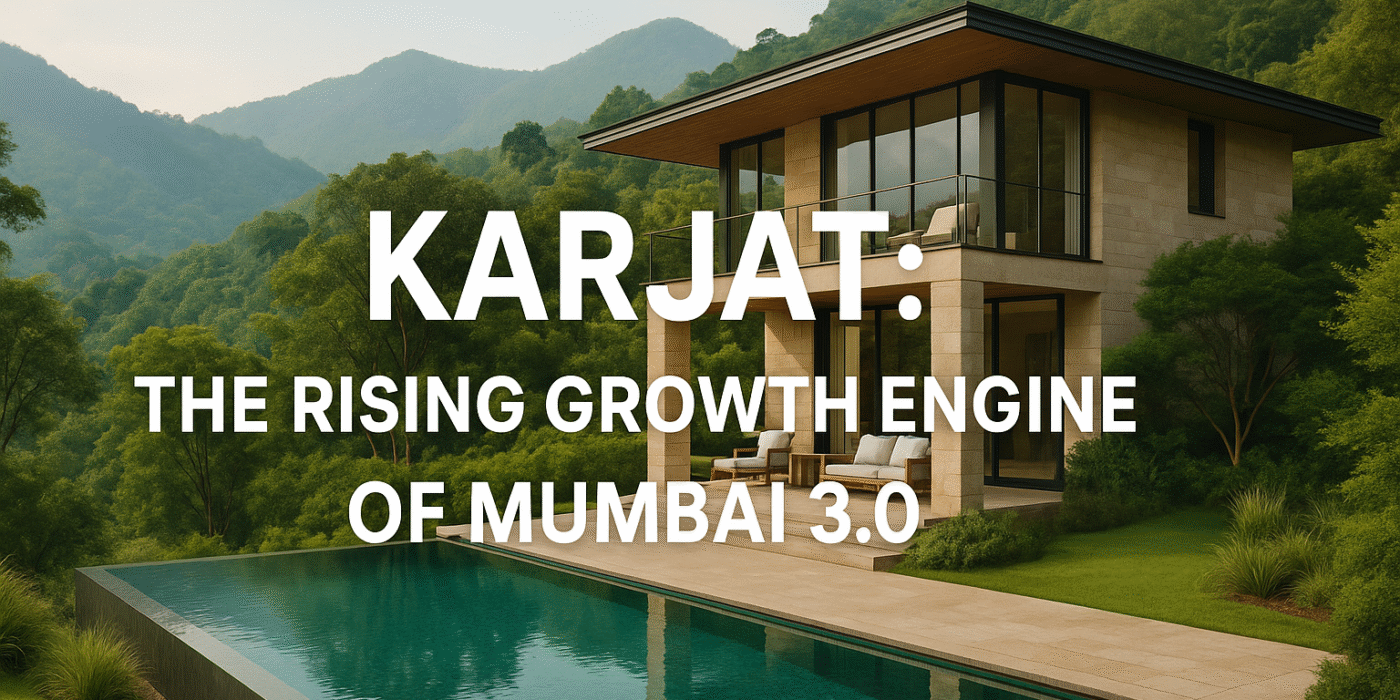
Karjat: The Green Powerhouse Fueling Mumbai 3.0’s Next Wave of Growth
As Mumbai enters the era of Mumbai 3.0—a strategic expansion marked by smart infrastructure, multi-nodal development, and global-standard planning—one region is quietly but decisively rising to the forefront: Karjat.
Once seen as a quaint nature escape, Karjat is now evolving into one of MMR’s most powerful growth engines, driven by connectivity upgrades, land availability, and an evolving urban mindset that prioritizes sustainability and space.
Today, Karjat is no longer “outside Mumbai.”
It is the new frontier of Mumbai.
Why Karjat Matters in Mumbai 3.0
Mumbai 3.0 is not just about horizontal expansion—it’s about creating liveable, connected, future-ready satellite cities that ease pressure from the core while fueling new economic corridors.
In this blueprint, Karjat occupies a strategic, high-impact position.
According to Girish Chhalwani, Founder & CEO of THE EDGE Developments,
“Karjat offers the purest version of what Mumbai 3.0 wants to build—nature, connectivity, land, and long-term expansion capacity. It is positioned to become one of the strongest residential and investment hubs of the next decade.”
Karjat’s transformation reflects a shift in how Mumbai thinks about growth:
from vertical congestion to horizontal, sustainable development.
The Infrastructure Wave Redefining Karjat
Karjat’s rise is not accidental—it is the result of multiple mega infrastructure projects converging around the region:
1. Panvel–Karjat Railway Upgrade
Improved frequency and upcoming enhancements will reduce commute time to Navi Mumbai, Panvel, and major employment hubs, making Karjat a viable residential zone for working professionals.
2. Navi Mumbai International Airport (NMIA)
Karjat falls within the airport’s influence zone—an economic magnet that historically transforms land value, job creation, hospitality, and commercial activity.
3. Virar–Alibaug Multimodal Corridor
One of Maharashtra’s largest mobility projects, it will connect Karjat directly to major industrial and residential zones across MMR.
4. Karjat–Bhimashankar Highway
This upcoming corridor will unlock Karjat’s untouched hinterland, opening vast opportunities for plotted development, tourism, and weekend homes.
Combined, these projects position Karjat as a connectivity-rich transit hub, capable of absorbing future urban expansion in a structured manner.
Karjat: MMR’s New Residential & Lifestyle Capital
As buyers increasingly look beyond saturated Mumbai and Navi Mumbai markets, Karjat has emerged as a balanced residential destination offering:
Green landscapes and open spaces
Significantly lower population density
Larger land parcels and better living standards
Modern plotting and villa communities
Affordability with long-term appreciation
A growing cluster of schools, resorts, restaurants, and wellness retreats
The shift toward hybrid work and lifestyle-driven housing has accelerated demand.
Families from Mumbai, Navi Mumbai, Thane, and Pune are now exploring Karjat as a primary or second-home location.
Chhalwani explains:
“Karjat offers the perfect mix—affordable entry, high appreciation potential, and a quality of life that’s impossible to find in traditional suburbs.”
The Rise of Weekend Homes and Nature-Led Living
Karjat has become the epicentre of weekend home investing in MMR.
Buyers today look for:
Privacy
Greenscapes
Cleaner air
Waterfalls, hills, and nature trails
Large plots for villas and retreats
Many developers believe Karjat will become the Bisleri belt of MMR—where clean air, clean water, and wellness become its economic identity.
This shift is not just lifestyle—it’s economic.
Weekend homes are fuelling construction, local employment, tourism, and hospitality, transforming Karjat into a self-sustaining micro-economy.
Karjat as a Future Economic Sub-Center
Karjat’s land availability (unlike the constrained island city) allows it to evolve into:
Tourism and hospitality hubs
Education clusters
Health & wellness districts
Eco-friendly manufacturing pockets
Senior-living communities
Digital/remote-work townships
Warehousing & logistics centres
Its proximity to two major cities—Mumbai and Pune—makes it a natural midpoint for future growth, similar to how Gurugram emerged for Delhi.
Investment Outlook: The Smart Bet of Mumbai 3.0
THE EDGE’s research shows the following trends driving investor interest:
Land prices in Karjat have appreciated steadily over the past five years.
Plotting projects and villa communities are seeing high absorption.
End-user demand is rising, not just speculative buying.
Developers are entering the region earlier than they did in Navi Mumbai.
Infrastructure delivery timelines are improving district-wide.
In simple words:
Karjat today is where Navi Mumbai was 15 years ago.
And that window will not remain open for long.
Challenges to Address
Karjat’s growth must balance:
Environmental and ecological preservation
Infrastructure rollout timelines
High-quality, low-density planning
Transparent land consolidation processes
Experts emphasize that the region’s long-term success relies on sustainable execution, not rushed construction.
Conclusion: Karjat — The Green Superpower of Mumbai 3.0
Karjat represents the new philosophy of Mumbai’s growth:
decentralized, connected, sustainable, and nature-driven.
With mega infrastructure, land-driven affordability, and rising investor confidence, Karjat is moving from a weekend retreat to a core pillar of Mumbai 3.0’s expansion strategy.
As Girish Chhalwani summarizes:
“Karjat is not just a destination—it is the future foundation of Mumbai’s next phase of urban evolution.”