
TL;DR — KEY TAKEAWAYS
- Real land ROI isn’t sale-minus-purchase — it’s net CAGR after stamp duty, legal, carrying costs, brokerage and 12.5% LTCG.
- Use CAGR = (Sale/Purchase)^(1/years) − 1; a strong net result is 12–18% over 5–10 years.
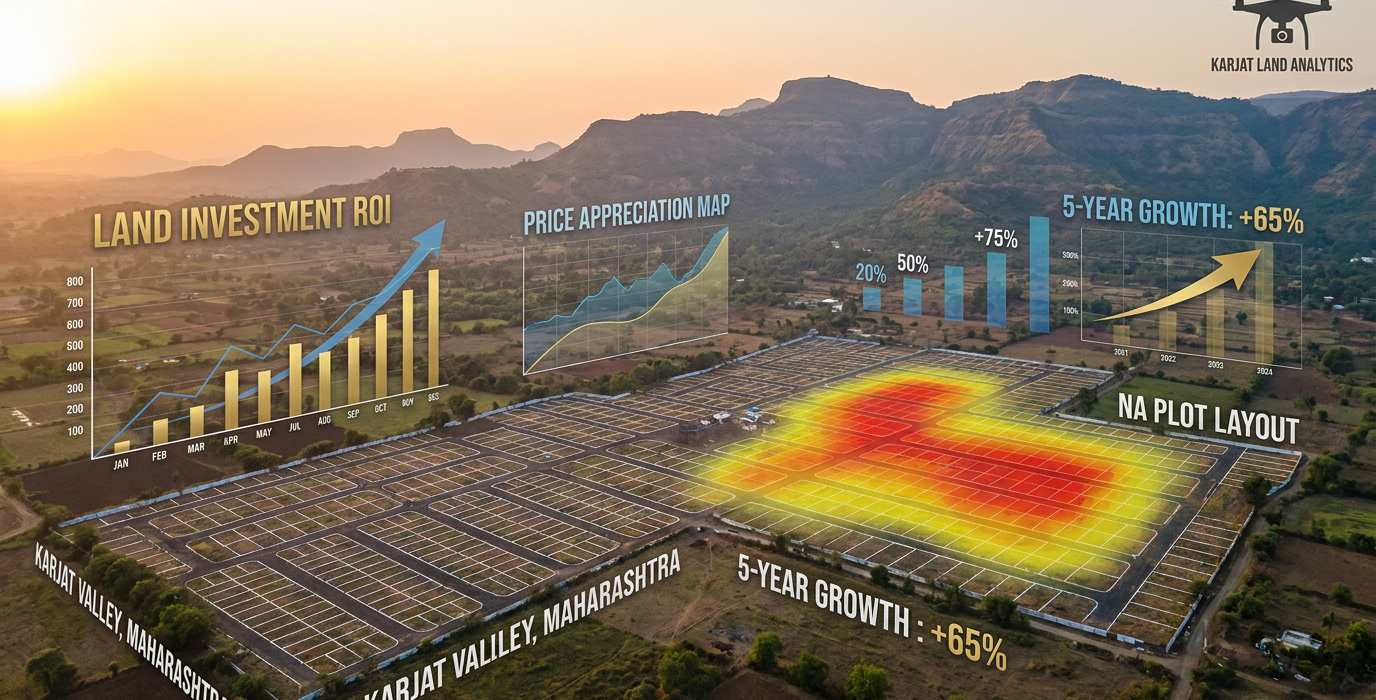
- Karjat/Khopoli NA plots delivered ~15–22% gross CAGR (2016–2026) — beating FDs, gold and Mumbai flats.
- Hold 5–8 years to match the infrastructure build cycle; returns moderate once an area is built-up.
Most land investors make the mistake of evaluating ROI only on paper — they look at the price they paid and the price they can sell at, and calculate a percentage. Real land investment ROI is far more nuanced: it accounts for the time value of money, carrying costs, transaction costs, tax, and the opportunity cost of the capital deployed. This guide gives you the exact formula, three real case studies from Karjat, and a 10-year projection model for MMR corridor land.
Reading time: 15 minutes | Last updated: July 2026 | Author: Girish Chhalwani, Founder & CEO, THE EDGE Developments
Land in infrastructure corridors adjacent to India’s major metros has historically delivered 15–25% CAGR over 5–10 year periods — significantly outperforming most other asset classes including equities, gold, and residential apartments in the same cities. The Karjat–Khopoli corridor of the Mumbai Metropolitan Region has seen land prices appreciate from ₹200–400/sq.ft in 2015 to ₹1,200–2,500/sq.ft in 2026, representing a 10-year CAGR of approximately 18–22%. — Source: THE EDGE Developments Market Research; Maharashtra land registration data 2015–2026
What is the complete land investment ROI formula?
Simple ROI (Not Recommended for Long-Term Analysis)
Simple ROI = [(Sale Price − Purchase Price) / Purchase Price] × 100
Annualised ROI / CAGR (The Right Metric)
CAGR = [(Sale Price / Purchase Price) ^ (1/Years)] − 1
Net ROI (Accounting for All Costs)
Net Sale Value = Sale Price − LTCG Tax − Brokerage − Legal Costs
Net Purchase Cost = Purchase Price + Stamp Duty + Registration + Legal Due Diligence
Net CAGR = [(Net Sale Value / Net Purchase Cost) ^ (1/Years)] − 1
What to include in your cost calculation
| Cost Type | Typical Amount | Include in ROI? |
|---|---|---|
| Purchase price | As agreed | Yes |
| Stamp duty (Maharashtra) | 5–6% of value | Yes |
| Registration fee | 1% (max ₹30,000) | Yes |
| Legal due diligence | ₹25,000–75,000 | Yes |
| Annual property tax | ₹500–5,000/year | Yes (annualised) |
| Maintenance/security | ₹0–50,000/year | Yes (if any) |
| LTCG tax on sale | 12.5% of gain post-Budget 2024 | Yes |
| Brokerage on sale | 1–2% | Yes |
Case Study 1: Karjat Core Agricultural Land (2016–2026)
| Parameter | Detail |
|---|---|
| Land type | Agricultural, 1 acre, Karjat taluka |
| Purchase year | 2016 |
| Purchase price | ₹25 lakh/acre |
| Total acquisition cost (incl. stamp duty, legal) | ₹28.5 lakh |
| Annual carrying cost (property tax + misc.) | ~₹4,000/year |
| Sale price in 2026 | ₹1.4 Cr/acre |
| Net sale proceeds (after tax @12.5% LTCG, 2% brokerage) | ~₹1.10 Cr |
| Holding period | 10 years |
| Net CAGR | ~14.5% |
| Simple CAGR (gross) | ~18.8% |
Key driver: Infrastructure — announcement and construction of Second Mumbai-Pune Expressway and Virar-Alibaug Multimodal Corridor drove sustained demand from Mumbai buyers.
Case Study 2: NA Plot in Branded Development (2019–2026)
| Parameter | Detail |
|---|---|
| Land type | NA plot, 2,000 sq.ft in RERA-registered branded development, Khopoli |
| Purchase year | 2019 |
| Purchase price | ₹900/sq.ft = ₹18 lakh |
| Total acquisition cost | ₹21 lakh (incl. 15% development charges) |
| Annual carrying cost | ₹12,000/year (maintenance) |
| Sale price in 2026 | ₹2,400/sq.ft = ₹48 lakh |
| Net sale proceeds | ~₹40 lakh |
| Holding period | 7 years |
| Net CAGR | ~9.7% |
| Simple CAGR (gross) | ~15.0% |
Key insight: NA plotted developments carry higher upfront costs (stamp duty, development charges) but offer liquidity premium when selling — they attract buyers who want ready, legally clear land without conversion risk.
The distinction between gross CAGR and net CAGR matters enormously. A land investment that appears to deliver 20% gross CAGR often yields only 13–15% net CAGR once stamp duty, registration, LTCG tax at 12.5%, and annual carrying costs are factored in. In the Karjat–MMR corridor, the best-structured land investments — NA plots in infrastructure corridors with clear title — have delivered net 14–18% CAGR over 7–10 year holding periods. — Source: THE EDGE Developments Transaction Analysis, 2026
Case Study 3: Weekend Home Plot with Rental Income (2020–2026)
| Parameter | Detail |
|---|---|
| Asset type | 3,000 sq.ft NA plot + weekend home (₹1.1 Cr construction) |
| Total investment (2020) | ₹1.6 Cr (land + construction) |
| Annual rental income (2021–2026) | ₹8–12 lakh/year (Airbnb/direct) |
| Total rental collected (5 years) | ~₹45 lakh |
| Current market value (2026) | ₹3.5 Cr |
| Total return | ₹3.5 Cr + ₹45 lakh rental − ₹1.6 Cr = ₹2.35 Cr profit |
| Holding period | 6 years |
| Blended net CAGR (capital + income) | ~18.5% |
What are the 10-year ROI projections for MMR corridor land (2026–2036)?
| Location | Current Price (2026) | CAGR Projection | Projected Value (2031) | Projected Value (2036) |
|---|---|---|---|---|
| Karjat core (NA plot) | ₹1,500–2,000/sq.ft | 14–18% | ₹2,900–4,500/sq.ft | ₹5,600–9,700/sq.ft |
| Khopoli/Khalapur corridor | ₹1,200–1,800/sq.ft | 12–16% | ₹2,100–3,700/sq.ft | ₹3,700–7,900/sq.ft |
| Alibaug (sea-facing NA) | ₹3,000–5,000/sq.ft | 10–14% | ₹4,800–9,600/sq.ft | ₹7,800–18,500/sq.ft |
| Panvel (near NMIA) | ₹4,000–7,000/sq.ft | 12–18% | ₹7,000–16,000/sq.ft | ₹12,400–35,000/sq.ft |
Projections are based on infrastructure timelines (VAMC Phase 1, NMIA completion, expressway widening) and historical appreciation rates. Past performance is not a guarantee of future results.
FAQs: Land Investment ROI India
What is a good CAGR for land investment in India?
A net CAGR of 12–18% over a 5–10 year holding period is considered strong for land investment in India’s peri-urban infrastructure corridors. This outperforms FD rates (6–7%), gold (8–10%), and is comparable to well-managed equity mutual funds over the same period — but with physical asset backing and lower volatility.
How long should you hold land for maximum ROI?
In infrastructure-driven corridors like Karjat–MMR, the ideal holding period aligns with key project milestones — the period between announcement of major infrastructure and completion of Phase 1 construction. This is typically 5–8 years. Holding beyond 10 years in rapidly developing corridors often yields diminishing marginal returns as the area becomes built-up and land supply shrinks.
Is land a better investment than apartments in MMR?
Over the 2016–2026 period, NA land in the Karjat–Khopoli MMR corridor appreciated at 15–22% CAGR, compared to 4–8% CAGR for apartments in established Mumbai micro-markets. Land offers superior capital appreciation but no rental income (unless developed). Apartments offer lower appreciation but consistent rental yield of 2–3% in Mumbai suburbs.
What is the impact of Budget 2024 on land investment ROI?
Budget 2024’s switch to 12.5% flat LTCG (without indexation) reduced the net ROI for investors who bought land at low cost many years ago. For recent purchases (2019–2024) where indexation would have provided limited benefit anyway, the new flat rate at 12.5% is actually more favourable than the previous 20% (with indexation).
Want a Custom ROI Projection for a Specific Land Parcel?
THE EDGE Developments provides detailed investment analysis for NA plots and land parcels across the Karjat–MMR corridor. Contact us for a site-specific ROI model.
Contact: info@edgerea.com | +91-9664662938 | edgere.in