
TL;DR — KEY TAKEAWAYS
- Maharashtra landowners have 5 land monetisation models — outright sale, JDA, Development Management, self-development, and long-term lease — not just “sell or hold.”
- Development Management has delivered 1.8-2.5x higher total value than outright sale over 4-6 year project timelines in Karjat, Khopoli, Panvel, and Alibaug corridors.
- DM gives landowners 85-92% of net project revenue versus 15-40% area share in a typical JDA, in exchange for a 8-15% management fee and more active involvement.
- The right model depends on liquidity needs, land size, and risk appetite — outright sale suits urgent cash needs, DM suits large parcels with clear title and patient capital.
A Maharashtra landowner sitting on 5 acres in the Karjat corridor has more options than they typically realise. Most landowners think the choice is binary: sell the land, or do nothing. The reality is that there are five distinct monetisation models available — and the choice between them can mean a difference of 2–4x in the total value realised over a 5-year period.
This guide breaks down all five models, compares their risk-return profiles, and explains why Development Management — the least understood of the five — often delivers the highest returns for landowners with clear-title land in active corridors.
Reading time: 14 minutes | Last updated: July 2026 | Author: Girish Chhalwani, Founder & CEO, THE EDGE Developments
Maharashtra landowners in peri-urban infrastructure corridors (Karjat, Khopoli, Panvel, Alibaug) who opt for Development Management agreements over outright land sale have realised 1.8–2.5x higher total value over 4–6 year project timelines compared to landowners who sold the same land outright at market rates in 2019–2021. The differential is driven by infrastructure-led appreciation, escalating unit prices during the sales period, and revenue participation in the branded development premium. — Source: THE EDGE Developments Transaction Data 2019–2025
What Are the 5 Land Monetisation Models Available to Maharashtra Landowners?
Outright sale, JDA, Development Management, self-development, and long-term lease are the five models — each trading off liquidity, risk, and total return differently.
Model 1: Outright Land Sale
You sell the land. Money lands in your account. Done.
- Upside: Immediate liquidity; no execution risk; simple and clean
- Downside: You capture today’s price only — all future appreciation goes to the buyer; LTCG tax payable immediately (12.5% flat post-Budget 2024)
- Best for: Urgent liquidity needs; uncertain land title; non-viable land parcels for development
- Return benchmark: Baseline (100%)
Model 2: Joint Development Agreement (JDA)
You contribute land; developer contributes capital, construction, marketing. You receive a defined share of the developed project (area share or revenue share).
- Upside: Participate in development value creation; tax deferral under Section 45(5A)
- Downside: Dependent on developer’s execution; can take 3–5 years to realise returns
- Best for: Landowners with clear-title NA land in established corridors, willing to wait for superior returns
- Return benchmark: 130–180% vs outright sale
Model 3: Development Management (DM) Agreement
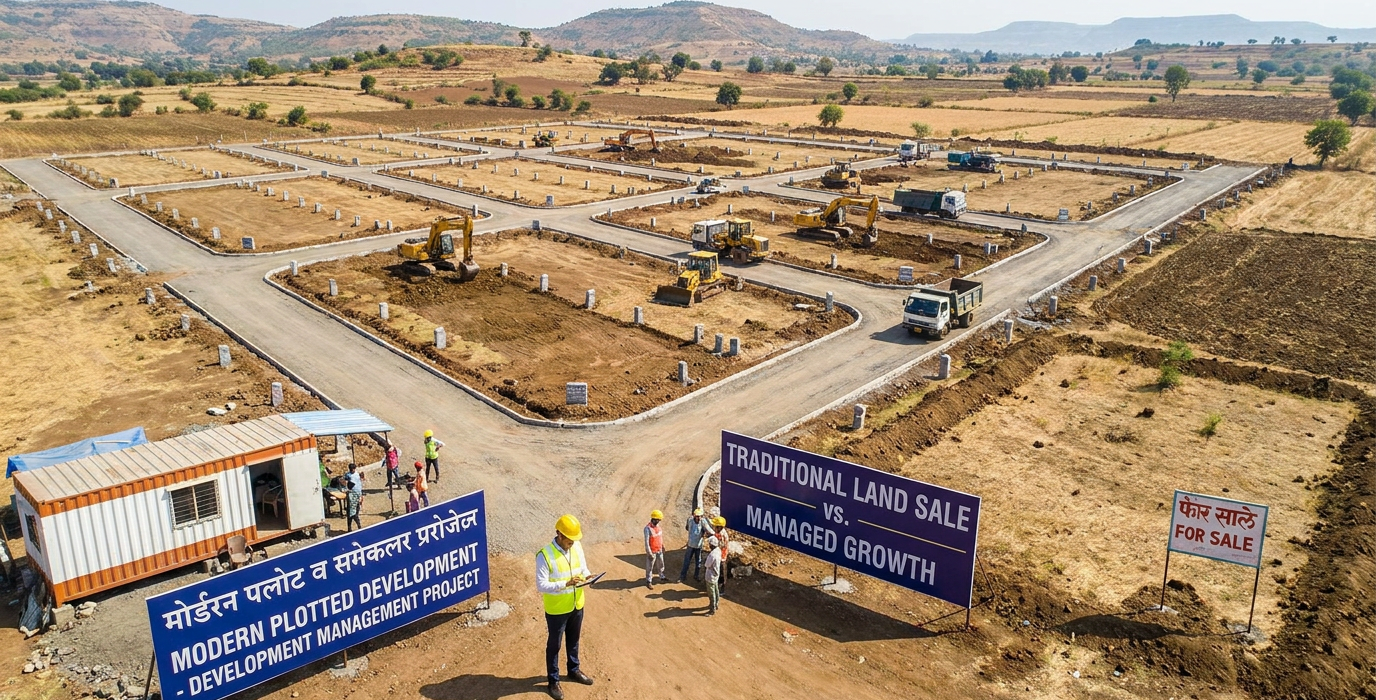
You retain land ownership and brand the project in your name (or jointly). A Development Manager (THE EDGE) manages the entire project — approvals, construction, marketing, sales — for a management fee (typically 8–15% of project revenue). You receive the majority of project revenue.
- Upside: Maximum revenue participation; brand ownership; full control retained by landowner
- Downside: Landowner bears more financial risk; requires active engagement in major decisions
- Best for: Large landowners (10+ acres) with clear title and appetite for maximum returns
- Return benchmark: 180–260% vs outright sale
Model 4: Self-Development
The landowner independently develops the project — obtains approvals, hires contractors, sells units.
- Upside: Maximum profit retention (no DM fee, no area share)
- Downside: Requires developer expertise, capital, and sales infrastructure that most landowners lack; extremely high execution risk
- Best for: Existing developers who happen to own land
- Return benchmark: 200–300% potential, but high failure rate reduces effective returns
Model 5: Long-Term Lease
Lease the land to a developer or operator for 30–99 years in exchange for annual lease rental.
- Upside: Regular income without selling the asset; land ownership retained
- Downside: No appreciation participation; complex legal structure; lease income taxable as income (not capital gains)
- Best for: Landowners who want income without risk; industrial/commercial land; legacy landholdings that must remain in family
- Return benchmark: 4–7% annual yield on land value
How Does Development Management Compare to a JDA?
Development Management gives landowners 85-92% of net project revenue versus 15-40% area share in a JDA, but requires more active involvement and higher financial risk.
| Parameter | JDA (Area Share) | Development Management |
|---|---|---|
| Land ownership | Stays with landowner during development | Stays with landowner throughout |
| Revenue share | 15–40% area share | 85–92% of net project revenue |
| Developer’s compensation | 60–85% area share | 8–15% management fee |
| Financial risk to landowner | Low (developer funds construction) | Moderate-High (landowner may co-fund or guarantee) |
| Project branding | Developer’s brand | Landowner’s brand or joint brand |
| Timeline control | Developer decides | Joint decision-making |
| Capital gains tax | Deferred to CC issuance (Section 45(5A)) | Complex — consult CA |
The choice between JDA and Development Management depends primarily on one variable: the landowner’s ability to absorb financial risk and engage actively in decision-making. A JDA transfers construction and sales risk entirely to the developer; Development Management retains both the risk and the upside with the landowner. For a Karjat landowner with a 10-acre parcel and clear title, the difference between JDA returns (₹15–25 Cr) and Development Management returns (₹25–45 Cr) on the same parcel over 5 years can be substantial — but only if the right DM partner is selected and the execution is delivered. — Source: THE EDGE Developments Project Modelling, Karjat Corridor 2024
Which Model Is Right for Your Situation?
The right model depends primarily on how urgently you need cash, how much land you hold, and how much risk and involvement you’re willing to take on.
| Situation | Recommended Model |
|---|---|
| Need cash in 6–12 months | Outright sale or partial sale + JDA for balance |
| Clear NA title, 2–5 acres, don’t want to be involved | JDA with established developer |
| Clear NA title, 10+ acres, want maximum returns, willing to co-invest time | Development Management |
| Agricultural land without NA, need buyer immediately | Outright sale — NA conversion timeline too long for JDA |
| Multi-generational family land in residential zone | Long-term lease or JDA |
| Industrial land in changing use zone | Self-development or DM for maximum capture |
FAQs: Land Monetisation for Maharashtra Landowners
- What is Development Management in real estate?
- Development Management (DM) is a model where a landowner retains ownership and project brand rights while engaging a Development Manager — a specialised company like THE EDGE Developments — to manage the entire project lifecycle (approvals, construction, marketing, sales) for a management fee of 8–15% of project revenue. The landowner receives 85–92% of net project revenue instead of the 15–40% area share typical in a JDA.
- Is Development Management better than a JDA for Maharashtra landowners?
- Development Management typically delivers 40–80% higher total returns compared to a JDA area share deal — but only if the DM partner has the execution capability to deliver on time, and only if the landowner has the financial capacity to participate in construction costs or provide guarantees. For risk-averse landowners without liquidity, a JDA is safer.
- What is a fair Development Management fee?
- Development Management fees in Maharashtra typically range from 8–15% of gross project revenue. The fee should cover project management, construction oversight, marketing, sales, and channel partner management. Lower fees (below 8%) may indicate that the DM is extracting value elsewhere (construction margin, procurement); higher fees (above 15%) reduce landowner economics significantly.
- Can a landowner retain land title in a JDA?
- Yes. In a properly structured JDA, land title remains with the landowner throughout the development period. The developer receives only development rights (backed by a registered General Power of Attorney). Title transfers to unit buyers only upon individual sale deeds being executed for each plot or unit.
Own Land in Karjat or the MMR Corridor? Let’s Talk.
THE EDGE Developments offers both JDA and Development Management structures for landowners in Karjat, Khopoli, and the Mumbai 3.0 corridor. Contact us for a no-obligation land monetisation assessment.
Contact: info@edgerea.com | +91-9664662938 | edgere.in