
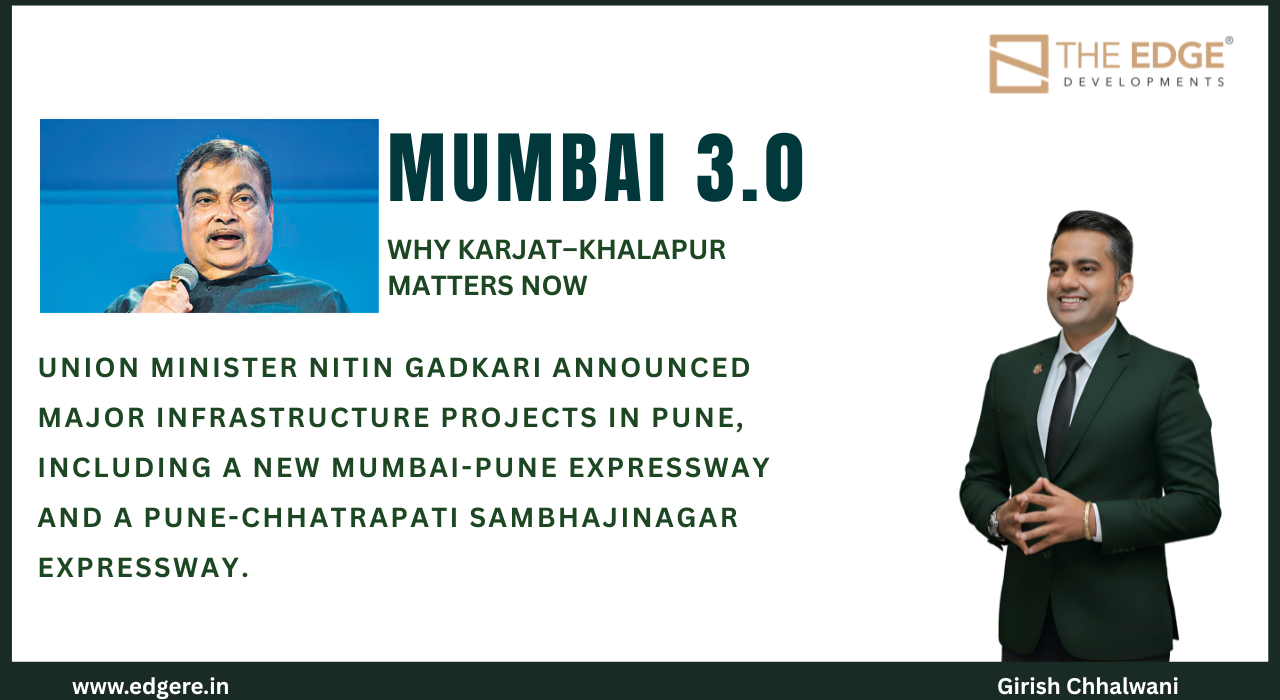
Second Mumbai–Pune Expressway: Why Karjat–Khalapur–Khopoli Is Emerging as Maharashtra’s Next Strategic Growth Corridor
By Girish Chhalwani
CEO, THE EDGE
Infrastructure announcements often dominate headlines for their scale and promised travel-time reductions. Yet their real significance unfolds far more quietly—through shifts in economic behaviour, land use patterns and long-term real estate cycles.
The announcement of a 130-km greenfield Mumbai–Pune Expressway, estimated to cost ₹15,000 crore, is one such moment. Planned to extend from the Atal Setu near JNPA to Pune’s Shivare Junction, this new corridor is set to run parallel to the existing Mumbai–Pune Expressway, which transformed regional development when it opened in 2002.
Beyond faster travel, the expressway is poised to redefine the importance of micro-markets lying between Mumbai and Pune, particularly Karjat, Khalapur and Khopoli.
What Has Been Announced
According to Union Minister for Road Transport and Highways Nitin Gadkari, the new expressway will significantly ease congestion on the existing corridor while preparing Maharashtra for future traffic volumes.
Key details include:
-
Length: Approximately 130 km
-
Estimated Cost: ₹15,000 crore
-
Alignment: Atal Setu (JNPA) → Pagote → Chowk (Panvel) → Shivare Junction (Pune)
-
Phase 1 Approved: Pagote to Chowk
-
Expected Travel Time: Mumbai–Pune in ~1.5 hours
-
Extended Connectivity: Pune–Mumbai–Bengaluru in ~5.5 hours
In addition, Gadkari also announced a greenfield expressway between Pune and Chhatrapati Sambhajinagar, estimated at ₹16,318 crore, which is expected to reduce travel time between the two cities to around two hours.
Why Karjat–Khalapur–Khopoli Matters Now
Infrastructure does not merely connect locations; it reorders regional priorities.
With the new expressway originating near JNPA–Pagote, the Karjat–Khalapur–Khopoli belt now sits at the intersection of three powerful drivers:
-
Port-led logistics expansion, supported by JNPA and allied freight infrastructure
-
Compressed Mumbai–Pune travel time, altering commuting psychology
-
Affordability compared to saturated urban markets
Historically, regions that benefit simultaneously from logistics access, residential viability and infrastructure investment tend to evolve into stable, multi-use growth corridors rather than speculative hotspots.
From Leisure Destination to Strategic Extension
For years, Karjat and its surrounding areas were discussed largely as weekend-home destinations—known for landscapes rather than long-term economic relevance.
However, this trajectory mirrors what occurred in Lonavala after the first Mumbai–Pune Expressway. Once connectivity stabilised, leisure-led demand gradually gave way to mixed-use development, including residential clusters, hospitality and commercial support services.
A similar pattern is now visible:
-
Khalapur and Chowk are emerging as logistics and warehousing anchors due to expressway access
-
Karjat is naturally suited for low-density residential formats such as plotted developments, villas and managed second homes
-
Khopoli acts as a connective industrial and residential link
Together, these micro-markets function as complementary nodes, not competitors.
Demand Will Change in Profile, Not Just Volume
One of the most important consequences of reduced travel time is not price appreciation—it is demand diversification.
The Karjat–Khalapur belt is likely to attract:
-
Professionals seeking larger homes within 90 minutes of Mumbai
-
Housing demand linked to logistics, warehousing and industrial employment
-
Investors focused on land-backed assets aligned with infrastructure timelines
As psychological distance between cities reduces, the definition of what constitutes “commutable” living expands, reshaping housing preferences.
What Developers and Investors Must Get Right
While infrastructure creates opportunity, outcomes depend on execution. Over multiple real estate cycles, a consistent pattern emerges: regions succeed when development aligns with infrastructure phasing and real demand.
For the Karjat–Khalapur–Khopoli corridor, this means:
-
Respecting zoning, environmental and planning norms
-
Phasing projects in sync with infrastructure milestones
-
Designing communities rather than focusing solely on plot monetisation
This is a corridor where planning discipline will outperform aggressive promotion.
A Long-Term Value Curve
The Second Mumbai–Pune Expressway is not an overnight catalyst. It represents a 10–15 year growth curve, unfolding gradually as infrastructure, logistics and residential demand align.
Karjat and Khalapur currently sit at an inflection point—early enough to be meaningful, mature enough to be credible.
For stakeholders across real estate and infrastructure, the key question is no longer whether this belt will grow, but how thoughtfully that growth is shaped.
In real estate, the most enduring returns are rarely created at the peak of attention.
They are built just before it arrives.
What is the Second Mumbai–Pune Expressway?
It is a proposed 130-km greenfield expressway running parallel to the existing Mumbai–Pune Expressway, aimed at reducing congestion and improving intercity connectivity.
How much will the new expressway cost?
The project is estimated to cost around ₹15,000 crore.
What will be the Mumbai–Pune travel time after completion?
The expected travel time is approximately 1.5 hours.
Which areas will benefit most from the new expressway?
Regions such as Karjat, Khalapur, Chowk and Khopoli are expected to see long-term benefits due to improved connectivity and logistics access.
Is this expressway good for real estate investment?
Infrastructure-led corridors typically support long-term value creation, provided development is phased and aligned with demand rather than speculation.
About the Author
Girish Chhalwani is the CEO of THE EDGE, is a real estate land development based out of mumbai.