
NRI Indian couple reviewing property documents abroad with a world map and mixed currency — NRI buying property in India
CategoriesNRI Guides

NRI Buying Property in India 2026: Step-by-Step Process, FEMA and Bank Rules

THE EDGE — Direct Answer

NRIs can freely buy residential property, commercial property, and NA (Non-Agricultural) plots in India without any RBI permission under FEMA. Agricultural land, farmhouses, and plantation property require prior RBI approval — which is rarely granted — and should be avoided. All payment must route through an NRE or NRO bank account; cash is banned under FEMA. The 8-step process: open an NRE/NRO account, get a PAN card, verify the property independently (7/12, NA order, RERA, encumbrance certificate), execute a notarised and apostilled Power of Attorney if not physically present in India, transfer funds and obtain the FIRC from your bank, register the Sale Deed, update mutation records (Ferfar) at the Talathi office, and complete post-purchase tax compliance. Keep every FIRC — it is mandatory for repatriation when you sell.

TL;DR — KEY TAKEAWAYS

  • NRIs can freely buy residential/commercial property and NA plots in India — no RBI permission needed.
  • Agricultural land, farmhouses and plantations need RBI approval (rarely granted) — avoid them.
  • All payment must route through an NRE/NRO account; cash is banned under FEMA.
  • Keep every FIRC and use an apostilled, India-registered POA if you cannot attend registration in person.

NRIs can freely buy residential and commercial property (including NA plots) in India without any special RBI permission. Agricultural land, farmhouses, and plantation properties require RBI approval — and are practically unavailable. This step-by-step guide covers the complete process — FEMA rules, which properties you can buy, how to pay, POA requirements, and the specific gotchas that catch NRI buyers off guard.

Reading time: 14 minutes | Last updated: July 2026 | Author: Girish Chhalwani, Founder & CEO, THE EDGE Developments

NRI investment in Indian real estate crossed ₹1.5 lakh crore in FY2024–25 — the highest in India’s recorded history. The combination of rupee depreciation (20–25% weaker vs 2015 for most major currencies), improving regulatory clarity under RERA, and robust infrastructure investment is making Indian property compelling for the diaspora. NRIs who bought NA plots near Mumbai in 2019–2021 have seen 120–180% appreciation in rupee terms — and even more in dollar or dirham terms. — Source: RBI Annual Report 2025, ANAROCK NRI Survey 2025

What properties can an NRI buy in India under FEMA?

NRIs can freely buy residential flats, commercial property, and NA plots — no RBI permission required. Agricultural land, farmhouses, and plantation property need prior RBI approval, which is rarely granted. FEMA is the Foreign Exchange Management Act that governs these rules.

Property Type Can NRI Buy? RBI Permission Needed?
Residential flat / apartment Yes, freely No
NA plot (Non-Agricultural) Yes, freely No
Commercial property / office Yes, freely No
Agricultural land No (general rule) Yes — prior RBI approval needed
Farmhouse No (general rule) Yes — prior RBI approval needed
Plantation property No (general rule) Yes — prior RBI approval needed
Inherited agricultural land Yes — can retain/sell, cannot buy No for inheritance; approval for purchase

OCI (Overseas Citizen of India) cardholders follow the same rules as NRIs for property purchase.

What is the step-by-step process for an NRI to buy property in India?

The process has eight steps: open an NRE/NRO account, get a PAN, verify the property, execute a POA if absent, transfer funds and obtain the FIRC, register the sale deed, update revenue records, and complete post-purchase compliance.

Step 1: Open an NRE/NRO Account in India

All property purchase payments must route through an Indian bank account. NRIs need either:

  • NRE account (Non-Resident External): For foreign income remitted to India; fully repatriable
  • NRO account (Non-Resident Ordinary): For India-sourced income (rental, salary from Indian employer, etc.); limited repatriation (up to USD 1 million/year)

Most NRI property purchases are funded through NRE accounts — cleanest for repatriation of sale proceeds later.

Step 2: Get Your PAN Card

A PAN (Permanent Account Number) is mandatory for any property purchase above ₹5 lakh in India. NRIs can apply for PAN online through the NSDL portal with passport and overseas address proof. Allow 2–4 weeks for delivery.

Step 3: Shortlist and Verify the Property

  • For NA plots: Verify 7/12 extract, NA order, RERA registration, encumbrance certificate
  • Confirm the property is not agricultural land (NRI cannot buy without RBI approval)
  • Engage an independent property advocate in India (not the developer’s advocate)
  • Check MahaRERA registration for plotted development projects

Step 4: Execute Power of Attorney (If Not Present in India)

If you cannot be physically present in India for the registration, execute a Power of Attorney (POA) authorising a trusted person in India to sign on your behalf.

POA for property transactions must be:

  • Executed in your country of residence before a Notary Public
  • Apostilled (for Hague Convention countries: USA, UK, UAE, Australia, Canada, Singapore, etc.) OR attested by the Indian Embassy/Consulate
  • Adjudicated and registered at the Sub-Registrar office in India before it can be used for property registration

Step 5: Fund Transfer and FIRC

Transfer funds from your overseas bank account to your NRE/NRO account in India. When making payment to the seller, obtain a FIRC (Foreign Inward Remittance Certificate) from your Indian bank. This document proves the funds came from abroad and is essential for repatriation when you sell.

Step 6: Token, Agreement for Sale, Registration

  • Pay 10% token after RERA and legal verification
  • Execute registered Agreement for Sale (AFS) — contains possession date, price, payment schedule
  • Pay stamp duty and registration charges (6% + 1% in most Maharashtra cases)
  • Execute and register Sale Deed at Sub-Registrar office in India (you or POA holder must be present)

Step 7: Update Revenue Records

After registration, file for mutation (Ferfar) at the Talathi office to update the 7/12 extract with your name as owner. This is separate from the sub-registrar registration and must be done proactively.

Step 8: Compliance Post-Purchase

  • File Indian Income Tax Return (ITR) if you have any Indian income — including notional rental value of a second property
  • Declare foreign assets in the country of residence as required by local tax laws (FATCA in USA, FBAR for US taxpayers)
  • Maintain all purchase documents for future repatriation

How can an NRI legally pay for property in India?

Payment must come through banking channels into an NRE/NRO account. Foreign currency notes, traveller’s cheques, and cash are all prohibited under FEMA and PMLA.

  • Remittance from overseas through normal banking channels (to NRE/NRO account) — most common
  • Funds from NRE or NRO account
  • Foreign currency itself — not permitted; must be converted to INR first
  • Traveller’s cheques or foreign currency notes — not permitted for property transactions
  • Payment in cash — not permitted under FEMA and PMLA regulations

What TDS rules apply when NRIs transact property?

When an NRI sells property, the buyer must deduct TDS at 12.5%+ (LTCG) or 30%+ (STCG), plus surcharge and cess. If you buy from an NRI seller, this compliance obligation is yours.

  • LTCG transactions (held 24+ months): 12.5% + surcharge + cess (effective 14–23% depending on sale value)
  • STCG transactions: 30% + surcharge + cess

What red flags should NRI buyers watch for?

Watch for cash-payment pressure, verbal POA, agricultural land mislabelled as “RERA plot,” and missing FIRCs — each can trigger FEMA penalties or block future repatriation.

  • Pressure to pay in cash: Any portion of cash payment violates FEMA and can complicate future repatriation. Insist on 100% cheque/RTGS through NRE/NRO account.
  • Verbal POA: Never rely on verbal authority. All POA must be properly documented, notarised, apostilled, and registered in India.
  • Agricultural land offered as “RERA plot”: Verify NA status independently. An NRI buying agricultural land without RBI approval violates FEMA and attracts penalties.
  • No FIRC: Always obtain FIRC for every payment. Without it, repatriation of sale proceeds will face RBI documentation challenges.

Frequently Asked Questions

Can NRI buy land in India without RBI permission?

Yes — NRIs can freely buy residential, commercial property and NA plots without any RBI permission. Agricultural land, farmhouses, and plantation properties require prior RBI approval, which is generally not granted. NRIs should only buy NA-converted plots, not agricultural land.

What is the process for NRI to buy property in India?

Key steps: (1) Open NRE/NRO account, (2) Get PAN card, (3) Verify property legally (7/12, NA order, RERA), (4) Execute notarised and apostilled POA if not present in India, (5) Transfer funds via NRE/NRO account and obtain FIRC, (6) Register Sale Deed via POA holder, (7) Update mutation in revenue records.

Can NRI buy agricultural land in Maharashtra?

No — NRIs cannot purchase agricultural land in Maharashtra (or anywhere in India) without prior approval from the Reserve Bank of India. This approval is rarely granted. NRIs can purchase NA plots freely. Inherited agricultural land can be retained or sold, but not purchased.

How does an NRI repatriate money after selling property in India?

Sale proceeds from NRI property sale can be repatriated via NRE account (if original purchase was funded from NRE account or foreign remittance). Form 15CA/CB is required. Maintain all FIRCs from purchase for smooth repatriation.

About the Author — Girish Chhalwani

Girish Chhalwani is the Founder & CEO of THE EDGE Developments, a RERA-registered plotted-development company in the Karjat–MMR corridor. With 20+ years in Maharashtra land acquisition, NA conversion, and infrastructure-led land investment, he advises HNI and NRI investors on land strategy near Mumbai.

 ·  About THE EDGE Developments

NRI-Ready Plots in the Karjat–MMR Corridor

THE EDGE Developments helps NRI investors buy RERA-registered, NA-converted plots near Mumbai — with FEMA-compliant payment routing, POA support, and full documentation. Speak with our team for a remote consultation.
Book an NRI Consultation →

Aerial view of green land plots near Mumbai with Sahyadri mountains at golden sunrise — land investment 2026
CategoriesMarket Insights

Is Buying Land Near Mumbai a Good Investment in 2026?

THE EDGE — DIRECT ANSWER

Yes—buying land near Mumbai is a compelling investment in 2026, but only with a 5+ year holding horizon, clear legal title, and proper due diligence. NA plots in infrastructure corridors (Karjat, Khopoli, VAMC belt) delivered 15–25% CAGR between 2020–2025, outperforming Nifty 50. Five drivers converge now: the operational NMIA, the VAMC corridor, fixed land supply, post-pandemic weekend-home demand, and NRI capital inflows. Avoid if you need liquidity within 3 years or skip due diligence. The next appreciation wave is driven by infrastructure completion events through 2028.

TL;DR — KEY TAKEAWAYS

  • Yes — land near Mumbai is a good 2026 investment in infrastructure corridors, with clear title and a 5+ year hold.
  • NA plots in the Karjat/Khopoli/VAMC belt delivered 15–25% CAGR (2020–2025), beating the Nifty 50.
  • The next appreciation wave is driven by NMIA, the VAMC, and the Second Expressway reaching completion.
  • Avoid it if you need liquidity within 3 years or will not do proper legal due diligence.

Yes — buying land near Mumbai is a good investment in 2026, but only in the right locations, with clear legal title, and a minimum 5-year holding horizon. NA plots in infrastructure-adjacent corridors like Karjat, Khopoli, and the VAMC belt have delivered 15–25% CAGR over the last five years, outperforming equity markets and traditional real estate.

Reading time: 12 minutes | Last updated: July 2026 | Author: Girish Chhalwani, Founder & CEO, THE EDGE Developments

Land near Mumbai in infrastructure-growth corridors has appreciated 40–80% between 2020 and 2025. The Navi Mumbai International Airport (NMIA), Virar–Alibaug Multimodal Corridor, and the Second Mumbai–Pune Expressway are reshaping economic geography across the MMR, creating predictable land appreciation zones within 50–100 km of Mumbai. — Source: MSRDC Reports 2025, THE EDGE Developments Market Research

Why is Mumbai’s land market structurally different?

Because Mumbai is physically constrained and can only grow outward, a fixed supply of developable land meets relentless demand. Over ₹3 lakh crore of funded MMR infrastructure is now permanently expanding the city’s economic boundary — and land in its path gets absorbed.

Mumbai is India’s economic engine — generating over 6% of India’s GDP from a geography that is physically constrained. The island city cannot expand. Its suburbs have saturated. The only direction left is outward — into the Mumbai Metropolitan Region (MMR).

Over ₹3 lakh crore of infrastructure investment is being deployed across the MMR between 2022 and 2030. This is not speculative spending — these are under-construction, funded projects that are literally restructuring how far people can live from Mumbai and still commute efficiently. When infrastructure reduces travel time from 90 minutes to 40 minutes, it does not just save commute time — it permanently expands the economic boundary of the city.

Land that was beyond the boundary gets absorbed. Prices follow.

What does the 5-year data show on land appreciation near Mumbai?

NA plots in prime MMR corridors appreciated 80–200% between 2020 and 2025 — 12–25% CAGR depending on location — outperforming the Nifty 50’s ~14% over the same period.

Location 2020 Price (₹/sq.ft) 2025 Price (₹/sq.ft) 5-Yr Appreciation CAGR
Karjat (NA Plot) ₹400–600 ₹900–2,000 ~120–180% ~18–24%
Khopoli ₹350–500 ₹700–1,500 ~100–150% ~15–20%
Alibaug (coastal) ₹1,800–3,000 ₹5,000–10,000 ~150–200% ~20–25%
Panvel corridor ₹900–1,500 ₹2,500–4,500 ~100–150% ~18–22%
Igatpuri / Shahapur ₹180–300 ₹400–700 ~80–120% ~12–18%

For context: Nifty 50 delivered approximately 14% CAGR over the same period. Premium land near Mumbai has outperformed India’s benchmark equity index — with lower correlation to stock market volatility.

What are the 5 drivers making land near Mumbai compelling in 2026?

Five structural forces converge: the operational NMIA, the VAMC corridor, fixed land supply, post-pandemic weekend-home demand, and NRI capital inflows.

1. The Navi Mumbai International Airport (NMIA)

India’s largest greenfield airport — 60 million passengers per year capacity — is operational at Panvel. Every airport in modern history has generated a 30–50 km radius of sustained real estate appreciation. Karjat, Khopoli, Pen, and Uran all fall within this zone. The value creation from NMIA is in its early stages.

2. Virar–Alibaug Multimodal Corridor (VAMC)

The 126 km, ₹80,000 crore corridor will connect Virar in the north to Alibaug in the south, passing through the entire western MMR including Karjat and Khopoli. When complete, it will reduce end-to-end travel time from 4+ hours to under 90 minutes. Land along this spine is in its highest-appreciation window right now — during construction, before completion.

3. Fixed Land Supply

Unlike flats — where a developer can always add another floor — land near Mumbai cannot be manufactured. The area of legally developable, NA-converted land within 80 km of Mumbai is finite. As infrastructure reduces effective distance, demand for this finite supply accelerates.

4. Post-Pandemic Weekend Home Demand

The desire for clean air, open space, and personal retreats has permanently shifted upper-middle-class buyer preferences. This is not a passing trend — it is a lifestyle restructuring that has created structural demand for land and weekend homes within 60–90 minutes of Mumbai.

5. NRI Capital

NRIs invested over ₹1.5 lakh crore in Indian real estate in 2024. With the rupee offering 20–30% effective currency discount versus 2015 levels, Indian land represents significant value for dollar, dirham, and pound earners. NRI demand provides a strong floor under MMR land prices.

When is land near Mumbai a bad investment?

Land is the wrong choice if you need liquidity within 2–3 years, skip due diligence, over-rely on infrastructure promises, or buy from unregistered projects.

  • If you need liquidity within 2–3 years: Land is illiquid. Plan for minimum 5-year hold.
  • If you skip due diligence: Maharashtra’s land records are complex. Fraudulent NA claims, disputed titles, and encumbrances are common.
  • If you buy purely on infrastructure promise: Projects get delayed. Don’t be financially stretched by a timeline that extends.
  • If you buy from unregistered projects: Always verify RERA registration before any payment.

Who should buy land near Mumbai in 2026?

It suits 5–10 year investors, NRIs wanting India exposure, HNIs seeking an appreciating weekend home, and developers/JDA partners.

  • Investors with a 5–10 year horizon who want inflation-beating, real asset returns
  • NRIs wanting India exposure with lifestyle optionality
  • HNIs seeking a weekend home that also appreciates
  • Developers and JDA partners entering a development opportunity

What type of land should you buy in 2026?

Prioritise a RERA-registered NA plot for safety, a clear-title private NA plot for returns with rigorous verification, or agricultural land with conversion potential only if you are experienced.

  1. NA Plot in a RERA-registered branded project — highest legal safety, best for first-time buyers
  2. NA Plot (private sale with clear title) — good returns, requires thorough legal verification
  3. Agricultural land with conversion potential — highest upside, highest complexity; only for experienced investors

The Verdict

2026 is not too late to buy land near Mumbai — but the easy money from the lowest entry points (2019–2021) has already been made. The next wave of appreciation will be driven by infrastructure completion events: NMIA operations, VAMC opening, and expressway commissioning. Investors entering in 2026 with a 5–7 year view will still benefit meaningfully — but selectivity matters more now than it did five years ago.

Frequently Asked Questions

Is buying land a better investment than buying a flat near Mumbai?

For capital appreciation with a 5+ year horizon, land has historically outperformed flats in MMR peripheral markets. Flats offer rental income but structurally depreciate. Land appreciates and gives development optionality. Choose based on your liquidity needs and holding capacity.

What is the minimum budget to buy land near Mumbai in 2026?

NA plots in the Karjat–Khopoli corridor start from ₹25–40 lakh for 2,000–3,000 sq.ft. Premium branded plotted developments begin at ₹50–75 lakh. Agricultural land parcels can be found from ₹15–20 lakh, but carry higher legal complexity.

Which area near Mumbai has the best land ROI in 2026?

The Karjat–Khopoli–VAMC corridor offers the best risk-adjusted returns for 2026 entry. Panvel and Uran are also strong on NMIA demand. Alibaug remains premium but entry prices are now high. Karjat combines affordability, infrastructure timing, and lifestyle credentials.

Is it safe to buy land near Mumbai?

Yes, with proper due diligence. Verify the 7/12 extract, property card, encumbrance certificate, NA conversion order, and RERA registration. Engage a local property advocate. A RERA-registered branded project significantly reduces legal risk for first-time buyers.

What returns can I expect from land near Mumbai over 5 years?

Based on historical data from 2019–2024, NA plots in high-growth MMR corridors delivered 15–25% CAGR. Projections for 2026–2031, given infrastructure completion events, suggest similar or slightly lower appreciation of 12–20% CAGR in well-chosen locations.

Explore RERA-Registered Plots in the Karjat–MMR Corridor

THE EDGE Developments offers legally clear, NA-converted plotted developments in Mumbai’s fastest-growing infrastructure corridor. Speak with our team for current pricing and a guided site visit.

Book a Consultation →

Girish Chhalwani, Founder & CEO of THE EDGE Developments, land investment and real estate expert in Mumbai
CategoriesLand Investment tips & tricks

Why Most Land Buyers Get Stuck

Why Most Land Buyers Get Stuck

Most land journeys don’t fail at the time of purchase.

They fail quietly — months or even years later — when everything looks fine on paper, yet nothing really moves forward.

That silent pause is what being stuck in land actually looks like.


Buying the wrong land is rarely the real problem

This often surprises people.

In reality, most buyers don’t buy bad land. They buy land with incomplete understanding.

The title is clear. The paperwork is done. The intent is genuine. The money is paid.

And then progress slows — or stops altogether.

Because land doesn’t respond to intent. It responds to preparedness.


Buying land feels like an end. It’s actually the beginning.

Many people treat land purchase as a finish line.

There’s a sense of relief:

“Now I own land. It will take care of itself.”

That assumption is where most journeys begin to stall.

Ownership introduces a new phase — one that requires:

  • Regulatory awareness

  • Ground-level understanding

  • Monitoring access and usability

  • Tracking infrastructure execution (not announcements)

  • Adapting to evolving development rules

When buyers disengage after purchase, land doesn’t move forward. It simply waits.


Why paperwork creates a false sense of security

Another common reason people get stuck is over-reliance on documentation.

Documents can be technically correct and still practically limiting.

What many buyers discover later:

  • Access exists legally, but not physically

  • Use is permitted, but restricted by conditions

  • Development is allowed, but not viable

  • Infrastructure is proposed, but not prioritised

Paperwork confirms legal ownership. It does not guarantee functional ownership.


Land demands decisions even during quiet phases

This is the hardest part for most people.

Land requires attention when:

  • Prices are flat

  • Development feels distant

  • There are no clear external triggers

Many owners wait for something to “happen” — a road, a policy change, a market cycle.

But land rarely rewards passive waiting.

It rewards timely alignment.


When emotional attachment becomes a limitation

This is an uncomfortable but important truth.

People often become emotionally attached to land — and stop reassessing it objectively.

They stop asking:

  • Is this still the right use for this land?

  • Has the surrounding context changed?

  • Is holding still the best decision right now?

Legacy ownership is not blind attachment. It is informed stewardship.

Sometimes progress means rethinking, not holding tighter.


The real reason most land buyers get stuck

It’s not lack of money. It’s not lack of opportunity.

It’s the gap between buying land and growing with it.

Land evolves. Regulations change. Infrastructure shifts. Markets mature.

If the owner doesn’t evolve alongside the land, stagnation follows.


How long-term landowners avoid getting stuck

Experienced landowners do a few disciplined things consistently:

  • They revisit assumptions regularly

  • They stay close to ground realities

  • They seek clarity before urgency

  • They remain flexible about outcomes

  • They understand that timing is dynamic

Most importantly, they don’t confuse patience with inaction.


Final thought

Land doesn’t trap people.

People trap themselves by assuming land is static.

Buying land requires confidence. Owning land requires continuous judgment.

Those who stay engaged move forward. Those who disengage often get stuck — quietly, expensively, and indefinitely.

By Girish Chhalwani

Mumbai 3.0 Land Investment
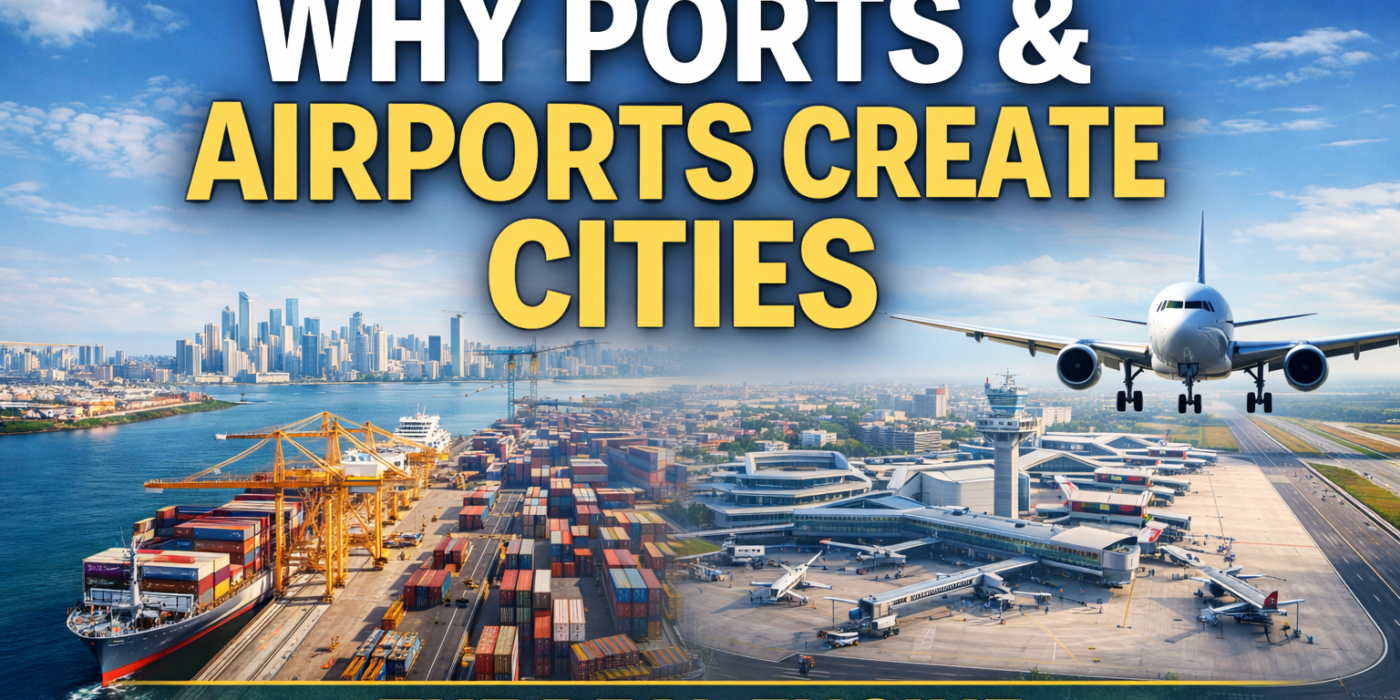
Why Ports and Airports Create Cities: The Real Engine of Urban Growth
CategoriesMumbai 3.0 tips & tricks

Why Ports and Airports Create Cities: The Real Engine of Urban Growth

Why Ports and Airports Create Cities: The Hidden Architecture of Urban Growth

Cities are not accidents.
They are outcomes.

Long before skylines appear, before housing demand rises, and before real estate prices move, cities are quietly shaped by two forces that rarely make headlines but always decide destiny:

Ports and Airports.

Throughout history, every major global city has shared one common trait —
access to movement.
Movement of goods.
Movement of people.
Movement of opportunity.

Where movement concentrates, cities emerge.


The Old Truth We Keep Rediscovering

Trade created civilisation.

From ancient ports to modern aviation hubs, economic history repeats a simple pattern:

Where goods move efficiently, people follow.
Where people follow, cities are born.

Ports and airports are not infrastructure projects.
They are economic magnets.

They compress distance, reduce friction, and turn geography into advantage.


Ports: The Original City Builders

Before roads, before railways, before highways — there were ports.

Some of the world’s greatest cities began as simple trading posts:

  • Mumbai

  • Singapore

  • Shanghai

  • Rotterdam

  • London

Ports enabled:

  • Trade

  • Employment

  • Industry

  • Migration

  • Wealth circulation

Once trade stabilised, cities layered themselves around ports:

  1. Warehousing and logistics

  2. Manufacturing and processing

  3. Worker housing

  4. Markets, institutions, governance

Ports didn’t just support cities.
They created them.


Airports: The Modern Accelerators

If ports were the builders of old cities, airports are the accelerators of modern ones.

Airports collapse time.

A city that is one flight away becomes:

  • A business destination

  • A logistics hub

  • A tourism centre

  • A services economy

Airports don’t just move passengers.
They move capital, talent, and decision-makers.

This is why every global city invests heavily in airport-led development:

  • Airport cities

  • Aerotropolises

  • Logistics and cargo hubs

  • Business districts within 30–60 minutes of runways

Airports turn peripheral land into strategic real estate.


Why Ports and Airports Always Create Real Estate Demand

The sequence is predictable:

  1. Infrastructure is built

  2. Economic activity increases

  3. Jobs are created

  4. Migration begins

  5. Housing demand rises

  6. Social infrastructure follows

  7. Cities formalise

Real estate demand is not the cause —
it is the consequence.

That’s why the smartest investors track:

  • Freight movement

  • Cargo capacity

  • Connectivity corridors

  • Policy focus on logistics and trade

Not advertisements.
Not hype.


India’s Shift: From City-Centric to Infrastructure-Led Growth

India is entering a phase where growth is no longer limited to a few metros.

The strategy is clear:

  • Decongest existing cities

  • Build new economic nodes

  • Anchor them around ports and airports

  • Let cities emerge organically

Projects like:

  • Port-led development corridors

  • New international airports

  • Dedicated freight corridors

  • Multimodal logistics parks

are not random investments.
They are city-making tools.


Mumbai as the Living Example

Mumbai itself is the proof.

The city didn’t grow because of real estate.
It grew because:

  • It was a port

  • It connected India to the world

  • Trade created opportunity

  • Opportunity attracted people

Today, Mumbai is repeating history — consciously.

Mumbai 3.0, Navi Mumbai Airport, port-led development in Konkan, and logistics corridors are all part of the same philosophy:

Let infrastructure lead. Cities will follow.


Why This Matters for the Next 20 Years

The next generation of Indian cities will not look like the old ones.

They will be:

  • Multi-nodal

  • Spread out

  • Infrastructure-first

  • Livability-driven

  • Logistics-backed

And at the centre of each will be either:

  • A port

  • An airport

  • Or both

This is not speculation.
It is urban economics.


The Investor’s Lens (Without the Hype)

For those who understand cycles, ports and airports signal one thing clearly:

Long-term inevitability.

They don’t promise overnight returns.
They promise structural growth.

Land around ports and airports appreciates not because of emotion —
but because demand becomes permanent.


The Bigger Insight

Cities don’t grow because people want to live there.

People live where:

  • They can work

  • They can trade

  • They can move

  • They can connect

Ports and airports make all four possible.

Everything else follows.


Final Thought

If you want to understand where cities will emerge tomorrow,
don’t look at skylines.

Look at:

  • Runways

  • Docks

  • Freight routes

  • Shipping lanes

That is where the future is being quietly built.

Cities are not imagined.
They are engineered by movement.

Mumbai 3.0 Land Investment
How India is building satellite cities before congestion — planned urban growth in MMR growth corridors
CategoriesMumbai 3.0 tips & tricks

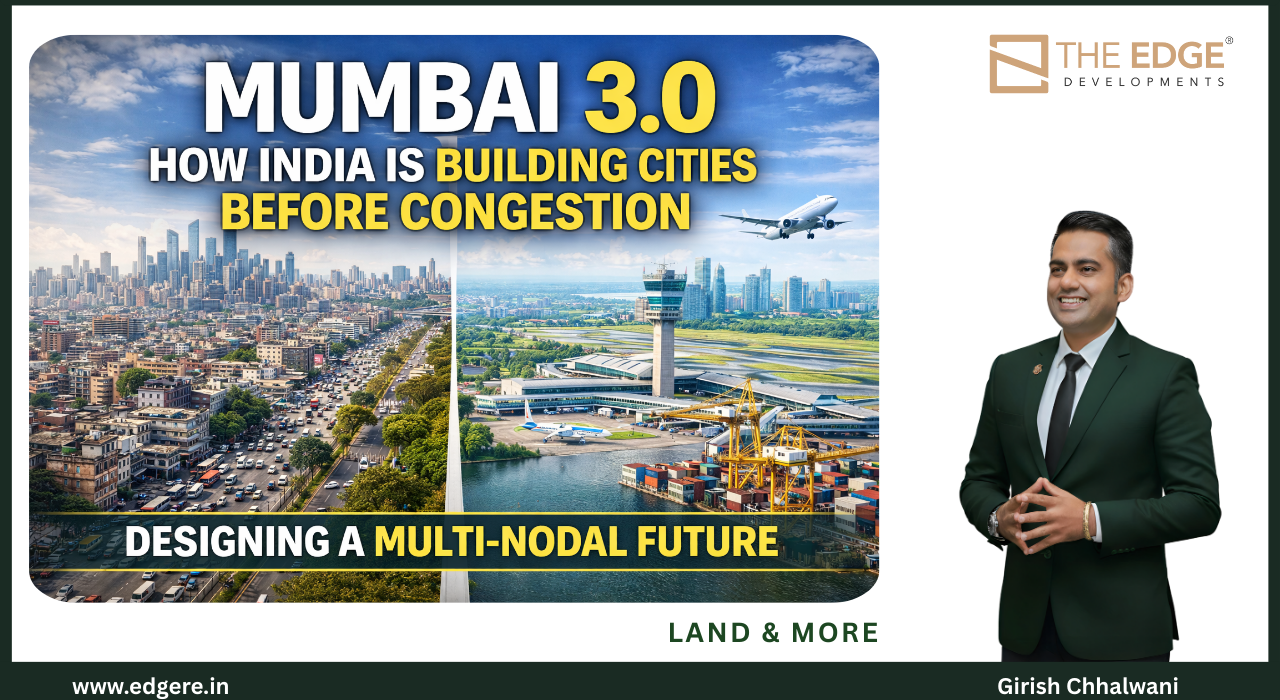
How India Is Building Cities Before Congestion

Mumbai 3.0: How India Is Building Cities Before Congestion


Mumbai 3.0 is India’s first large-scale attempt to build cities before congestion sets in—by expanding economic activity, infrastructure, and housing outward in a planned, multi-nodal manner rather than forcing more density into an already saturated core.

This is not urban expansion by default.
It is urban expansion by design.


Why Mumbai Could Not Continue Growing the Old Way

Mumbai has always grown by absorbing pressure inward:

  • Taller buildings

  • Longer commutes

  • Heavier congestion

  • Rising costs

  • Declining quality of life

For decades, this worked because opportunity outweighed discomfort.

That balance no longer exists.

Today, Mumbai faces:

  • Extreme land scarcity

  • Infrastructure saturation

  • Unsustainable commute times

  • Environmental stress

  • Diminishing livability returns

At this stage, adding more people to the same geography doesn’t create growth—it creates friction.

Mumbai 3.0 is the response to that reality.


What Is Mumbai 3.0—In Practical Terms?

Direct answer:
Mumbai 3.0 is the strategic expansion of the Mumbai Metropolitan Region (MMR) into a multi-nodal urban system, where economic activity, housing, and infrastructure are deliberately distributed across new growth corridors instead of concentrated in the island city.

It is not one new city.
It is a system of cities.

Each node is designed to:

  • Host employment

  • Support housing

  • Enable mobility

  • Maintain livability

Before congestion forces reactive solutions.


The Most Important Shift: Infrastructure First, Density Later

This is where Mumbai 3.0 breaks from history.

Traditionally:

  1. People moved in

  2. Density increased

  3. Infrastructure struggled to catch up

Mumbai 3.0 reverses the sequence:

  1. Infrastructure is built first

  2. Connectivity is ensured

  3. Economic nodes are planned

  4. Housing follows demand

This sequencing alone determines whether a city thrives or chokes.


Why Multi-Nodal Cities Are the Future

Single-core cities fail at scale.

Multi-nodal cities succeed because they:

  • Shorten commute distances

  • Reduce pressure on one CBD

  • Spread economic opportunity

  • Improve resilience

  • Enable better quality of life

Mumbai 3.0 embraces this by developing multiple centres of gravity across MMR—each connected, but independently functional.

This is how global cities evolve when they reach maturity.


How Mumbai 3.0 Aligns With Human Behaviour

Urban planning fails when it ignores people.

Mumbai 3.0 works because it reflects how people now live and work:

  • Hybrid work is normal

  • Daily office commutes are less rigid

  • People value space, time, and air

  • Families are willing to move outward—if connectivity exists

When infrastructure supports lifestyle, migration becomes voluntary, not forced.

That’s how healthy cities grow.


Why This Is an Economic Strategy—Not a Real Estate One

It’s tempting to view Mumbai 3.0 through a property lens.
That would be a mistake.

At its core, Mumbai 3.0 is about:

  • Sustaining Mumbai’s role as India’s financial engine

  • Preventing productivity loss due to congestion

  • Creating new employment hubs

  • Attracting global capital and talent

  • Future-proofing urban growth

Real estate responds to these forces—it does not drive them.


What Makes Mumbai 3.0 Different From Past Expansions

Mumbai has expanded before.

What’s different now is alignment:

  • Policy intent

  • Infrastructure investment

  • Economic decentralisation

  • Lifestyle preference shifts

For the first time, expansion is anticipatory, not reactive.

That makes Mumbai 3.0 structurally stronger than previous growth cycles.


The Long-Term Impact on the Region

If executed consistently, Mumbai 3.0 will:

  • Reduce pressure on the island city

  • Improve average commute times

  • Create balanced urban ecosystems

  • Enable affordable, planned housing

  • Improve regional livability metrics

Most importantly, it ensures that Mumbai grows outward intelligently, instead of inward destructively.


Why Mumbai 3.0 Matters Beyond Mumbai

This is bigger than one city.

Mumbai 3.0 is a template:

  • For other Indian metros reaching saturation

  • For future infrastructure-led urbanisation

  • For building cities that scale without collapsing

India doesn’t just need bigger cities.
It needs better-designed ones.


Final Thought

Great cities fail when they stop planning ahead.

Mumbai 3.0 exists because Mumbai chose foresight over fatigue.

By building cities before congestion—not after—Mumbai is doing what mature global cities eventually must:

Reinvent growth, without losing relevance

Mumbai 3.0 Land Investment
Mumbai's land growth triangle — Karjat, Khopoli, and Panvel investment zones in the Mumbai 3.0 corridor
CategoriesMumbai 3.0 tips & tricks

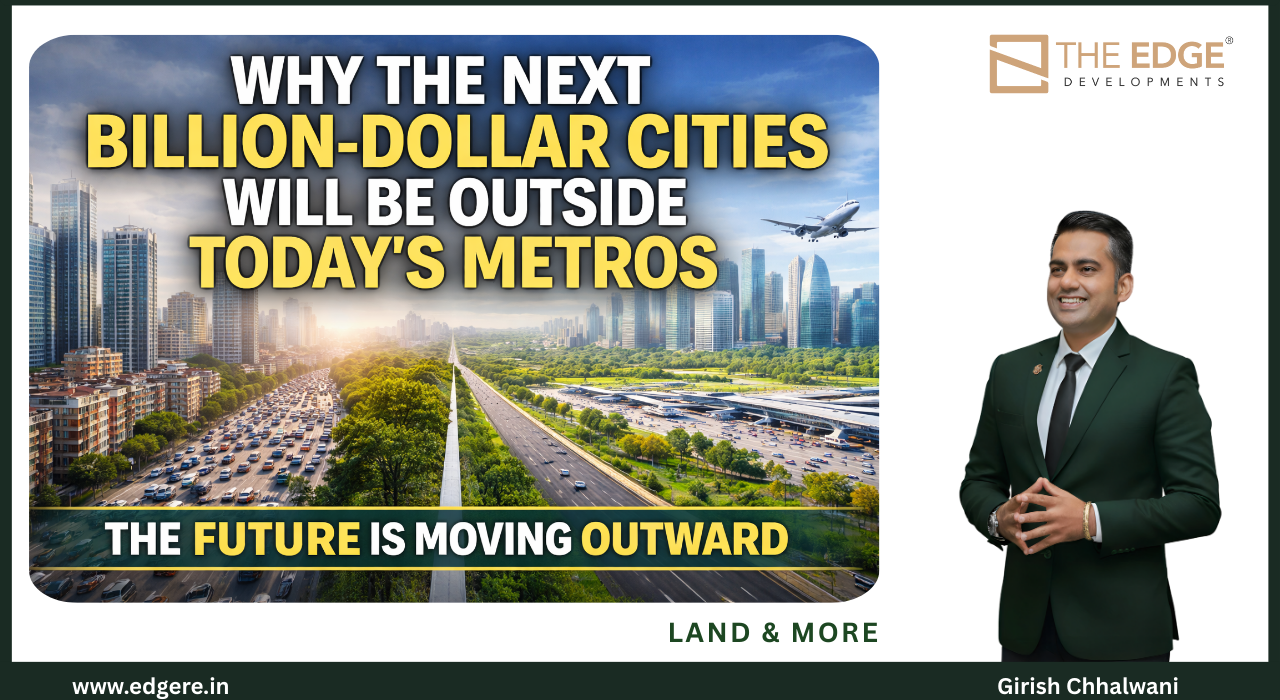
Why the Next Billion-Dollar Cities Will Be Outside Today’s Metros

Why the Next Billion-Dollar Cities Will Be Outside Today’s Metros

The next billion-dollar cities will emerge outside today’s metros because large cities have exhausted land, livability, and infrastructure capacity—while growth, capital, and people are now moving toward regions where land, connectivity, and planning still allow scale.

This shift is not cyclical.
It is structural.


The End of Metro-Centric Growth

For decades, economic growth followed a predictable pattern:

Bigger city = bigger opportunity.

That equation no longer holds.

Most major metros today face the same constraints:

  • Severe land scarcity

  • Infrastructure saturation

  • High cost of living

  • Declining quality of life

  • Environmental stress

  • Long commute times

At a certain point, cities stop compounding advantage and start taxing productivity.

That tipping point has arrived.


What Actually Creates a Billion-Dollar City?

Direct answer:
A billion-dollar city is created when four conditions align simultaneously:

  1. Scalable land availability

  2. Infrastructure-led connectivity

  3. Economic decentralisation

  4. Livability that attracts people voluntarily

Most existing metros no longer meet all four.

Emerging regions do.


Why Land Is the First Deciding Factor

Cities don’t fail because they lack ambition.
They fail because they lack land flexibility.

Land determines:

  • Density limits

  • Infrastructure layout

  • Cost of housing

  • Quality of urban life

  • Speed of expansion

Without land, growth becomes vertical, expensive, and fragile.

Every future billion-dollar city will be built where land:

  • Exists at scale

  • Can be planned before congestion

  • Allows infrastructure to arrive first

This alone disqualifies most mature metros.


Infrastructure Is Now Being Built Before Cities

This is the most important change of our time.

Historically:

  • Cities grew first

  • Infrastructure chased demand

Now:

  • Infrastructure is built first

  • Cities grow around it

Airports, ports, logistics corridors, highways, rail networks, and industrial zones are being deliberately placed outside existing city cores.

Why?
Because that’s where growth can be controlled, scalable, and sustainable.

This single sequencing shift explains why future cities won’t be born inside today’s metros.


Economic Gravity Is Moving, Quietly

Jobs no longer need one postcode.

With:

  • Distributed manufacturing

  • Logistics-led industries

  • Digital services

  • Hybrid work

  • Global supply chains

Economic gravity has become mobile.

When jobs decentralise, people follow.
When people follow, housing forms.
When housing forms, cities emerge.

This is how satellite regions quietly become economic capitals within a decade.


Human Behaviour Has Permanently Changed

This is the most underestimated driver.

People today prioritise:

  • Time over proximity

  • Space over status

  • Air quality over pin codes

  • Quality of life over density

They are willing to move outward, not upward.

Once this behavioural shift happens at scale, it doesn’t reverse easily.

Cities grow where people want to live—not where they are forced to.


Why Capital Is Following This Shift

Institutional capital doesn’t chase headlines.
It chases inevitability.

Investors are increasingly backing:

  • Infrastructure corridors

  • Peripheral growth zones

  • Airport-influence regions

  • Port-led economies

  • New industrial clusters

Because these regions offer:

  • Lower entry cost

  • Longer growth runways

  • Lower execution risk

  • Policy alignment

Capital always arrives before cities are obvious.


This Is Not an “Urban Sprawl” Story

It’s important to clarify what this is not.

This is not uncontrolled sprawl.
This is planned decentralisation.

Future cities will be:

  • Multi-nodal

  • Infrastructure-anchored

  • Lower density

  • Digitally connected

  • Environmentally conscious

They won’t replace metros.
They will relieve them.


What History Tells Us (Without Nostalgia)

Every era produces its own cities.

  • Industrial era → port cities

  • Manufacturing era → factory towns

  • Service era → metro hubs

The next era—logistics, mobility, sustainability, and digital services—demands new geography.

That geography does not exist inside old city limits.


What This Means Going Forward

Clear answer:
The next billion-dollar cities will be born:

  • Where infrastructure arrives before congestion

  • Where land allows planning at scale

  • Where people choose to live, not endure

  • Where economics and livability align

They will sit outside today’s metros—but remain deeply connected to them.


Final Thought

Cities don’t die.
They evolve.

But evolution doesn’t happen in the same place forever.

The future of urban growth belongs to regions that can still breathe, plan, and scale.

That is why the next billion-dollar cities will not rise inside today’s metros—
they will rise beyond them.


Mumbai 3.0 Land Investment
How infrastructure changes human behaviour and drives real estate growth near ports and airports in Mumbai MMR
CategoriesMumbai 3.0 tips & tricks

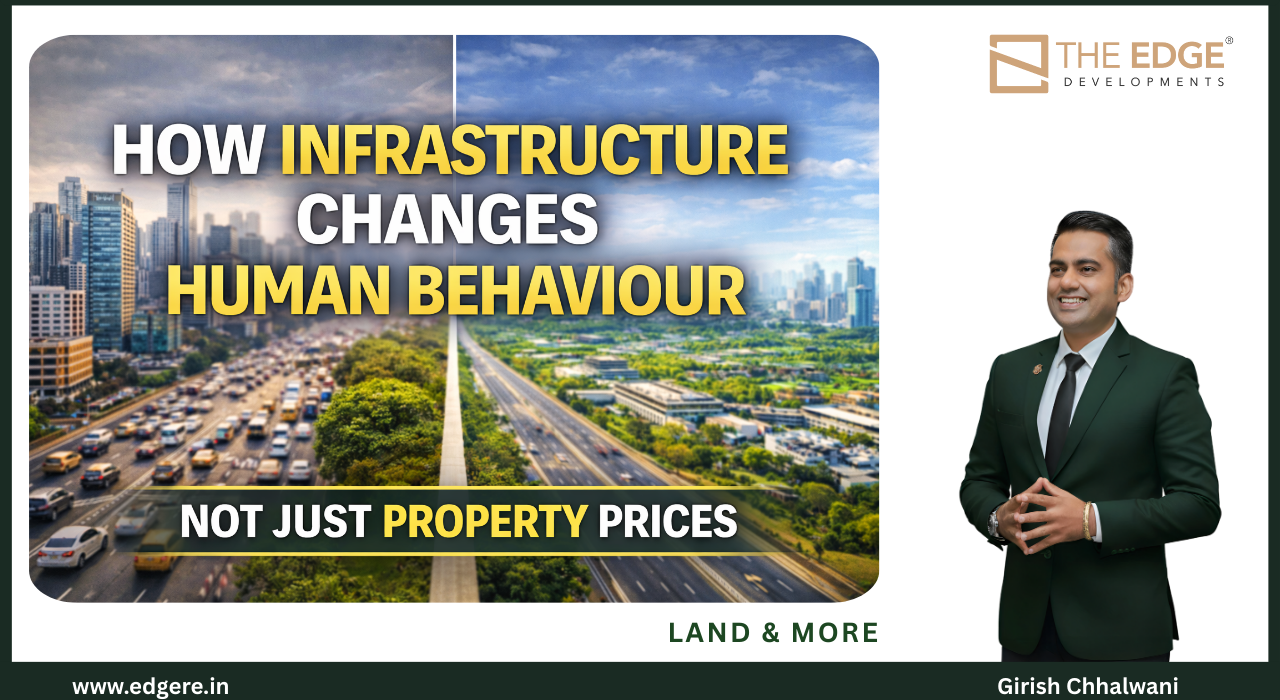
How Infrastructure Changes Human Behaviour

How Infrastructure Changes Human Behaviour (Not Just Property Prices)

Short answer:
Infrastructure changes human behaviour by altering how people value time, distance, opportunity, and quality of life. When movement becomes easier and faster, people don’t just travel differently — they live differently.

This is why infrastructure doesn’t merely shift real estate prices.
It reshapes choices.


The Biggest Urban Myth We Still Believe

There is a persistent myth in urban conversations:

Infrastructure only impacts property prices.

That is surface-level thinking.

In reality, infrastructure influences:

  • Where people choose to live

  • How far they are willing to commute

  • What they consider “close” or “far”

  • How they balance work, family, and health

  • What they value in a home and a city

Prices are the last signal, not the first.


Why Distance Is Psychological, Not Just Physical

Before infrastructure:

  • 20 km feels far

  • 60 minutes feels unbearable

After infrastructure:

  • 40 km feels manageable

  • 60 minutes becomes productive time

When roads, rail, airports, and digital connectivity improve, mental maps collapse.

People stop asking:
“Is it far?”

They start asking:
“Is it connected?”

That shift alone changes settlement patterns.


How Infrastructure Alters Daily Life Decisions

Direct answer:
Infrastructure reduces friction — and friction dictates behaviour.

When friction drops:

  • People accept longer physical distances

  • Employers decentralise offices

  • Families move outward

  • Lifestyle becomes a deciding factor

  • Cities spread horizontally, not vertically

This is why new corridors grow even before housing stock catches up.

Behaviour moves first.
Construction follows later.


Why People Don’t Leave Cities — They Leave Friction

This is a crucial distinction.

People are not abandoning cities because they dislike opportunity.
They are leaving because of:

  • Long commutes

  • Congestion

  • Noise

  • Pollution

  • Lack of personal time

When infrastructure creates alternative geographies that offer:

  • Connectivity

  • Employment access

  • Better living conditions

Migration becomes a choice, not an escape.


Infrastructure and the Rise of Hybrid Living

Infrastructure has enabled a new behaviour pattern:
hybrid living.

People now:

  • Work part-time from offices

  • Travel fewer days per week

  • Choose homes based on lifestyle, not proximity

  • Optimise for health, space, and time

This behaviour would collapse without:

  • Reliable transport

  • Digital infrastructure

  • Predictable commute times

Cities that support hybrid behaviour grow faster — and more sustainably.


Why Infrastructure Changes What People Value in Property

Once connectivity improves, priorities shift.

People start valuing:

  • Space over pin codes

  • Air quality over address prestige

  • Community over congestion

  • Time over location

This is why land, plotted developments, and low-density housing gain demand after infrastructure upgrades.

Not because they are cheaper —
but because they align with evolved behaviour.


The Domino Effect: From Infrastructure to Urban Form

The sequence is consistent across regions:

  1. Infrastructure improves

  2. Travel time reduces

  3. Behaviour adapts

  4. Migration patterns shift

  5. Housing demand follows

  6. Urban form changes

Urban sprawl happens when this is unplanned.
Urban growth happens when it is anticipated.


Why This Matters for City Planning

Cities fail when planners focus only on buildings.

Cities succeed when planners understand:

  • Behavioural response to infrastructure

  • How people actually use cities

  • What makes movement tolerable

  • How lifestyle choices evolve

Infrastructure is not about concrete and steel.
It is about human psychology at scale.


The Long-Term Implication

As infrastructure networks expand:

  • Cities become multi-nodal

  • Workplaces decentralise

  • Housing spreads outward

  • Congestion reduces — if planned

  • Livability improves

The cities that thrive will be the ones that:
design for behaviour, not just density.


Final Thought

Infrastructure doesn’t tell people where to live.

It gives them permission to choose.

And when people are free to choose, they don’t choose congestion —
they choose connection, space, and quality of life.

That is how cities truly change

Mumbai 3.0 Land Investment
Girish Chhalwani is a visionary real estate leader known for his ability to identify, evaluate, and unlock land value with precision and foresight. A Business Management graduate from the University of Mumbai, he has strengthened his expertise with a PGDFM, an MBA in Marketing, and global certifications in Change Management, Strategy Management (IBMI, Germany), Digital Marketing (Google), and Strategic Sales Negotiation (Mercuri Goldman). This blend of academic rigour and on-ground experience gives him a rare combination of strategic clarity, operational depth, and market intelligence. Before establishing THE EDGE in 2017, Girish held leadership roles across renowned real estate organisations including Lodha Group, Bhairaav Group, and Adhiraj Capital City. He has successfully built and led diverse business verticals of Channel & Distribution Sales—also played a key role in Lodha Group’s expansion into the South East Asia & GCC market. As the founder of THE EDGE Developments, Girish specialises in land identification, acquisition processes, regulatory navigation, pricing structure, and market positioning. His deep understanding of land development enables the creation of plotted communities, villa estates, and large-scale developments that are aligned with future demand and long-term value creation. From Sales Manager to Business Architect His journey began on the ground — as a multi-ticket sales closer at Lodha. He soon moved into cross-functional leadership roles, contributing to channel strategy, international sales, product planning, and marketing — even generating significant revenue from regions like Southeast Asia and Dubai. By 2015, Girish had internalized the DNA of real estate scaling — and chose to channel that insight into building his own Business & Corporate Advisory. He has led over 45+ project launches, partnered with and executed 250+ marketing campaigns — directly or strategically influencing over ₹8,500 Cr in sales as Professional & Entrepreneur. As he founded a specialized Development vertical within The Edge, Girish also drives plotted developments, joint ventures, and luxury villa communities — especially in emerging markets like Karjat, Pali, Khopoli, and Raigad (Mumbai 3.0). His expertise in regulatory navigation, land structuring, and market mapping helps unlock long-term value for landowners and investors.
CategoriesEco Living tips & tricks

Why Clean Air Will Decide Where Cities Grow

AQI Is the New Luxury: Why Clean Air Will Decide Where Cities Grow


Clean air has become a scarce resource in modern cities. As air quality deteriorates in dense urban cores, people, capital, and future cities are increasingly moving toward regions that offer lower AQI, open land, and healthier living conditions.

Air is no longer invisible.
It is now decisive.


When Pollution Becomes Personal

For decades, pollution was treated as an abstract statistic — something governments measured and citizens tolerated.

That era is over.

Today, people track AQI the way they once tracked stock prices.
They plan weekends around it.
They choose homes, schools, and even careers based on it.

When air affects:

  • Children’s health

  • Elderly longevity

  • Daily energy levels

  • Mental well-being

It stops being an environmental issue.
It becomes a lifestyle decision.


Why AQI Is Now a Migration Trigger

Direct answer:
People don’t leave cities because of ambition loss.
They leave because pollution erodes quality of life faster than opportunity compensates.

When:

  • Asthma increases

  • Allergies worsen

  • Outdoor life disappears

  • Medical costs rise

The city starts extracting a hidden tax.

Once that tax becomes visible, migration follows.


The Shift From Proximity to Well-Being

Earlier generations chose cities for:

  • Jobs

  • Connectivity

  • Status

Today’s choices look different:

  • Health over hierarchy

  • Space over skyline

  • Air over address

  • Time over traffic

This doesn’t mean cities will empty.
It means growth will redirect.

Cities that cannot improve AQI will lose residents to places that already have what money can’t buy: clean air.


Why Clean Air Regions Are Becoming the Next Growth Zones

Regions with:

  • Lower population density

  • Natural buffers (forests, hills, coastlines)

  • Horizontal growth potential

  • Planned infrastructure

have a structural advantage.

They attract:

  • Families

  • Remote professionals

  • Wellness-driven communities

  • Long-term residents

This is why towns once considered “too far” are now seen as future-ready.

Not because they are cheaper —
but because they are healthier.


AQI and the Rise of Low-Density Urbanism

High-density cities struggle to fix AQI quickly.
Low-density regions protect it naturally.

This is pushing demand toward:

  • Plotted developments

  • Villa communities

  • Green townships

  • Nature-integrated housing

People are no longer impressed by towers if they can’t open windows.

Urban growth is slowly shifting from vertical density to horizontal dignity.


Why This Changes Real Estate Economics Permanently

Answer-first insight:
AQI converts environmental quality into economic value.

Land in cleaner regions appreciates because:

  • Demand is lifestyle-driven

  • Migration is end-user led

  • Supply remains limited

  • Retention is higher

This creates stable, long-term demand, not speculative spikes.

Air quality doesn’t fluctuate daily the way markets do.
Its impact compounds over time.


Why Governments Will Follow This Shift

Policy always follows people.

As migration patterns change, governments are forced to:

  • Invest in cleaner growth zones

  • Improve regional infrastructure

  • Encourage decentralisation

  • Reduce pressure on polluted cores

AQI is quietly shaping urban policy — even when it’s not openly acknowledged.


What This Means for the Future of Cities

Cities of the future will compete on:

  • Air quality

  • Water quality

  • Open space

  • Health infrastructure

  • Environmental resilience

GDP alone won’t define success.
Livability metrics will.

The most successful cities won’t just offer jobs.
They will offer longer, healthier lives.


The Hard Truth

You can’t filter air forever.
You can’t mask pollution with branding.
You can’t compensate poor health with higher income.

Eventually, people choose what sustains them.

That choice is reshaping where cities grow.


Final Thought

In the next decade, wealth will follow wellness.

And wellness begins with breath.

AQI is no longer an environmental statistic.
It is the new luxury signal — and the strongest predictor of where tomorrow’s cities will rise

Mumbai 3.0 Land Investment
Prime land near Navi Mumbai Airport in the Mumbai 3.0 growth corridor — investment opportunity by THE EDGE Developments
CategoriesMumbai 3.0 tips & tricks

What Exactly Is a Micro-City

Karjat, Dighi, Konkan: How Micro-Cities Are Born


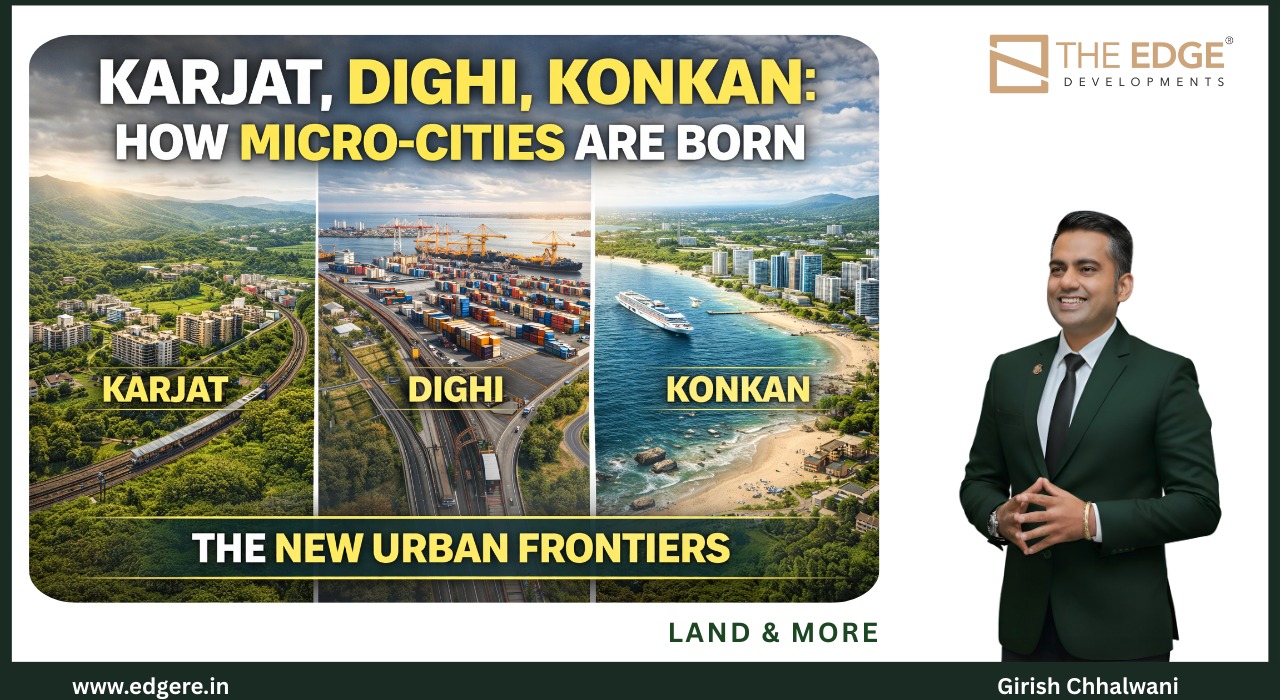
Micro-cities are born when infrastructure, land availability, livability, and economic purpose align at the right moment. Regions like Karjat, Dighi Port, and the Konkan exemplify how small geographies evolve into self-sustaining urban ecosystems—quietly, structurally, and irreversibly.

This is not rapid urbanisation.
It is measured emergence.


What Exactly Is a Micro-City?

Direct answer:
A micro-city is a compact, connected, and purpose-driven urban node that offers employment access, livability, and services without the congestion of a mega metro.

Micro-cities are not suburbs.
They are independent urban organisms.

They typically feature:

  • Proximity to major infrastructure (ports, airports, highways, rail)

  • Available land for planned growth

  • Lower density and better environmental quality

  • A clear economic role (logistics, tourism, education, wellness, industry)

  • Strong connectivity to larger metros


Why Micro-Cities Are Replacing the Old Growth Model

Large metros don’t fail—they overload.

As cities mature:

  • Infrastructure lags

  • Land fragments

  • Commutes lengthen

  • AQI worsens

  • Quality of life erodes

Micro-cities emerge as pressure valves—absorbing growth that the core can no longer handle sustainably.

This is not decentralisation by abandonment.
It is decentralisation by design.


Karjat: From Getaway to Growth Node

Karjat is a textbook example of micro-city formation.

Why Karjat fits the pattern:

  • Strong rail and road connectivity

  • Proximity to major employment zones

  • Abundant land for low-density planning

  • Natural buffers that protect AQI

  • Rising demand for permanent and hybrid living

Karjat didn’t grow because of marketing.
It grew because people chose it—for space, health, and balance.

That choice created:

  • Residential demand

  • Education and hospitality services

  • Local employment

  • Stable, end-user-led growth

This is how micro-cities solidify.


Dighi: When Ports Seed Urban Ecosystems

Ports don’t just move goods.
They anchor economies.

Dighi Port illustrates how industrial and logistics infrastructure triggers micro-city dynamics.

The sequence is predictable:

  1. Port operations expand

  2. Logistics and warehousing cluster

  3. Employment rises

  4. Support housing and services follow

  5. Nearby towns urbanise organically

This growth is not speculative.
It is employment-backed—the most resilient form of urban expansion.


Konkan: The Quiet Geography of the Future

The Konkan region represents a broader micro-city canvas.

Its advantages are structural:

  • Coastline-driven trade and tourism

  • Cleaner air and lower density

  • Expanding road and port connectivity

  • Cultural continuity and livability

  • Large land parcels suitable for planned development

Konkan won’t become one mega city.
It will evolve into a network of micro-cities—each with a distinct role, connected but not congested.

That is modern urban resilience.


How Micro-Cities Actually Form (The Real Sequence)

Answer-first clarity:
Micro-cities do not begin with housing.
They begin with function.

The typical sequence:

  1. Infrastructure arrives

  2. Economic activity anchors

  3. People migrate by choice

  4. Housing follows demand

  5. Social infrastructure matures

  6. Identity forms

When this sequence is respected, cities grow with stability.
When it’s reversed, cities struggle.


Why Micro-Cities Attract Long-Term Capital

Capital seeks predictability, not noise.

Micro-cities offer:

  • Lower entry costs

  • Longer growth runways

  • End-user demand

  • Policy alignment

  • Environmental resilience

They don’t promise overnight returns.
They promise durability.

This is why patient capital enters early—and stays.


What This Means for India’s Urban Future

India doesn’t need more megacities.
It needs many well-designed micro-cities.

Cities that:

  • Breathe

  • Scale

  • Adapt

  • Absorb growth without collapsing

Karjat, Dighi, and the Konkan belt are not exceptions.
They are prototypes.


Final Thought

Cities are no longer born in one dramatic moment.

They form quietly—through movement, choice, and alignment.

The future belongs to places that grow small before they grow big.

That is how micro-cities are born.
And that is how India’s next urban chapter will be written

Mumbai 3.0 Land Investment
How cities are really built — infrastructure-led urban growth in the Mumbai Metropolitan Region
CategoriesMumbai 3.0 tips & tricks

How Cities Are Really Built

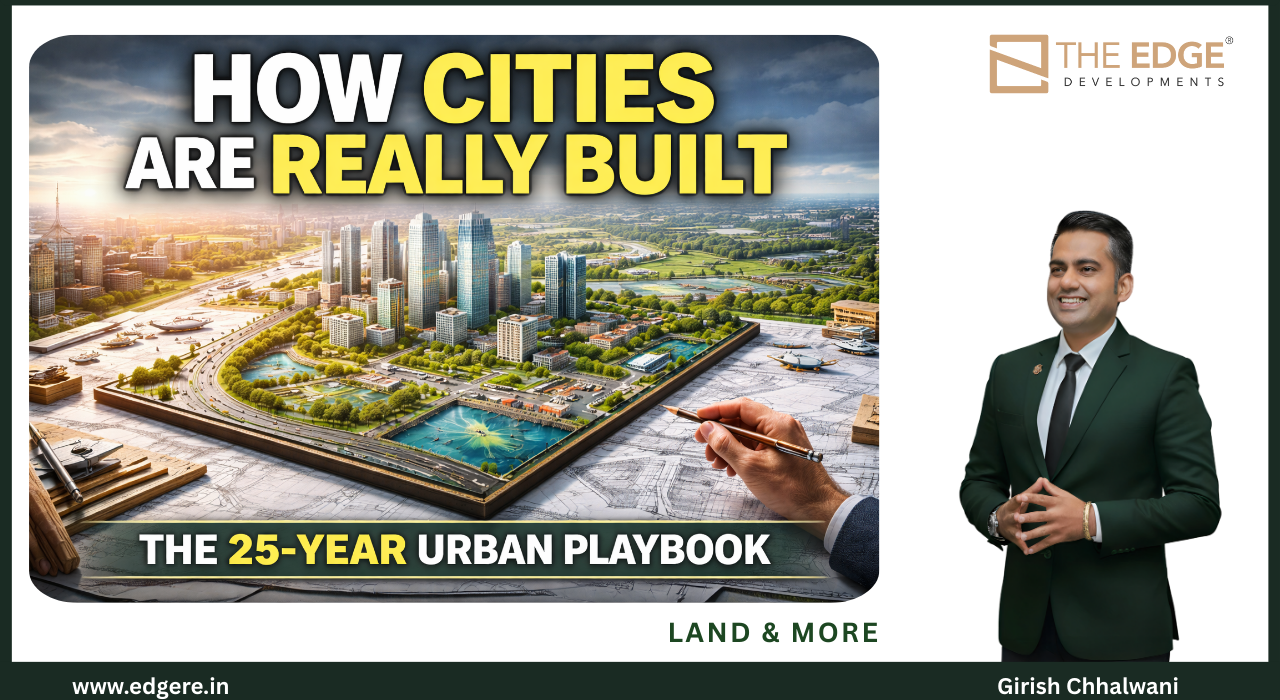
How Cities Are Really Built: A 25-Year Urban Playbook

Short answer:
Cities are not built by buildings, policies, or real estate cycles. They are built over decades through the alignment of land, infrastructure, economics, human behaviour, and governance. When these forces move in the right sequence, cities thrive. When they don’t, cities struggle—no matter how tall they grow.

This is the long game of urban development.
And it always follows a pattern.


Why Most Conversations About Cities Are Incomplete

Urban discussions usually focus on:

  • Housing supply

  • Property prices

  • Infrastructure announcements

  • Smart city branding

These are visible layers.
But cities are shaped much earlier, at levels most people never see.

Cities are not reactions.
They are outcomes.

Understanding how they are really built requires looking at time, not trends.


The 5 Forces That Build Every City

Every successful city—historically and globally—emerges from the interaction of five forces.

1. Land (The Foundation)

Land is the first decision—and the most irreversible one.

Land determines:

  • Density

  • Mobility

  • Infrastructure feasibility

  • Cost of living

  • Environmental resilience

When land is planned early, cities scale gracefully.
When land is misused, cities are forced into congestion and correction.

Land is not an asset class.
It is the DNA of the city.


2. Infrastructure (The Skeleton)

Infrastructure gives land purpose.

Roads, rail, ports, airports, utilities, and digital networks define:

  • How people move

  • Where jobs locate

  • How far cities can stretch

  • Whether growth is inclusive or fractured

Crucially, cities succeed when infrastructure comes before density, not after.

This sequencing alone decides whether a city becomes efficient or exhausting.


3. Economics (The Engine)

Cities exist because of work.

Economic anchors—trade, manufacturing, services, logistics, finance, tourism—give cities relevance.

Without a clear economic role:

  • Housing becomes speculative

  • Infrastructure underutilised

  • Migration unstable

Cities that last are built around function, not aspiration.


4. Human Behaviour (The Catalyst)

This is the most underestimated force.

People decide cities’ futures through:

  • Where they choose to live

  • How far they’re willing to commute

  • What they value (time, air, space, health)

  • How they balance work and life

Infrastructure reshapes behaviour.
Behaviour reshapes cities.

When planning ignores human psychology, cities grow—but people leave.


5. Governance (The Glue)

Governance doesn’t create cities.
But poor governance can destroy them.

Cities need:

  • Predictable policy

  • Long-term vision

  • Institutional continuity

  • Discipline in land use and zoning

The best cities are boring administratively—and brilliant structurally.


The 25-Year City-Building Timeline

Cities don’t appear overnight.
They mature in phases.

Years 0–5: Land & Infrastructure Alignment

  • Land consolidation

  • Connectivity planning

  • Economic intent defined

Years 5–10: Economic Anchoring

  • Jobs arrive

  • Logistics and services cluster

  • Early migration begins

Years 10–15: Residential Formation

  • Housing demand stabilises

  • Social infrastructure develops

  • Communities form

Years 15–20: Urban Identity

  • Culture emerges

  • Institutions strengthen

  • City gains recognition

Years 20–25: Maturity or Stress

  • Well-planned cities scale

  • Poorly planned cities congest

Cities don’t fail suddenly.
They fail when early decisions compound badly.


Why Most Cities Get It Wrong

Common mistakes include:

  • Treating land as inventory, not foundation

  • Allowing density before infrastructure

  • Chasing real estate before employment

  • Ignoring environmental limits

  • Underestimating behaviour shifts

These mistakes don’t show immediately.
They surface 10–15 years later, when correction becomes painful.


Why the Next Cities Will Look Different

Future cities will not compete on:

  • Height

  • Population

  • Density

They will compete on:

  • Livability

  • Air quality

  • Mobility

  • Time efficiency

  • Economic resilience

They will be:

  • Multi-nodal

  • Lower density

  • Infrastructure-first

  • Regionally connected

  • Human-centred

Growth will spread, not stack.


The Investor and Planner’s Reality Check

Answer-first truth:
Cities reward patience, not speed.

The best city-linked opportunities:

  • Appear boring early

  • Mature slowly

  • Compound quietly

  • Endure structurally

Speculation chases headlines.
City-building follows fundamentals.


What This Means for the Next Generation

The cities that succeed over the next 25 years will be those that:

  • Respect land

  • Sequence infrastructure correctly

  • Anchor economies thoughtfully

  • Design for behaviour

  • Govern with restraint

Everything else is decoration.


Final Thought

Cities are not built by ambition alone.

They are built by:

  • Decisions made early

  • Sequencing done right

  • Patience held consistently

Skylines may define a moment.
But cities are shaped by decades of invisible discipline.

Those who understand this don’t just invest in cities.
They help create them.

Mumbai 3.0 Land Investment