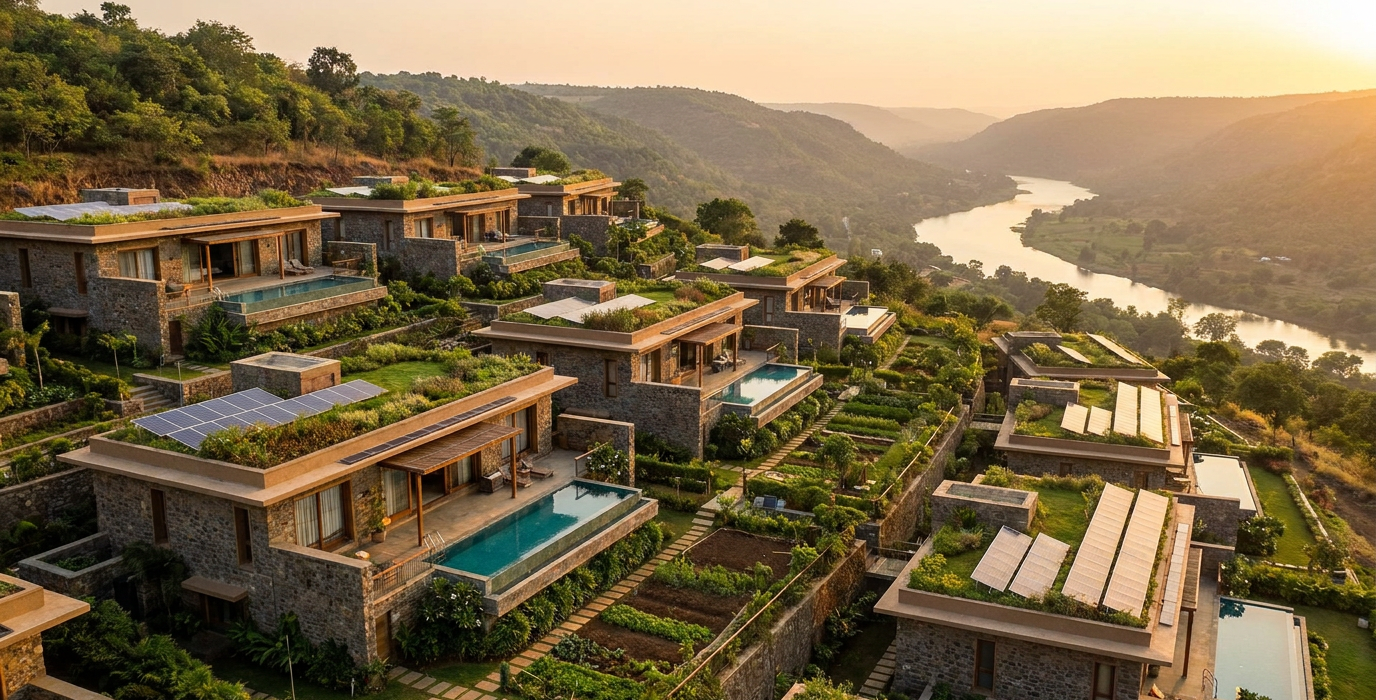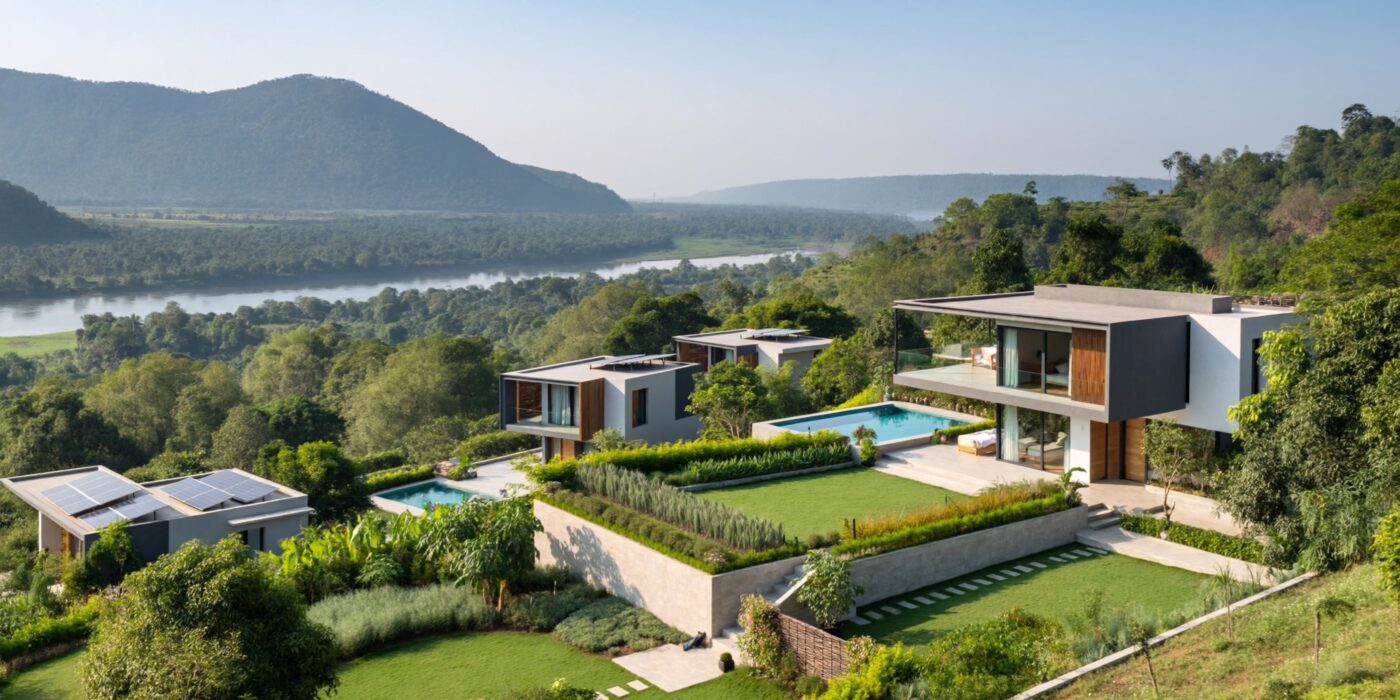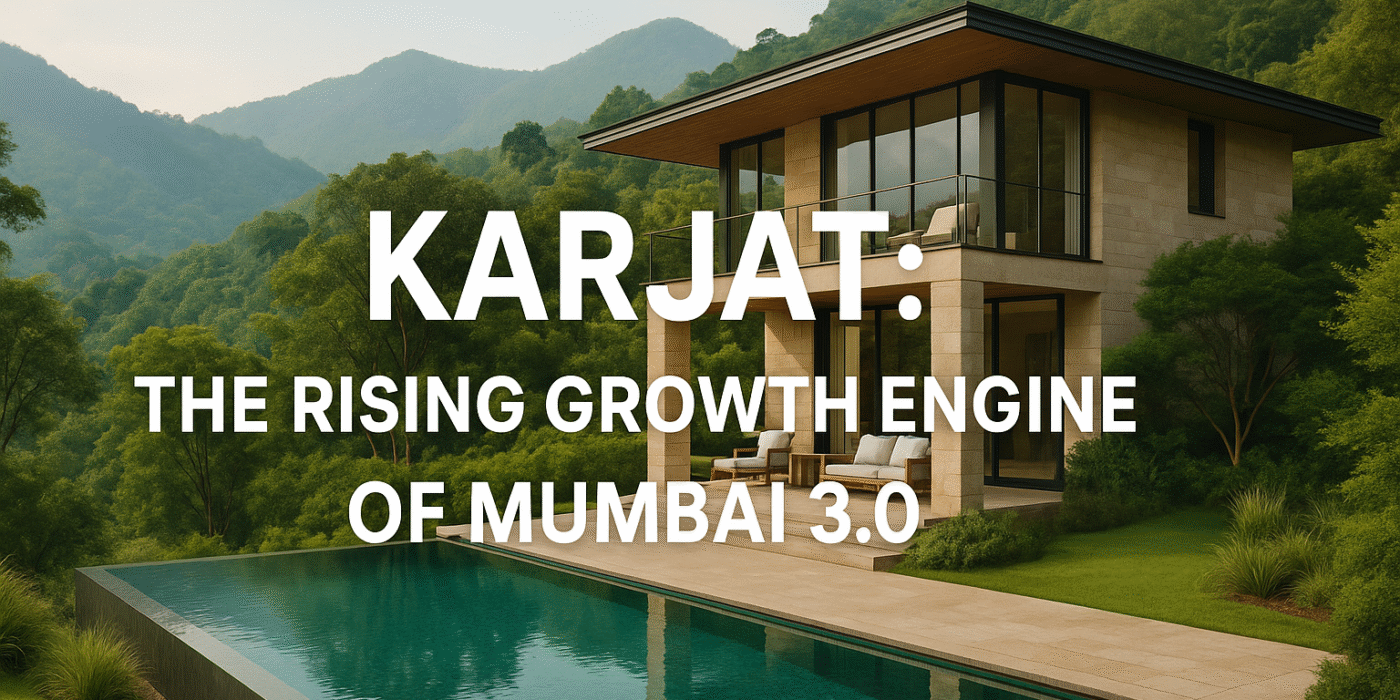
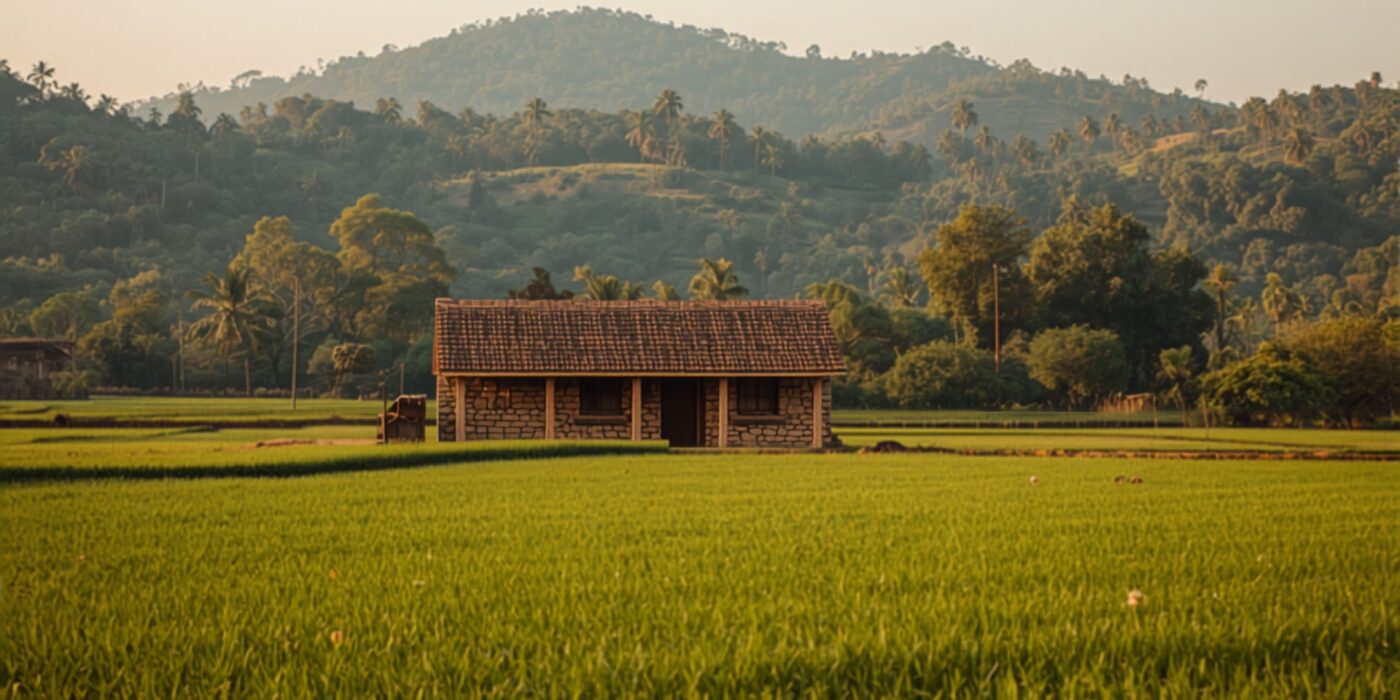
Modern hillside villas with private pools and lush landscaping overlooking a river valley and distant mountains.
CategoriesEco Living Uncategorized Weekend Homes

Sustainable Living Near Mumbai: Top Locations, Lifestyle & Investment Guide 2025

Sustainable Living Near Mumbai: Top Locations, Lifestyle & Investment Guide 2025

The concept of sustainable living near Mumbai has moved from fringe ideology to mainstream investment thesis. In 2025, more Mumbai families than ever are actively searching for ways to live more intentionally — with clean air, organic food sources, natural building materials, and genuine community — while remaining within reach of the city for work and family.

This guide by Girish Chhalwani, Founder & CEO of THE EDGE Developments, maps the best sustainable living destinations near Mumbai, what “sustainable” actually means in the context of near-Mumbai real estate, and how eco-conscious living overlaps with sound investment strategy.


What Does Sustainable Living Near Mumbai Actually Mean?

In the context of near-Mumbai real estate, sustainable living encompasses several dimensions that buyers increasingly treat as non-negotiable:

  • Air quality: Living where the AQI is below 60 (Good category) year-round — a threshold Mumbai’s urban core rarely meets. Karjat, Alibaug, and Bhimashankar-Chowk all qualify.
  • Water independence: Access to borewell water, rainwater harvesting, or natural springs — not dependence on municipal supply that can be intermittent and chemically treated.
  • Food production: Space to grow vegetables, herbs, or fruit trees. Even a 3,000 sq.ft. NA plot can support meaningful kitchen garden production.
  • Natural building materials: Bamboo, stone, lime plaster, and timber — structures that breathe, regulate temperature naturally, and carry no toxic off-gassing from synthetic construction materials.
  • Community: Living among like-minded families with shared values around nature, children’s education, and intentional lifestyle choices.

Top Locations for Sustainable Living Near Mumbai

1. Karjat — Best Overall for Sustainable Living Investment

Karjat leads the near-Mumbai sustainable living landscape for a compelling combination of reasons: AQI consistently below 65, river valley setting with abundant ground water, cooler temperatures (3-5°C below Mumbai on summer days), well-established rail connectivity (Karjat railway station on the Central line), and a growing community of relocating urban families building their second and primary homes here.

THE EDGE Developments’ Edge County Estate is designed around sustainable luxury principles — bamboo and natural stone architecture, passive cooling design, and a site ecology that is enhanced rather than disrupted by development.

Sustainable living indicators: AQI 40-65, groundwater table high (3-8m depth in many areas), average summer temperature 32-35°C (vs. 38-42°C in Mumbai), river frontage available in multiple sub-locations.

2. Bhimashankar-Chowk Corridor — Best for Deep Eco Living

The Bhimashankar Wildlife Sanctuary and the Chowk valley below it represent the most genuinely wild, ecologically rich corridor within 3 hours of Mumbai. This is not mainstream real estate — it is for buyers who want deep immersion in forest living, wildlife proximity, and a near-complete disconnection from urban density.

Sustainable living here means: perennial streams, 100% renewable energy feasibility, organic farm potential on red-laterite soil, and air quality that is exceptional year-round (AQI 25-45). The trade-off: limited social infrastructure, no railway, and an investor market that is early-stage and illiquid.

3. Shrivardhan-Murud (Konkan Coast) — Best for Coastal Sustainable Living

For families drawn to the ocean, Shrivardhan and Murud on the Konkan coast offer a sustainable coastal lifestyle that is almost extinct within 4 hours of any major Indian city. Fishing villages, organic coconut and cashew cultivation, tidal creeks, and sea breezes create a genuinely different quality of life from anything available closer to Mumbai.

With Dighi Port development still in early stages, the pace of change here is slow — which is precisely its appeal for families seeking sustainable lifestyle over rapid urban development.

4. Alibaug — Best Established Sustainable Luxury

Alibaug has led the near-Mumbai eco-luxury market for two decades. Biodynamic farms, farm-to-table restaurants, wellness retreats, and a community of design-conscious, sustainably-minded families make it the most developed sustainable living ecosystem near Mumbai. Price reflects this maturity — but the lifestyle infrastructure is unmatched.

5. Khopoli-Khandala Hills — Best for Elevation Living

The elevated terrain between Khopoli and Khandala (550-780m above sea level) offers natural climate control that no other near-Mumbai location can match — temperatures 6-8°C below Mumbai even in peak summer, morning cloud cover, and dramatic Western Ghats scenery. The Second Mumbai-Pune Expressway is improving access dramatically.


Sustainable Architecture for Near-Mumbai Homes

The most forward-thinking sustainable homes near Mumbai in 2025 share these design principles:

  • Passive cooling: Orientation-optimised design that minimises east and west solar gain, cross-ventilated floor plans, verandah shading. Reduces or eliminates air conditioning requirement in Karjat and Konkan coastal settings.
  • Natural materials: Bamboo (the fastest-renewable structural material; tensile strength comparable to steel), locally quarried stone (shaley basalt in Raigad district), lime plaster (breathable, no VOC), and timber from certified sustainable sources.
  • Water systems: Rainwater harvesting integrated into roof and landscape design; greywater recycling; drip irrigation for food gardens; borewell as primary water source.
  • Energy: Solar PV with battery storage as primary power source — economically viable and increasingly affordable in 2025. Grid connection maintained as backup only.
  • Waste: Composting systems for organic waste; biogas from kitchen waste is viable at the scale of a family home; zero plastic construction materials.

Is Sustainable Living Near Mumbai a Good Investment?

Yes — and the financial case has strengthened in recent years for three reasons:

  1. Demand growth: Post-pandemic research consistently shows that proximity to nature, clean air, and space are top-ranked factors in home-buying decisions for the upper-income segment. This demand is structural, not cyclical.
  2. Supply scarcity: Well-designed, genuinely sustainable eco-luxury properties near Mumbai are extremely scarce. Supply is limited by land availability, regulatory complexity, and the expertise required to execute authentic sustainable design.
  3. Premium pricing: Sustainable eco-luxury properties near Mumbai command a 20-35% premium over conventional construction in the same micro-location — and the premium is widening as awareness grows.

For investors, this means sustainable living properties near Mumbai are not just a lifestyle choice — they are a category with structural supply-demand imbalance favouring price appreciation.


Explore THE EDGE’s approach to sustainable eco-luxury living: Edge County Estate — Karjat’s Premier Eco-Luxury Villa Project

Understand the Mumbai 3.0 growth map: What Is Mumbai 3.0? The Vision Redefining Urban Growth in MMR


About the Author

Girish Chhalwani is the Founder & CEO of THE EDGE Developments, a Mumbai-based real estate strategist with 20+ years of experience across 45+ project launches and ₹8,500 Cr in influenced real estate transactions in the Mumbai Metropolitan Region. He specialises in land investment, NA plots, branded plotted developments, and eco-luxury villa advisory in Karjat and the wider MMR. Read Girish’s full profile →

THE EDGE Developments — Sustainable Living Near Mumbai

Girish Chhalwani is a visionary real estate leader known for his ability to identify, evaluate, and unlock land value with precision and foresight. A Business Management graduate from the University of Mumbai, he has strengthened his expertise with a PGDFM, an MBA in Marketing, and global certifications in Change Management, Strategy Management (IBMI, Germany), Digital Marketing (Google), and Strategic Sales Negotiation (Mercuri Goldman). This blend of academic rigour and on-ground experience gives him a rare combination of strategic clarity, operational depth, and market intelligence. Before establishing THE EDGE in 2017, Girish held leadership roles across renowned real estate organisations including Lodha Group, Bhairaav Group, and Adhiraj Capital City. He has successfully built and led diverse business verticals of Channel & Distribution Sales—also played a key role in Lodha Group’s expansion into the South East Asia & GCC market. As the founder of THE EDGE Developments, Girish specialises in land identification, acquisition processes, regulatory navigation, pricing structure, and market positioning. His deep understanding of land development enables the creation of plotted communities, villa estates, and large-scale developments that are aligned with future demand and long-term value creation. From Sales Manager to Business Architect His journey began on the ground — as a multi-ticket sales closer at Lodha. He soon moved into cross-functional leadership roles, contributing to channel strategy, international sales, product planning, and marketing — even generating significant revenue from regions like Southeast Asia and Dubai. By 2015, Girish had internalized the DNA of real estate scaling — and chose to channel that insight into building his own Business & Corporate Advisory. He has led over 45+ project launches, partnered with and executed 250+ marketing campaigns — directly or strategically influencing over ₹8,500 Cr in sales as Professional & Entrepreneur. As he founded a specialized Development vertical within The Edge, Girish also drives plotted developments, joint ventures, and luxury villa communities — especially in emerging markets like Karjat, Pali, Khopoli, and Raigad (Mumbai 3.0). His expertise in regulatory navigation, land structuring, and market mapping helps unlock long-term value for landowners and investors.
CategoriesEco Living tips & tricks

Why Clean Air Will Decide Where Cities Grow

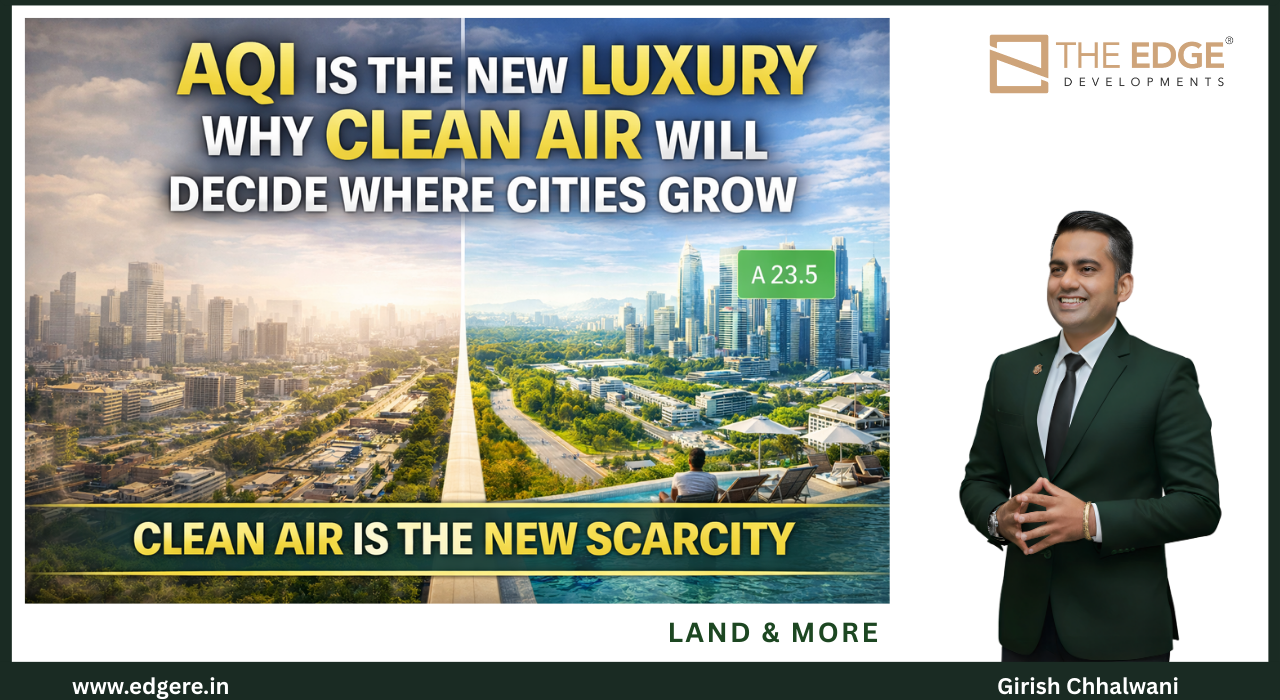
AQI Is the New Luxury: Why Clean Air Will Decide Where Cities Grow


Clean air has become a scarce resource in modern cities. As air quality deteriorates in dense urban cores, people, capital, and future cities are increasingly moving toward regions that offer lower AQI, open land, and healthier living conditions.

Air is no longer invisible.
It is now decisive.


When Pollution Becomes Personal

For decades, pollution was treated as an abstract statistic — something governments measured and citizens tolerated.

That era is over.

Today, people track AQI the way they once tracked stock prices.
They plan weekends around it.
They choose homes, schools, and even careers based on it.

When air affects:

  • Children’s health

  • Elderly longevity

  • Daily energy levels

  • Mental well-being

It stops being an environmental issue.
It becomes a lifestyle decision.


Why AQI Is Now a Migration Trigger

Direct answer:
People don’t leave cities because of ambition loss.
They leave because pollution erodes quality of life faster than opportunity compensates.

When:

  • Asthma increases

  • Allergies worsen

  • Outdoor life disappears

  • Medical costs rise

The city starts extracting a hidden tax.

Once that tax becomes visible, migration follows.


The Shift From Proximity to Well-Being

Earlier generations chose cities for:

  • Jobs

  • Connectivity

  • Status

Today’s choices look different:

  • Health over hierarchy

  • Space over skyline

  • Air over address

  • Time over traffic

This doesn’t mean cities will empty.
It means growth will redirect.

Cities that cannot improve AQI will lose residents to places that already have what money can’t buy: clean air.


Why Clean Air Regions Are Becoming the Next Growth Zones

Regions with:

  • Lower population density

  • Natural buffers (forests, hills, coastlines)

  • Horizontal growth potential

  • Planned infrastructure

have a structural advantage.

They attract:

  • Families

  • Remote professionals

  • Wellness-driven communities

  • Long-term residents

This is why towns once considered “too far” are now seen as future-ready.

Not because they are cheaper —
but because they are healthier.


AQI and the Rise of Low-Density Urbanism

High-density cities struggle to fix AQI quickly.
Low-density regions protect it naturally.

This is pushing demand toward:

  • Plotted developments

  • Villa communities

  • Green townships

  • Nature-integrated housing

People are no longer impressed by towers if they can’t open windows.

Urban growth is slowly shifting from vertical density to horizontal dignity.


Why This Changes Real Estate Economics Permanently

Answer-first insight:
AQI converts environmental quality into economic value.

Land in cleaner regions appreciates because:

  • Demand is lifestyle-driven

  • Migration is end-user led

  • Supply remains limited

  • Retention is higher

This creates stable, long-term demand, not speculative spikes.

Air quality doesn’t fluctuate daily the way markets do.
Its impact compounds over time.


Why Governments Will Follow This Shift

Policy always follows people.

As migration patterns change, governments are forced to:

  • Invest in cleaner growth zones

  • Improve regional infrastructure

  • Encourage decentralisation

  • Reduce pressure on polluted cores

AQI is quietly shaping urban policy — even when it’s not openly acknowledged.


What This Means for the Future of Cities

Cities of the future will compete on:

  • Air quality

  • Water quality

  • Open space

  • Health infrastructure

  • Environmental resilience

GDP alone won’t define success.
Livability metrics will.

The most successful cities won’t just offer jobs.
They will offer longer, healthier lives.


The Hard Truth

You can’t filter air forever.
You can’t mask pollution with branding.
You can’t compensate poor health with higher income.

Eventually, people choose what sustains them.

That choice is reshaping where cities grow.


Final Thought

In the next decade, wealth will follow wellness.

And wellness begins with breath.

AQI is no longer an environmental statistic.
It is the new luxury signal — and the strongest predictor of where tomorrow’s cities will rise

Mumbai 3.0 Land Investment
AQI Is the New Luxury
CategoriesEco Living Market Insights tips & tricks

AQI Is the New Luxury

AQI Is the New Luxury

For decades, luxury was defined by what you could see.
Sea views. Marble floors. Height, glass, scale.

Today, luxury is increasingly defined by what you cannot see — the air you breathe.

In a city like Mumbai, where air quality alerts have become routine, AQI numbers are quietly replacing pin codes as markers of privilege. Clean air has become scarce, and scarcity has a way of redefining value.

The photograph captures a simple moment — standing under an old banyan tree, surrounded by earth, shade, and silence. No skyline. No traffic. No honking. Just breathable air. And that is precisely the point.

Air used to be free.
Now, it is negotiated.

Urban life has normalised compromise. We accept air purifiers as furniture, masks as accessories, and respiratory issues as “part of city life.” Children grow up indoors not by choice, but by necessity. Morning walks are timed not to sunrise, but to pollution charts.

This is where the conversation around Mumbai 3.0 becomes relevant — not as a real estate headline, but as a lifestyle correction.

As infrastructure pushes outward and connectivity improves, regions like Karjat and Khopoli are no longer distant retreats. They are becoming natural extensions of Mumbai’s future — places where development and ecology still coexist. Better road and rail links are compressing distances, but what truly differentiates these regions is not accessibility alone — it is air quality, green cover, and breathing space.

This isn’t nostalgia.It’s data.

Medical costs linked to pollution are rising. Productivity is impacted. Lifestyle diseases are appearing earlier. Increasingly, homebuyers and land investors are asking a new question before committing capital:

“What will my lungs experience here over the next 20 years?”

Low-density developments, nature-led planning, and land parcels around Karjat–Khopoli are not indulgences anymore. They are long-term health decisions. Investments not just in real estate, but in respiration, immunity, and mental clarity.

Luxury was once about adding more.
Now it’s about removing what harms you.

Noise. Congestion. Pollution. Anxiety.

In the coming decade, the most premium developments will not be defined by height or hardware. They will be defined by AQI levels, wind flow, green buffers, water tables, and distance from urban stress.

Because when everything else is available,
clean air becomes the ultimate upgrade.

AQI isn’t just a number anymore.
It’s the new luxury benchmark.

THE EDGE – Real Estate Development’s
Girish Chhalwani 🧑🏻‍✈️
www.edgere.in

Mumbai 3.0 Land Investment
Discover why Karjat’s land prices are booming. Airport influence, better connectivity, luxury projects, and strong rentals make it a high-growth MMR hotspot.
CategoriesEco Living Land Investment tips & tricks

Karjat Property Growth Explained: Infrastructure, Demand & ROI

Karjat: The New Epicentre of Land Growth in MMR

Karjat is emerging as one of the fastest-growing land investment destinations in the Mumbai Metropolitan Region (MMR). Backed by major infrastructure upgrades, rising demand for second homes, and a growing preference for sustainable, nature-led living, the region is witnessing unprecedented appreciation across land categories — from agricultural plots to premium villa estates.

Over the last decade, Karjat has transitioned from a quiet weekend getaway to a high-return investment hotspot, with farmland prices increasing by over 1,100%, and residential development demand hitting record highs. Its strategic location, scenic environment, and enhanced connectivity have positioned Karjat as a prime zone for both investors and lifestyle buyers.


Key Drivers of Karjat’s Land Growth

1. Massive Infrastructural Development

Karjat’s real transformation is powered by large-scale infrastructure projects that are redefining mobility and accessibility:

  • Navi Mumbai International Airport (NMIA):
    The airport’s influence zone extends deep into Karjat, creating demand for hospitality, rentals, second homes, and plotted development.

  • Enhanced Road Connectivity:
    New highway upgrades and the upcoming Karjat–Bhimashankar Road are strengthening Karjat’s link to Panvel, Navi Mumbai, and Pune.

  • Improved Rail Access:
    The Panvel–Karjat double-tracking and frequency upgrades are making Karjat more accessible for daily commuters and long-term residents.

These enhancements are turning Karjat into a seamlessly connected micro-city, directly benefiting land valuations.


2. Rising Demand for Second Homes & Rentals

Karjat’s natural beauty, lower pollution levels, and peaceful surroundings have sparked a boom in:

  • Weekend homes

  • Farmhouses

  • Airbnb-friendly properties

  • Boutique resorts

  • Wellness retreats

Investors are increasingly drawn by high rental yields, especially during weekends, holidays, and festive seasons. For many, Karjat is now the go-to destination for passive income through rentals.


3. Growth in Luxury & Sustainable Developments

Karjat is witnessing an influx of premium and eco-friendly residential projects:

  • Luxury villas

  • Gated communities

  • Resort-style developments

  • Sustainable estates with solar energy and rainwater harvesting

  • Nature-integrated homes with landscaped gardens and private pools

This upscale development trend is attracting HNIs, NRIs, and Mumbai families seeking a healthy, low-density lifestyle without compromising on comfort.


4. Affordability With Strong Appreciation Potential

Compared to Mumbai, Navi Mumbai, and Thane, Karjat offers:

  • Lower entry prices

  • Larger plots

  • Higher appreciation potential

  • Better long-term value

With development accelerating and land supply limited, appreciation is expected to continue rising for the next decade.


Investment Outlook: Why Karjat Is a Smart Bet

  • Over 1100% appreciation in farmland prices over the past 10 years.

  • Continuous demand from investors, second-home buyers, and weekend travelers.

  • Low supply of premium land parcels, leading to future price pressure.

  • Ideal for long-term capital growth and short-term rental income.

  • Perfect for hybrid living, sustainable communities, and luxury villa projects.

Karjat’s rare combination of affordability, appreciation, natural environment, and infrastructure-backed growth makes it one of the strongest land investment markets in MMR right now.


Final Word

Karjat is no longer just a serene escape — it is a high-growth, long-term investment corridor aligned with Mumbai 3.0’s future development blueprint. With connectivity improving, demand rising, and lifestyle shifts accelerating, the region is primed for sustained expansion.

For investors looking to build wealth through land, Karjat is not just an opportunity —
it is one of the smartest investment decisions of this decade.

Looking to invest in Karjat? Explore Edge County Estate — 6 exclusive Mediterranean-inspired eco-luxury villas in Karjat by THE EDGE Developments. Clear-title NA plots, RERA compliant, 55 minutes from Navi Mumbai Airport. View the project →


Mumbai 3.0 Land Investment
Plots or land at karjat
CategoriesEco Living Mumbai 3.0 tips & tricks

Karjat: The Green Powerhouse Fueling Mumbai 3.0’s Next Wave of Growth

Karjat: The Green Powerhouse Fueling Mumbai 3.0’s Next Wave of Growth

As Mumbai enters the era of Mumbai 3.0—a strategic expansion marked by smart infrastructure, multi-nodal development, and global-standard planning—one region is quietly but decisively rising to the forefront: Karjat.
Once seen as a quaint nature escape, Karjat is now evolving into one of MMR’s most powerful growth engines, driven by connectivity upgrades, land availability, and an evolving urban mindset that prioritizes sustainability and space.

Today, Karjat is no longer “outside Mumbai.”
It is the new frontier of Mumbai.


Why Karjat Matters in Mumbai 3.0

Mumbai 3.0 is not just about horizontal expansion—it’s about creating liveable, connected, future-ready satellite cities that ease pressure from the core while fueling new economic corridors.
In this blueprint, Karjat occupies a strategic, high-impact position.

According to Girish Chhalwani, Founder & CEO of THE EDGE Developments,
“Karjat offers the purest version of what Mumbai 3.0 wants to build—nature, connectivity, land, and long-term expansion capacity. It is positioned to become one of the strongest residential and investment hubs of the next decade.”

Karjat’s transformation reflects a shift in how Mumbai thinks about growth:
from vertical congestion to horizontal, sustainable development.


The Infrastructure Wave Redefining Karjat

Karjat’s rise is not accidental—it is the result of multiple mega infrastructure projects converging around the region:

1. Panvel–Karjat Railway Upgrade

Improved frequency and upcoming enhancements will reduce commute time to Navi Mumbai, Panvel, and major employment hubs, making Karjat a viable residential zone for working professionals.

2. Navi Mumbai International Airport (NMIA)

Karjat falls within the airport’s influence zone—an economic magnet that historically transforms land value, job creation, hospitality, and commercial activity.

3. Virar–Alibaug Multimodal Corridor

One of Maharashtra’s largest mobility projects, it will connect Karjat directly to major industrial and residential zones across MMR.

4. Karjat–Bhimashankar Highway

This upcoming corridor will unlock Karjat’s untouched hinterland, opening vast opportunities for plotted development, tourism, and weekend homes.

Combined, these projects position Karjat as a connectivity-rich transit hub, capable of absorbing future urban expansion in a structured manner.


Karjat: MMR’s New Residential & Lifestyle Capital

As buyers increasingly look beyond saturated Mumbai and Navi Mumbai markets, Karjat has emerged as a balanced residential destination offering:

  • Green landscapes and open spaces

  • Significantly lower population density

  • Larger land parcels and better living standards

  • Modern plotting and villa communities

  • Affordability with long-term appreciation

  • A growing cluster of schools, resorts, restaurants, and wellness retreats

The shift toward hybrid work and lifestyle-driven housing has accelerated demand.
Families from Mumbai, Navi Mumbai, Thane, and Pune are now exploring Karjat as a primary or second-home location.

Chhalwani explains:
“Karjat offers the perfect mix—affordable entry, high appreciation potential, and a quality of life that’s impossible to find in traditional suburbs.”


The Rise of Weekend Homes and Nature-Led Living

Karjat has become the epicentre of weekend home investing in MMR.
Buyers today look for:

  • Privacy

  • Greenscapes

  • Cleaner air

  • Waterfalls, hills, and nature trails

  • Large plots for villas and retreats

Many developers believe Karjat will become the Bisleri belt of MMR—where clean air, clean water, and wellness become its economic identity.

This shift is not just lifestyle—it’s economic.
Weekend homes are fuelling construction, local employment, tourism, and hospitality, transforming Karjat into a self-sustaining micro-economy.


Karjat as a Future Economic Sub-Center

Karjat’s land availability (unlike the constrained island city) allows it to evolve into:

  • Tourism and hospitality hubs

  • Education clusters

  • Health & wellness districts

  • Eco-friendly manufacturing pockets

  • Senior-living communities

  • Digital/remote-work townships

  • Warehousing & logistics centres

Its proximity to two major cities—Mumbai and Pune—makes it a natural midpoint for future growth, similar to how Gurugram emerged for Delhi.


Investment Outlook: The Smart Bet of Mumbai 3.0

THE EDGE’s research shows the following trends driving investor interest:

  • Land prices in Karjat have appreciated steadily over the past five years.

  • Plotting projects and villa communities are seeing high absorption.

  • End-user demand is rising, not just speculative buying.

  • Developers are entering the region earlier than they did in Navi Mumbai.

  • Infrastructure delivery timelines are improving district-wide.

In simple words:
Karjat today is where Navi Mumbai was 15 years ago.
And that window will not remain open for long.


Challenges to Address

Karjat’s growth must balance:

  • Environmental and ecological preservation

  • Infrastructure rollout timelines

  • High-quality, low-density planning

  • Transparent land consolidation processes

Experts emphasize that the region’s long-term success relies on sustainable execution, not rushed construction.


Conclusion: Karjat — The Green Superpower of Mumbai 3.0

Karjat represents the new philosophy of Mumbai’s growth:
decentralized, connected, sustainable, and nature-driven.

With mega infrastructure, land-driven affordability, and rising investor confidence, Karjat is moving from a weekend retreat to a core pillar of Mumbai 3.0’s expansion strategy.

As Girish Chhalwani summarizes:
“Karjat is not just a destination—it is the future foundation of Mumbai’s next phase of urban evolution.”

Mumbai 3.0 Land Investment
Why Rich Buyers Prefer Second Homes in Nature—Not Luxury Towers Anymore
CategoriesEco Living tips & tricks Weekend Homes

Why Rich Buyers Prefer Second Homes in Nature

Why Rich Buyers Prefer Second Homes in Nature—Not Luxury Towers Anymore

There’s a significant shift happening in India’s high-end real estate market. HNIs (High Net-Worth Individuals) are no longer chasing luxury towers in metros — they’re choosing second homes nestled in nature.

Here’s why this trend is growing rapidly:

✅ 1. Post-Pandemic Lifestyle Reset

The pandemic changed how people value space, privacy, and wellness. Being stuck indoors made even the most luxurious apartments feel limiting. Buyers now want open land, natural surroundings, and freedom of movement.


✅ 2. Rise of Return on Experience (ROE)

Wealthy individuals are no longer only seeking ROI. They want ROE — Return on Emotions. Weekend homes offer peace of mind, wellness-focused living, and a connection with nature that high-rises simply can’t match.


✅ 3. Land Appreciation vs. Apartment Depreciation

Unlike high-rise apartments, plotted developments and land parcels have historically shown stronger appreciation over the long term. Second homes often double as smart long-term investments.


✅ 4. Privacy and Control

Second homes in nature provide full ownership and control — no society meetings, no shared elevators, and no overcrowding. It’s exclusive, personal, and often custom-built.


✅ 5. Shift in Definition of Luxury

Modern luxury is no longer about chandeliers and concierge desks. It’s about silence, space, fresh air, and self-sustainability. Nature offers a sense of exclusivity that even the most expensive buildings can’t replicate.


✅ 6. Better Inheritance Value

HNIs increasingly see land or second homes as long-term legacy assets. They offer emotional and tangible value to the next generation — unlike urban apartments with rising maintenance and depreciating interiors.

✅ 7. Emerging Hotspots Near Metros

Places like Alibaug, Karjat, Pali, Lonavala, Neral, and Mulshi are seeing a surge in second home developments. Proximity to Mumbai and Pune combined with upcoming infrastructure projects (like new expressways and rail links) are making these destinations highly attractive.


🎯 Conclusion:

The definition of aspirational real estate is evolving. India’s wealthy are no longer chasing sky-high apartments — they’re investing in serenity, space, and sustainability.

LANDS IN MUMBAI 3.0
CategoriesEco Living tips & tricks Weekend Homes

Maharashtra’s Emerging Eco-Luxury Corridor — A Journey Into a Future-Ready Lifestyle

We invite you to journey with us to Chowk-Karjat, a once-sleepy junction nestled amid the scenic landscapes of Maharashtra. For years, it was a tranquil weekend retreat where city dwellers escaped for brief respites. Today, however, it is transforming before our eyes into something far grander—a vibrant eco-luxury corridor that harmoniously blends nature’s serenity with the pulse of modern infrastructure and lifestyle.

The Shift in How We Choose Homes

We have all noticed how the pandemic changed our relationship with our homes. What was once just a place to sleep became our sanctuary, workspace, and wellness zone. This shift sparked a nationwide surge in demand for second homes—sanctuaries away from the city bustle, where fresh air and open horizons promise a better quality of life.

Here in Chowk-Karjat, this trend is palpable. We have seen buyers and investors alike flock to this corridor, drawn by the promise of eco-friendly living, wellness-focused amenities, and the chance to connect with nature daily. What excites us even more is how Chowk-Karjat is not only a weekend hideaway anymore but is fast becoming a favored choice for first-home seekers. It is no longer just about occasional escapes; it is about building a future and a community.

Transforming Connectivity — Bringing Us Closer

We marvel at the spectacular infrastructure developments that have rewritten the rules of accessibility. Consider the Atal Setu, India’s longest sea bridge, which dramatically cut travel time from South Mumbai to Chowk-Karjat to just about 75 minutes. What before took more than two hours is now less than a comfortable drive.

And the journey continues with the massive investment in the ₹4,500 crore JNPT-Chowk Highway. This six-lane corridor is more than a road; it is a lifeline weaving tourism, business, and residential life together. The impending Navi Mumbai International Airport adds yet another vital link, promising economic and employment boons that ripple through the region.

Together, these projects redefine Chowk-Karjat’s accessibility, opening its doors wider to residents, investors, and weekend visitors alike

Breathing Easy — The Wellness Edge

We often hear city-dwellers yearning for cleaner air, tranquil surroundings, and a slower pace. At Chowk-Karjat, the Air Quality Index stands proudly at 54, marked as “Good.” This is more than a statistic—it is a testament to the region’s promise of wellness, health, and rejuvenation.

Imagine waking up to fresh air, spending mornings walking along riverside paths or hiking lush trails, and evenings under star-lit skies. This is the lifestyle that Chowk-Karjat offers, attracting wellness seekers, elder communities, and those who embrace eco-conscious living.

Hospitality and Fine Dining Growth

We celebrate the rapid expansion of luxury hospitality and curated dining that marks Chowk-Karjat’s rise. Leading the hospitality scene are notable establishments like Radisson Blu Plaza Resort & Convention Centre, The Forest Club Resort, U Rivergate Karjat, and Oleander Farms. These venues offer more than just accommodation—they provide convention facilities, riverside stays, and boutique experiences that make every visit memorable.

The culinary landscape has also blossomed. Dining options such as Saltt Restaurant & Bar, Common House, Saltt Coffee House, Deewan Khana, and Saffron deliver gourmet and artisanal experiences that rival those of more established destinations. This impressive combination has elevated Chowk-Karjat’s image from a rustic weekend spot to a refined, luxury lifestyle destination.

Social Infrastructure for Everyday Living

We appreciate how Chowk-Karjat has matured into a socially self-sufficient hub beyond its scenic allure. Established schools like Hiranandani School (Fortune City) and Reliance Township, complemented by upcoming international schools, ensure quality educational access for families. Healthcare needs are supported by prominent institutions including Dhirubhai Ambani Hospital, alongside local clinics and wellness centres.

Retail requirements are met seamlessly through outlets such as DMart, boutique stores, and local markets, making daily life convenient. Additionally, recreational amenities abound including trekking trails, golf courses, riverside walks, and vibrant cultural centres that foster community connection and enjoyment.

Investor and NRI Interest

We recognize the heightened interest from non-resident Indians and savvy investors who seek long-term property appreciation combined with premium lifestyle options. Chowk-Karjat’s strategic location between Mumbai and Pune, paired with its growing luxury offerings, makes it a hotspot for discerning buyers.

Celebrity and industrialist investments have further amplified its aspirational appeal, reinforcing Chowk-Karjat’s position as Maharashtra’s luxury real estate frontier.

Investing in Tomorrow — Growth and Opportunity

It is impossible not to notice the buzz from investors and NRIs recognizing Chowk-Karjat’s potential. With forecasted property appreciation of 25-30% in the next three to five years, this corridor promises significant returns alongside lifestyle benefits. Celebrity endorsements and industrialist investments have added shine and credibility to this burgeoning real estate market.

Looking ahead, government initiatives underscore Chowk-Karjat’s sustainable growth—smart city developments, renewable energy hubs, metro expansion, and water management policies working in tandem to create a resilient and liveable future.

Vision 2030 — A Lifestyle Capital

What will Chowk-Karjat look like in a few years? We envision an integrated township where eco-luxury villas coexist with wellness hubs, branded residences, and cultural tourism experiences. By 2030, this corridor is set to become Maharashtra’s lifestyle capital, where investment opportunity meets the promise of high-quality living.

Closing Thoughts

As we stand witness to Chowk-Karjat’s exciting evolution, we recognize it as more than a location—it is a narrative of transformation and hope. From a quiet weekend escape to a future-ready, commuter-friendly eco-luxury corridor, it invites us all to imagine a life enriched by nature, connectivity, wellness, and community. Together, we step into this promising chapter, ready to embrace the best that Maharashtra has to offer.