
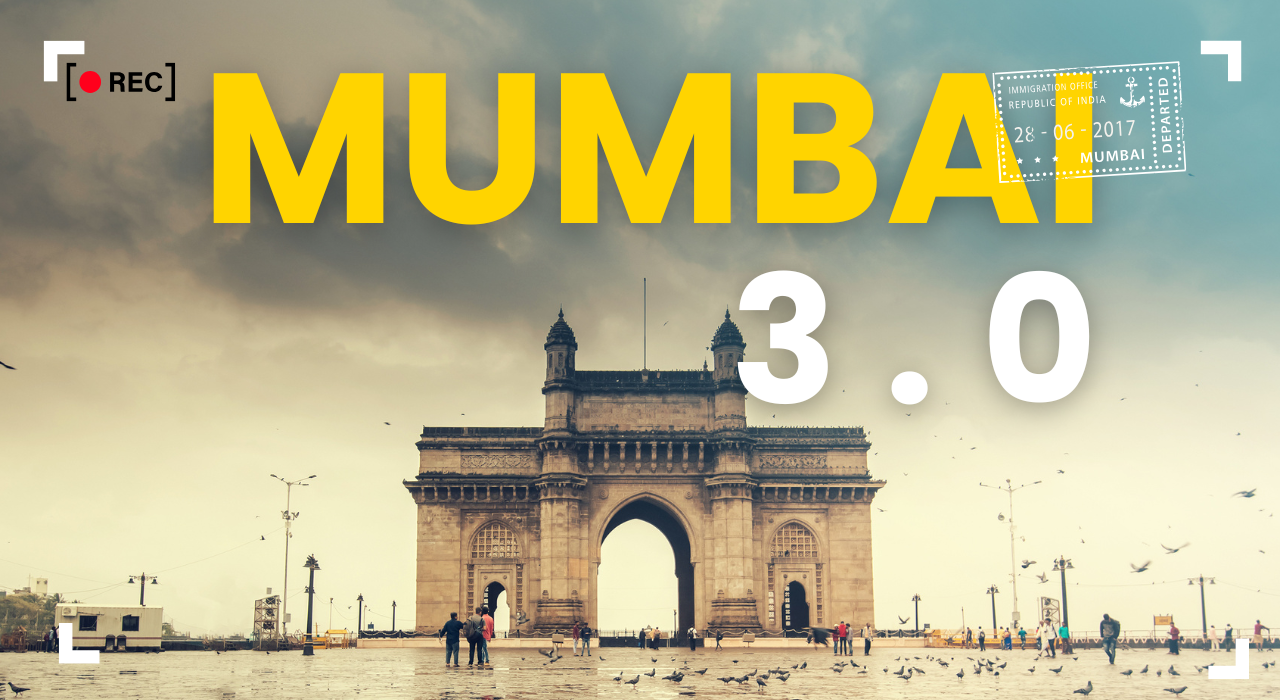
Mumbai 3.0: When a City Learns to Breathe Again
For over a century, Mumbai grew by pushing inward.
More people, more buildings, more pressure — all packed into a narrow peninsula that powered India’s economy but slowly ran out of space to live, move, and breathe.
Every great city eventually faces this moment.
A moment where growth can no longer be vertical.
Where expansion must become intelligent.
Where the city must reinvent itself — not by growing taller, but by growing wiser.
That moment for Mumbai is called Mumbai 3.0.
The End of Old Mumbai Thinking
Mumbai 1.0 was about survival and trade.
Mumbai 2.0 was about density, finance, and speed.
Mumbai 3.0 is about balance.
Balance between:
Growth and livability
Infrastructure and ecology
Density and dignity
Capital and community
For the first time, Mumbai is not reacting to pressure —
it is planning for the future.
What Mumbai 3.0 Really Is (And What It Is Not)
Mumbai 3.0 is not just a new city.
It is not just Navi Mumbai.
It is not just an airport or a highway.
Mumbai 3.0 is a regional reset.
It is the deliberate expansion of the Mumbai Metropolitan Region (MMR) into a multi-nodal economic ecosystem, where:
Jobs are closer to homes
Homes are closer to nature
Infrastructure leads development
Growth is decentralised, not suffocating
At the heart of this transformation lies the Karnala–Sai–Chirner (KSC) New Town, spread across 323 sq. km — not as an extension of chaos, but as an antidote to it.
Infrastructure Didn’t Just Connect Mumbai — It Rewired It
Every city-changing story begins with infrastructure.
Mumbai 3.0 is being stitched together by projects that don’t just reduce travel time — they redefine geography:
Mumbai Trans Harbour Link (Atal Setu) collapsed distance between South Mumbai and Navi Mumbai.
Navi Mumbai International Airport unlocked a new economic axis.
Virar–Alibaug Multimodal Corridor created a spine for logistics, housing, and industry.
Rail and highway upgrades pulled peripheral regions into daily life, not just weekend visits.
What was once “too far” is now strategically central.
Why Mumbai 3.0 Is an Economic Decision, Not a Real Estate One
This shift is not driven by property.
It is driven by economics.
Mumbai 3.0 creates:
New business districts
Data centre hubs
Logistics clusters
Education and healthcare cities
Residential zones designed for the next generation
This is how global cities evolve —
by creating multiple centres of gravity, not one overloaded core.
In simple terms:
Mumbai is no longer one city.
It is becoming a system of cities.
The Silent Winners of Mumbai 3.0
The most powerful changes rarely happen in the spotlight.
The real winners of Mumbai 3.0 are:
Regions with land + connectivity
Locations near infrastructure nodes
Areas that can absorb growth sustainably
Places that offer lifestyle, not just returns
Karjat, Panvel, Pen, Uran, Khalapur, Khopoli —
these are not “outskirts” anymore.
They are the future addresses of Mumbai.
Why This Moment Is Different From Past Expansions
Mumbai has expanded before.
But this time, three forces are aligned:
Infrastructure is arriving before mass construction
Lifestyle preferences have fundamentally changed
Policy and planning are proactive, not reactive
This alignment is rare.
And historically, it is during such phases that long-term wealth and urban stability are created.
Mumbai 3.0 Is About Living, Not Just Existing
The most important shift is philosophical.
Mumbai 3.0 asks a different question:
How should Indians live over the next 30 years?
With:
Cleaner air
More open space
Shorter commutes
Smarter cities
Stronger communities
It recognises that a city’s success is not measured only in GDP,
but in quality of life.
The Road Ahead
Mumbai 3.0 will not be built overnight.
There will be challenges — execution, environment, governance, alignment.
But the direction is clear.
Mumbai has chosen expansion over exhaustion.
Planning over pressure.
Vision over improvisation.
And that makes Mumbai 3.0 not just a project —
but a turning point in India’s urban story.