
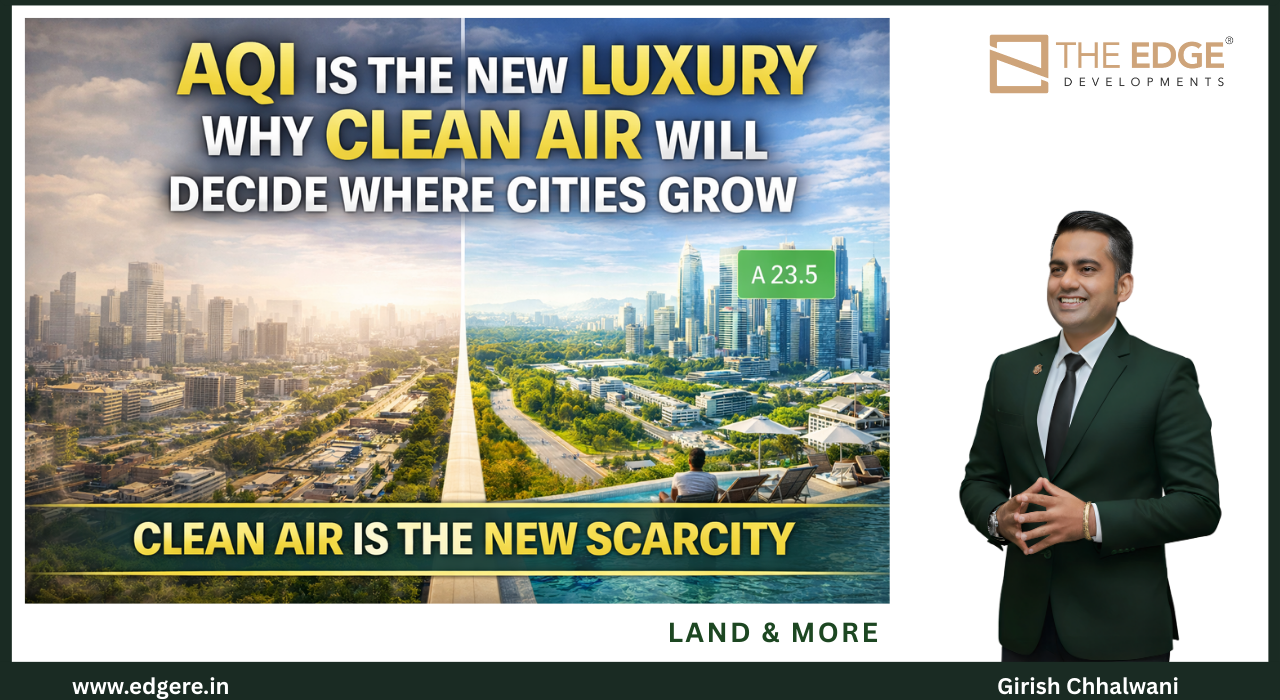
AQI Is the New Luxury: Why Clean Air Will Decide Where Cities Grow
Clean air has become a scarce resource in modern cities. As air quality deteriorates in dense urban cores, people, capital, and future cities are increasingly moving toward regions that offer lower AQI, open land, and healthier living conditions.
Air is no longer invisible.
It is now decisive.
When Pollution Becomes Personal
For decades, pollution was treated as an abstract statistic — something governments measured and citizens tolerated.
That era is over.
Today, people track AQI the way they once tracked stock prices.
They plan weekends around it.
They choose homes, schools, and even careers based on it.
When air affects:
Children’s health
Elderly longevity
Daily energy levels
Mental well-being
It stops being an environmental issue.
It becomes a lifestyle decision.
Why AQI Is Now a Migration Trigger
Direct answer:
People don’t leave cities because of ambition loss.
They leave because pollution erodes quality of life faster than opportunity compensates.
When:
Asthma increases
Allergies worsen
Outdoor life disappears
Medical costs rise
The city starts extracting a hidden tax.
Once that tax becomes visible, migration follows.
The Shift From Proximity to Well-Being
Earlier generations chose cities for:
Jobs
Connectivity
Status
Today’s choices look different:
Health over hierarchy
Space over skyline
Air over address
Time over traffic
This doesn’t mean cities will empty.
It means growth will redirect.
Cities that cannot improve AQI will lose residents to places that already have what money can’t buy: clean air.
Why Clean Air Regions Are Becoming the Next Growth Zones
Regions with:
Lower population density
Natural buffers (forests, hills, coastlines)
Horizontal growth potential
Planned infrastructure
have a structural advantage.
They attract:
Families
Remote professionals
Wellness-driven communities
Long-term residents
This is why towns once considered “too far” are now seen as future-ready.
Not because they are cheaper —
but because they are healthier.
AQI and the Rise of Low-Density Urbanism
High-density cities struggle to fix AQI quickly.
Low-density regions protect it naturally.
This is pushing demand toward:
Plotted developments
Villa communities
Green townships
Nature-integrated housing
People are no longer impressed by towers if they can’t open windows.
Urban growth is slowly shifting from vertical density to horizontal dignity.
Why This Changes Real Estate Economics Permanently
Answer-first insight:
AQI converts environmental quality into economic value.
Land in cleaner regions appreciates because:
Demand is lifestyle-driven
Migration is end-user led
Supply remains limited
Retention is higher
This creates stable, long-term demand, not speculative spikes.
Air quality doesn’t fluctuate daily the way markets do.
Its impact compounds over time.
Why Governments Will Follow This Shift
Policy always follows people.
As migration patterns change, governments are forced to:
Invest in cleaner growth zones
Improve regional infrastructure
Encourage decentralisation
Reduce pressure on polluted cores
AQI is quietly shaping urban policy — even when it’s not openly acknowledged.
What This Means for the Future of Cities
Cities of the future will compete on:
Air quality
Water quality
Open space
Health infrastructure
Environmental resilience
GDP alone won’t define success.
Livability metrics will.
The most successful cities won’t just offer jobs.
They will offer longer, healthier lives.
The Hard Truth
You can’t filter air forever.
You can’t mask pollution with branding.
You can’t compensate poor health with higher income.
Eventually, people choose what sustains them.
That choice is reshaping where cities grow.
Final Thought
In the next decade, wealth will follow wellness.
And wellness begins with breath.
AQI is no longer an environmental statistic.
It is the new luxury signal — and the strongest predictor of where tomorrow’s cities will rise