
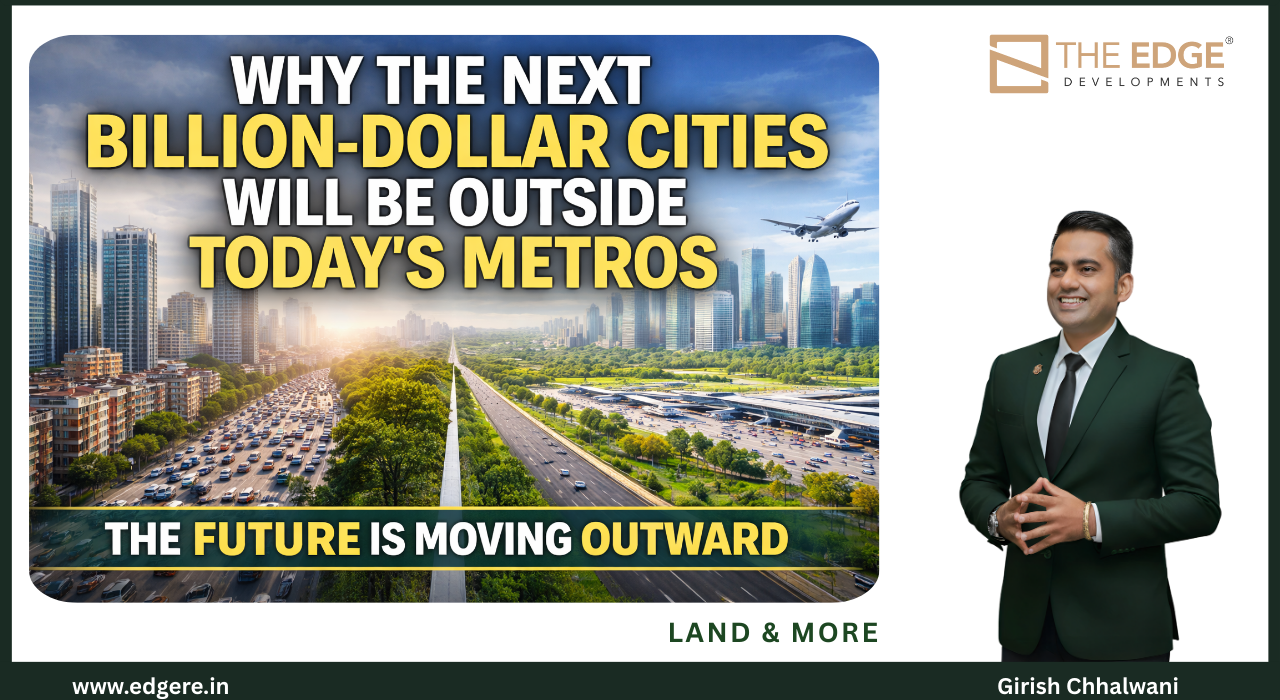
Why the Next Billion-Dollar Cities Will Be Outside Today’s Metros
The next billion-dollar cities will emerge outside today’s metros because large cities have exhausted land, livability, and infrastructure capacity—while growth, capital, and people are now moving toward regions where land, connectivity, and planning still allow scale.
This shift is not cyclical.
It is structural.
The End of Metro-Centric Growth
For decades, economic growth followed a predictable pattern:
Bigger city = bigger opportunity.
That equation no longer holds.
Most major metros today face the same constraints:
-
Severe land scarcity
-
Infrastructure saturation
-
High cost of living
-
Declining quality of life
-
Environmental stress
-
Long commute times
At a certain point, cities stop compounding advantage and start taxing productivity.
That tipping point has arrived.
What Actually Creates a Billion-Dollar City?
Direct answer:
A billion-dollar city is created when four conditions align simultaneously:
-
Scalable land availability
-
Infrastructure-led connectivity
-
Economic decentralisation
-
Livability that attracts people voluntarily
Most existing metros no longer meet all four.
Emerging regions do.
Why Land Is the First Deciding Factor
Cities don’t fail because they lack ambition.
They fail because they lack land flexibility.
Land determines:
-
Density limits
-
Infrastructure layout
-
Cost of housing
-
Quality of urban life
-
Speed of expansion
Without land, growth becomes vertical, expensive, and fragile.
Every future billion-dollar city will be built where land:
-
Exists at scale
-
Can be planned before congestion
-
Allows infrastructure to arrive first
This alone disqualifies most mature metros.
Infrastructure Is Now Being Built Before Cities
This is the most important change of our time.
Historically:
-
Cities grew first
-
Infrastructure chased demand
Now:
-
Infrastructure is built first
-
Cities grow around it
Airports, ports, logistics corridors, highways, rail networks, and industrial zones are being deliberately placed outside existing city cores.
Why?
Because that’s where growth can be controlled, scalable, and sustainable.
This single sequencing shift explains why future cities won’t be born inside today’s metros.
Economic Gravity Is Moving, Quietly
Jobs no longer need one postcode.
With:
-
Distributed manufacturing
-
Logistics-led industries
-
Digital services
-
Hybrid work
-
Global supply chains
Economic gravity has become mobile.
When jobs decentralise, people follow.
When people follow, housing forms.
When housing forms, cities emerge.
This is how satellite regions quietly become economic capitals within a decade.
Human Behaviour Has Permanently Changed
This is the most underestimated driver.
People today prioritise:
-
Time over proximity
-
Space over status
-
Air quality over pin codes
-
Quality of life over density
They are willing to move outward, not upward.
Once this behavioural shift happens at scale, it doesn’t reverse easily.
Cities grow where people want to live—not where they are forced to.
Why Capital Is Following This Shift
Institutional capital doesn’t chase headlines.
It chases inevitability.
Investors are increasingly backing:
-
Infrastructure corridors
-
Peripheral growth zones
-
Airport-influence regions
-
Port-led economies
-
New industrial clusters
Because these regions offer:
-
Lower entry cost
-
Longer growth runways
-
Lower execution risk
-
Policy alignment
Capital always arrives before cities are obvious.
This Is Not an “Urban Sprawl” Story
It’s important to clarify what this is not.
This is not uncontrolled sprawl.
This is planned decentralisation.
Future cities will be:
-
Multi-nodal
-
Infrastructure-anchored
-
Lower density
-
Digitally connected
-
Environmentally conscious
They won’t replace metros.
They will relieve them.
What History Tells Us (Without Nostalgia)
Every era produces its own cities.
-
Industrial era → port cities
-
Manufacturing era → factory towns
-
Service era → metro hubs
The next era—logistics, mobility, sustainability, and digital services—demands new geography.
That geography does not exist inside old city limits.
What This Means Going Forward
Clear answer:
The next billion-dollar cities will be born:
-
Where infrastructure arrives before congestion
-
Where land allows planning at scale
-
Where people choose to live, not endure
-
Where economics and livability align
They will sit outside today’s metros—but remain deeply connected to them.
Final Thought
Cities don’t die.
They evolve.
But evolution doesn’t happen in the same place forever.
The future of urban growth belongs to regions that can still breathe, plan, and scale.
That is why the next billion-dollar cities will not rise inside today’s metros—
they will rise beyond them.