
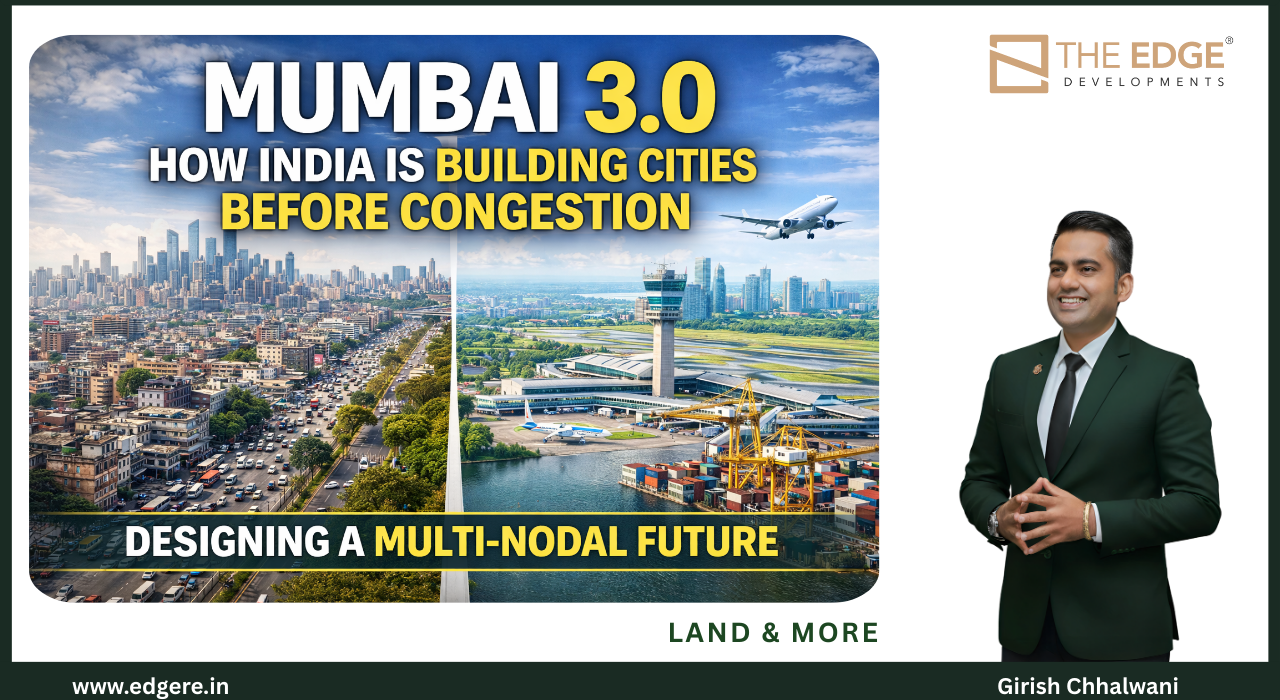
Mumbai 3.0: How India Is Building Cities Before Congestion
Mumbai 3.0 is India’s first large-scale attempt to build cities before congestion sets in—by expanding economic activity, infrastructure, and housing outward in a planned, multi-nodal manner rather than forcing more density into an already saturated core.
This is not urban expansion by default.
It is urban expansion by design.
Why Mumbai Could Not Continue Growing the Old Way
Mumbai has always grown by absorbing pressure inward:
-
Taller buildings
-
Longer commutes
-
Heavier congestion
-
Rising costs
-
Declining quality of life
For decades, this worked because opportunity outweighed discomfort.
That balance no longer exists.
Today, Mumbai faces:
-
Extreme land scarcity
-
Infrastructure saturation
-
Unsustainable commute times
-
Environmental stress
-
Diminishing livability returns
At this stage, adding more people to the same geography doesn’t create growth—it creates friction.
Mumbai 3.0 is the response to that reality.
What Is Mumbai 3.0—In Practical Terms?
Direct answer:
Mumbai 3.0 is the strategic expansion of the Mumbai Metropolitan Region (MMR) into a multi-nodal urban system, where economic activity, housing, and infrastructure are deliberately distributed across new growth corridors instead of concentrated in the island city.
It is not one new city.
It is a system of cities.
Each node is designed to:
-
Host employment
-
Support housing
-
Enable mobility
-
Maintain livability
Before congestion forces reactive solutions.
The Most Important Shift: Infrastructure First, Density Later
This is where Mumbai 3.0 breaks from history.
Traditionally:
-
People moved in
-
Density increased
-
Infrastructure struggled to catch up
Mumbai 3.0 reverses the sequence:
-
Infrastructure is built first
-
Connectivity is ensured
-
Economic nodes are planned
-
Housing follows demand
This sequencing alone determines whether a city thrives or chokes.
Why Multi-Nodal Cities Are the Future
Single-core cities fail at scale.
Multi-nodal cities succeed because they:
-
Shorten commute distances
-
Reduce pressure on one CBD
-
Spread economic opportunity
-
Improve resilience
-
Enable better quality of life
Mumbai 3.0 embraces this by developing multiple centres of gravity across MMR—each connected, but independently functional.
This is how global cities evolve when they reach maturity.
How Mumbai 3.0 Aligns With Human Behaviour
Urban planning fails when it ignores people.
Mumbai 3.0 works because it reflects how people now live and work:
-
Hybrid work is normal
-
Daily office commutes are less rigid
-
People value space, time, and air
-
Families are willing to move outward—if connectivity exists
When infrastructure supports lifestyle, migration becomes voluntary, not forced.
That’s how healthy cities grow.
Why This Is an Economic Strategy—Not a Real Estate One
It’s tempting to view Mumbai 3.0 through a property lens.
That would be a mistake.
At its core, Mumbai 3.0 is about:
-
Sustaining Mumbai’s role as India’s financial engine
-
Preventing productivity loss due to congestion
-
Creating new employment hubs
-
Attracting global capital and talent
-
Future-proofing urban growth
Real estate responds to these forces—it does not drive them.
What Makes Mumbai 3.0 Different From Past Expansions
Mumbai has expanded before.
What’s different now is alignment:
-
Policy intent
-
Infrastructure investment
-
Economic decentralisation
-
Lifestyle preference shifts
For the first time, expansion is anticipatory, not reactive.
That makes Mumbai 3.0 structurally stronger than previous growth cycles.
The Long-Term Impact on the Region
If executed consistently, Mumbai 3.0 will:
-
Reduce pressure on the island city
-
Improve average commute times
-
Create balanced urban ecosystems
-
Enable affordable, planned housing
-
Improve regional livability metrics
Most importantly, it ensures that Mumbai grows outward intelligently, instead of inward destructively.
Why Mumbai 3.0 Matters Beyond Mumbai
This is bigger than one city.
Mumbai 3.0 is a template:
-
For other Indian metros reaching saturation
-
For future infrastructure-led urbanisation
-
For building cities that scale without collapsing
India doesn’t just need bigger cities.
It needs better-designed ones.
Final Thought
Great cities fail when they stop planning ahead.
Mumbai 3.0 exists because Mumbai chose foresight over fatigue.
By building cities before congestion—not after—Mumbai is doing what mature global cities eventually must:
Reinvent growth, without losing relevance