
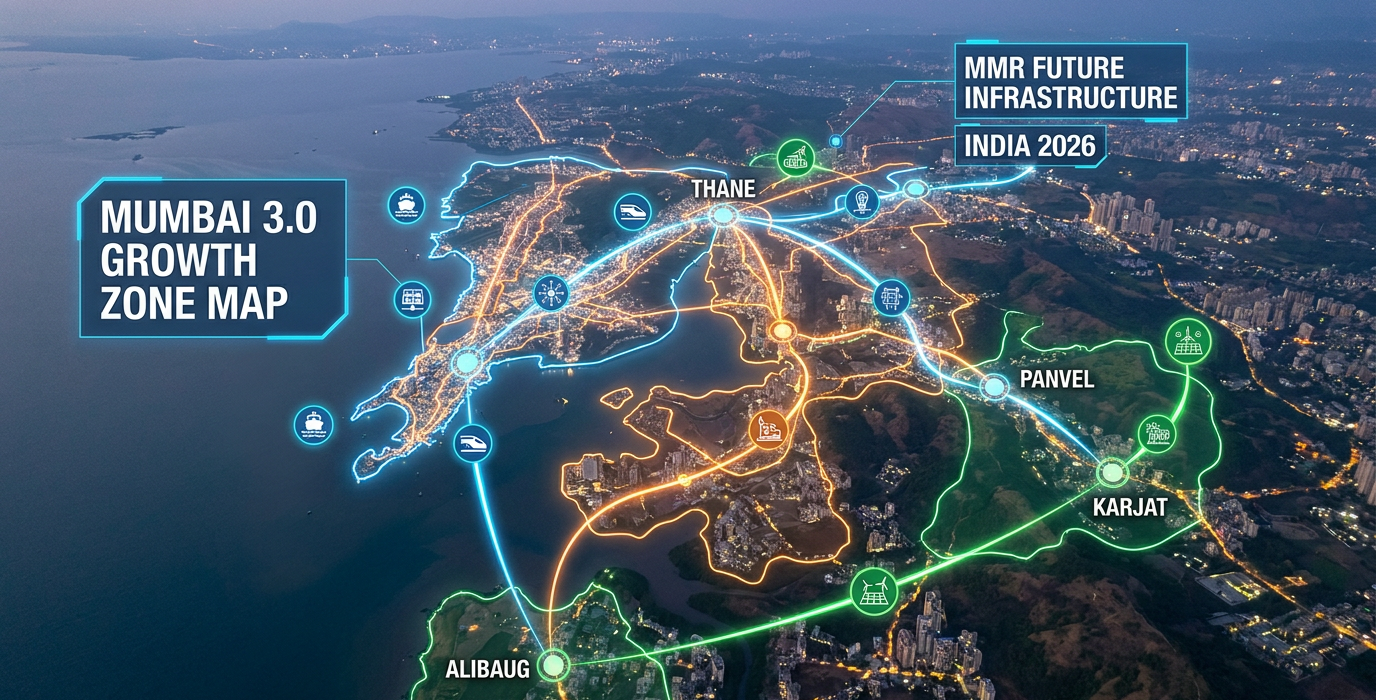
TL;DR — KEY TAKEAWAYS
- Mumbai 3.0 is a ₹3+ lakh crore infrastructure-driven expansion creating 6 new growth zones across the MMR beyond the historically developed footprint.
- Zone 2 (Karjat-Khalapur) offers the best remaining upside, priced at ₹1,200-2,500/sq.ft versus ₹5,000-12,000/sq.ft in the Panvel-NMIA zone.
- Three infrastructure catalysts converge on Karjat-Khalapur — VAMC, NMIA proximity, and expressway access — projecting 14-20% CAGR through 2031.
- Each of the 6 zones has a distinct investment profile, from conservative stability (Panvel-NMIA) to affordable entry-level (Vasai-Virar).
Mumbai is not expanding — it is multiplying. The original city (Mumbai 1.0) ran out of land. Navi Mumbai and the extended suburbs (Mumbai 2.0) absorbed the overflow. Now, driven by ₹3+ lakh crore of infrastructure investment, a third Mumbai is forming — a network of growth nodes across the MMR that will reshape where people live, invest, and work through 2031 and beyond.
This guide maps the 6 growth zones of Mumbai 3.0, analyses which micro-markets will lead returns in the next decade, and gives you a data-driven decision framework for where to invest in 2026.
Reading time: 15 minutes | Last updated: July 2026 | Author: Girish Chhalwani, Founder & CEO, THE EDGE Developments
Mumbai 3.0 refers to the third phase of the Mumbai Metropolitan Region’s growth, enabled by a convergence of major infrastructure projects: the Navi Mumbai International Airport (NMIA), the Virar–Alibaug Multimodal Corridor (VAMC), the Mumbai Trans Harbour Link (MTHL / Atal Setu), the Coastal Road, the Metro Rail expansion (Lines 1–12), and the Second Mumbai–Pune Expressway. Together, these projects represent more than ₹3 lakh crore of infrastructure investment that will fundamentally alter accessibility, land values, and commercial opportunity across the MMR. — Source: MMRDA Infrastructure Status Report 2024; Maharashtra Government Budget 2024–25
What Is Mumbai 3.0?
Mumbai 3.0 is the third, infrastructure-enabled phase of MMR growth — new zones like Panvel, Karjat, Alibaug, and Raigad district becoming accessible after Mumbai 1.0 (the island city) and Mumbai 2.0 (the extended suburbs) reached their land limits.
- Mumbai 1.0: The island city of South and Central Mumbai — Colaba to Dadar. Dense, expensive, limited land.
- Mumbai 2.0: Extended suburban growth — Bandra, Andheri, Thane, Navi Mumbai, Vasai-Virar. Developed primarily 1980–2015.
- Mumbai 3.0: Infrastructure-enabled new growth zones beyond MMR’s historical footprint — Panvel, Karjat, Alibaug, Khalapur, Raigad district — now becoming accessible through new infrastructure corridors.
What Are the 6 Growth Zones of Mumbai 3.0?
The six zones range from the already-priced-in Panvel-NMIA corridor to the still-early Karjat-Khalapur corridor, each anchored by different infrastructure catalysts.
Zone 1: Panvel–NMIA Corridor
- Key catalyst: Navi Mumbai International Airport (operational 2026–27)
- Current land price (NA): ₹5,000–12,000/sq.ft
- Growth thesis: Airport city formation — commercial, logistics, hospitality and residential demand surge around India’s newest international airport
- Investment profile: Moderate yield potential remaining (prices already appreciating significantly), high stability
Zone 2: Karjat–Khalapur Southern Corridor
- Key catalysts: VAMC southern node + NMIA adjacency + expressway access
- Current land price (NA): ₹1,200–2,500/sq.ft
- Growth thesis: Best remaining pre-infrastructure pricing in MMR; convergence of 3 major infrastructure catalysts; weekend home and land banking demand
- Investment profile: Highest remaining upside in MMR — best 2026 entry point
Zone 3: Thane–Bhiwandi Eastern Corridor
- Key catalysts: VAMC eastern arm + Metro Line 5 + logistics park development
- Current land price: ₹3,000–8,000/sq.ft (residential)
- Growth thesis: Warehouse and logistics-driven commercial development; residential affordability migration from central Mumbai
- Investment profile: Steady appreciation, lower upside than southern zones
Zone 4: Alibaug–Pen Coastal Zone
- Key catalysts: MTHL (Atal Setu) — reduces Mumbai–Alibaug commute; VAMC southern extension
- Current land price: ₹3,500–15,000/sq.ft (sea-facing premium)
- Growth thesis: Coastal lifestyle premium + Mumbai access improvement; NRI second-home demand
- Investment profile: Premium segment, high liquidity, moderate yield potential at current prices
Zone 5: Vasai–Virar Northern Corridor
- Key catalysts: VAMC northern anchor + Mumbai Western Railway improvements
- Current land price: ₹1,500–4,000/sq.ft
- Growth thesis: Affordable residential overspill from Mumbai western suburbs; industrial zone adjacency
- Investment profile: Value segment, steady but moderate appreciation
Zone 6: Raigad–Navi Mumbai New Growth Areas
- Key catalysts: NMIA spillover + MTHL connectivity + CIDCO development
- Current land price: ₹4,000–9,000/sq.ft
- Growth thesis: Planned township development by CIDCO; residential demand from airport employment
- Investment profile: Planned development with CIDCO execution certainty; mid-range returns
The Karjat–Khalapur corridor (Zone 2) represents the last significant pre-infrastructure pricing opportunity in the Mumbai 3.0 growth map. With land prices at ₹1,200–2,500/sq.ft in 2026 compared to ₹5,000–12,000/sq.ft in the Panvel–NMIA zone and ₹10,000–30,000/sq.ft in Thane and Navi Mumbai, the relative value proposition in Zone 2 is compelling — especially with 3 simultaneous infrastructure catalysts converging before 2030. — Source: THE EDGE Developments Zone Analysis; Maharashtra Land Registration Data 2026
Which Zone Offers the Best Investment Decision for 2026?
Karjat–Khalapur offers the highest projected CAGR (14-20%) at the lowest entry price of the six zones, making it the top pick for growth investors with a 5-7 year horizon.
| Zone | Entry Price | 5-Year CAGR Projection | Risk Level | Ideal Buyer |
|---|---|---|---|---|
| Panvel–NMIA | ₹5,000–12,000/sq.ft | 10–14% | Low | Conservative investor seeking stability |
| Karjat–Khalapur | ₹1,200–2,500/sq.ft | 14–20% | Medium | Growth investor, 5–7 year horizon |
| Thane–Bhiwandi | ₹3,000–8,000/sq.ft | 8–12% | Low | Rental income seeker |
| Alibaug Coastal | ₹3,500–15,000/sq.ft | 10–16% | Medium | Lifestyle + appreciation buyer, NRI |
| Vasai–Virar | ₹1,500–4,000/sq.ft | 8–11% | Low-Medium | Affordable housing or entry-level investor |
| Raigad–Navi Mumbai | ₹4,000–9,000/sq.ft | 9–13% | Low | Planned development buyer |
FAQs: Mumbai 3.0 Growth Zones
- What is Mumbai 3.0?
- Mumbai 3.0 refers to the third phase of Mumbai’s growth — infrastructure-enabled development of new zones beyond the historically developed MMR footprint. Driven by projects including the NMIA, VAMC, MTHL, and Metro expansion, Mumbai 3.0 is creating new growth hubs in Panvel, Karjat, Alibaug, Vasai, and Raigad district that are becoming viable alternatives to congested inner city zones.
- Which MMR micro-market offers the best investment returns through 2031?
- Based on current pricing, infrastructure catalysts, and demand trajectory, the Karjat–Khalapur corridor (Zone 2) offers the best balance of appreciation potential (14–20% CAGR projected) and entry affordability (₹1,200–2,500/sq.ft) through 2031. The convergence of VAMC, NMIA proximity, and expressway access creates a multi-catalyst appreciation story unmatched elsewhere in MMR at this price point.
- How does the Navi Mumbai International Airport affect MMR land values?
- The NMIA creates an airport city effect — demand for commercial, logistics, hospitality, and residential real estate within 15–30 km of the airport increases significantly. The Panvel–Uran zone (Zone 1) has already priced in much of this impact, while areas like Karjat (45 min from NMIA) are still in the early appreciation phase of this catalyst.
- Is Mumbai 3.0 just a real estate marketing concept?
- No. Mumbai 3.0 refers to a real infrastructure transformation backed by ₹3+ lakh crore of verified government projects (NMIA, VAMC, MTHL, Metro Lines 1–12) with allocated budgets, partial completions (Atal Setu is operational, Metro Lines 1 and 2A are running), and active construction. The term has been used in MMRDA planning documents and Maharashtra government communications.
Related Reading
- Infrastructure-Triggered Land Appreciation: Karjat Corridor Case Study
- Karjat as an Investment Destination: Complete Corridor Guide
Invest in Mumbai 3.0’s Highest-Upside Zone
THE EDGE Developments operates exclusively in Zone 2 of Mumbai 3.0 — the Karjat–Khalapur corridor. All projects are RERA-registered NA plots with clear title, township amenities, and pre-VAMC pricing.
Contact: info@edgerea.com | +91-9664662938 | edgere.in