
TL;DR — KEY TAKEAWAYS
- Land in India’s infrastructure corridors has delivered 15-25% CAGR over 10-year periods when acquired with legal clarity and held through infrastructure completion.
- Five criteria separate genuine land banking from speculation: confirmed infrastructure, NA conversion with clear title, market demand validation, holding period alignment, and appropriate ticket size.
- Karjat-Khopoli scores highest on all five criteria for 2026, with NA plots priced at ₹1,200-2,500/sq.ft versus ₹5,000-12,000/sq.ft in comparable NMIA zones.
- Section 54F can shield land banking gains from LTCG tax when proceeds are reinvested in residential property, saving ₹12.5 lakh on a ₹1 crore gain.
Land banking is India’s oldest wealth-creation strategy and its least-understood investment vehicle. Done right, it has made fortunes for families who held land near India’s expanding metros for a generation. Done wrong, it locks up capital in illiquid, legally contested parcels that never appreciate and can’t be sold.
The difference between the two is almost entirely about which land you buy, where, and with what legal structure. This is the complete 2026 guide to land banking in India — strategy, legal framework, tax, risk mitigation, and why the Karjat–MMR corridor is the most compelling opportunity right now.
Reading time: 15 minutes | Last updated: July 2026 | Author: Girish Chhalwani, Founder & CEO, THE EDGE Developments
Land in India’s infrastructure corridors adjacent to major metros has delivered 15–25% CAGR over 10-year periods — making it one of the highest-performing asset classes in the country when acquired with legal clarity and held through infrastructure completion. Land banking in the Karjat–MMR corridor has produced documented 10-year CAGRs of 18–22% for investors who acquired NA plots between 2015 and 2018 and held through 2025–2026. However, poorly structured land banking (agricultural land without NA conversion, unclear title, inactive or non-existent corridors) has produced near-zero or negative real returns for many investors. — Source: THE EDGE Developments Transaction Data; Maharashtra Sub-Registrar Data 2015–2026
What Is Land Banking?
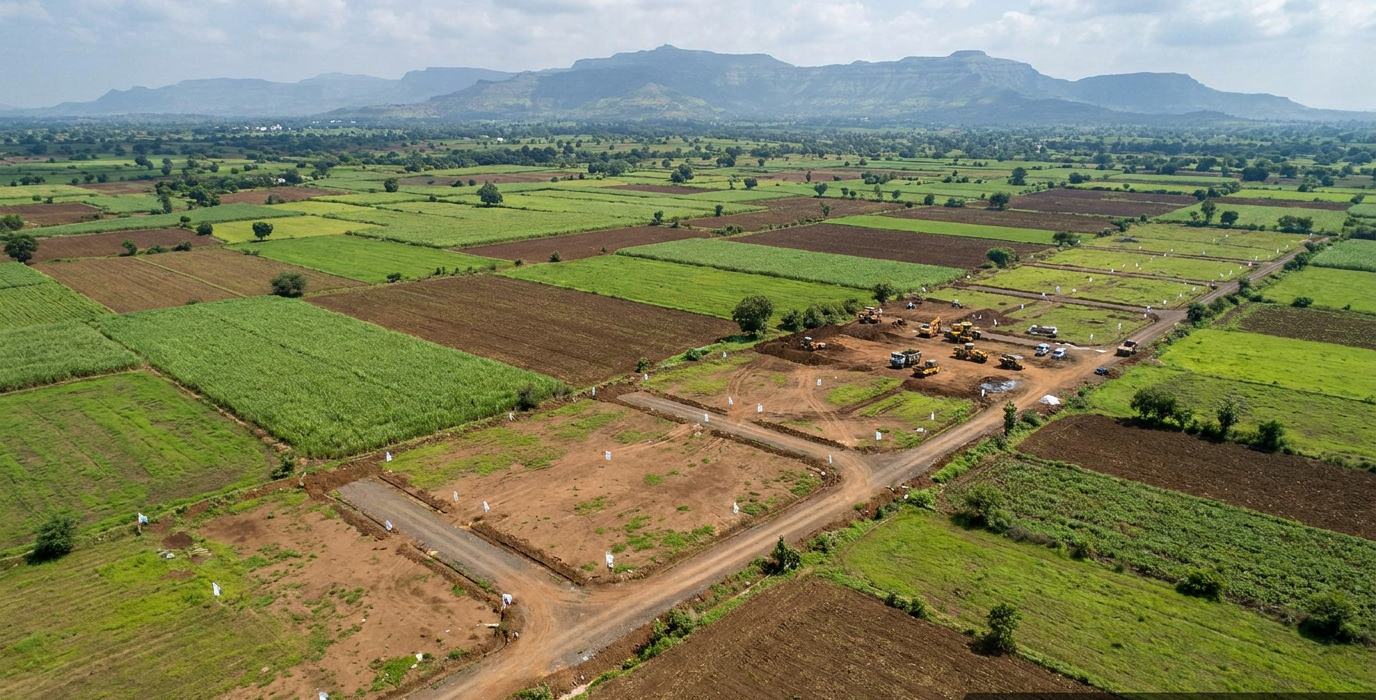
Land banking is the deliberate acquisition of land parcels ahead of expected development demand — typically ahead of infrastructure completion — and holding them until that demand materialises, at which point the land is sold or developed for superior returns.
The land banking equation:
Land Banking Return = Infrastructure Premium + Demand Premium + Scarcity Premium − (Carrying Costs + Tax)
What Are the 5 Criteria for Successful Land Banking in India?
Confirmed infrastructure, legal clarity, market demand validation, holding period alignment, and correct ticket sizing together separate genuine land banking from speculation.
Criterion 1: Confirmed Infrastructure in Pipeline
The single most powerful driver of land banking returns is infrastructure. The ideal land banking opportunity has at least one confirmed major infrastructure catalyst in construction or final planning — not just announced or proposed.
- Green flag: VAMC under construction + tender awarded; NMIA under construction
- Yellow flag: Expressway announced, DPR submitted
- Red flag: “Proposed” connectivity with no funding allocated or tender issued
Criterion 2: Legal Clarity — NA Conversion and Clear Title
Land banking in agricultural land without NA conversion is not land banking — it is agricultural land speculation. The NA conversion process in Maharashtra can take 2–5 years and involves state government approvals. During that period, your capital is locked in a speculative instrument.
For genuine land banking, the entry point should be NA-converted land with:
- 30-year clear title search completed
- 7/12 showing NA status and current owner
- No encumbrances in Column 12
- RERA registration (if within a branded development)
Criterion 3: Market Demand Validation
Before banking land in a location, verify that comparable plots in the area have transacted in the last 12 months at market prices. A location where no transactions have happened in 2+ years is a market liquidity trap — you may not be able to exit at all.
Criterion 4: Holding Period Alignment
Land banking is a medium-to-long term strategy. The ideal holding period aligns with infrastructure completion:
- Minimum viable hold: 3 years
- Optimal hold: 5–8 years (through infrastructure Phase 1 completion)
- Maximum efficient hold: 10 years (diminishing returns as area becomes built-up)
Criterion 5: Ticket Size and Portfolio Fit
Land banking capital should be in the “patient capital” category of your portfolio — funds you can do without for 5–8 years without distress. Borrowing to fund land banking is not recommended for most investors.
The most successful land banking families in Maharashtra’s peri-urban districts share one common trait: they bought land in the 5–10 years before a major infrastructure completion — railway extension, expressway opening, or airport inauguration — and held through the post-completion demand surge. The returns in the pre-completion phase were modest; the majority of the 10-year return was compressed into the 2–3 years immediately around infrastructure completion. This is why 2026–2028 is the critical window for Karjat–Khopoli land banking. — Source: THE EDGE Developments Historical Analysis; Maharashtra Property Research 2024
What Is the Legal Framework for Land Banking in Maharashtra?
Land banking in Maharashtra is governed by the Land Revenue Code, the MRTP Act, RERA, the Income Tax Act, and FEMA (for NRI buyers).
Key Laws
- Maharashtra Land Revenue Code 1966: Governs all land in Maharashtra — categories, conversion, mutation
- Maharashtra Regional and Town Planning Act (MRTP) 1966: Zone classifications (residential, agricultural, industrial, forest)
- RERA Act 2016: Mandatory if land is being developed and sold as plots/units
- Income Tax Act 1961: Capital gains tax — Section 45 (general), Section 45(5A) (JDA), Section 54F (exemption)
- FEMA 1999: Applicable for NRI buyers — specific restrictions on agricultural land purchases
Can NRIs Do Land Banking in India?
- NRIs can purchase: NA (non-agricultural) land anywhere in India
- NRIs cannot purchase: Agricultural land, plantation land, farmhouses in agricultural zones
- Exception: NRIs may inherit agricultural land; they cannot purchase it
- Repatriation: NRIs can repatriate sale proceeds of NA land subject to FEMA limits (up to USD 1 million/year from sale of two properties)
How Does Section 54F Shield Land Banking Gains From Tax?
Reinvesting the entire net sale proceeds from a land banking exit into a new residential property within 2 years (or construction within 3 years) exempts you from LTCG tax under Section 54F.
When you exit a land banking investment after 24+ months, reinvesting the entire net sale proceeds in a new residential property within 2 years (or constructing within 3 years) exempts you from LTCG tax under Section 54F.
For a ₹1 crore LTCG on a Karjat land sale, this saves ₹12.5 lakh in tax — and allows you to pivot from land banking to residential property in one tax-efficient step.
Why Is Karjat–Khopoli the Best Land Banking Opportunity in 2026?
Karjat–Khopoli scores highly on all five land banking criteria, with active transactions, confirmed infrastructure, and pricing well below comparable NMIA-zone land.
| Criterion | Karjat–Khopoli Score | Reason |
|---|---|---|
| Infrastructure in pipeline | ★★★★★ | VAMC (construction), NMIA (operational 2026–27), expressway |
| Legal clarity | ★★★★☆ | NA plots available in RERA-registered developments; due diligence required |
| Market demand validation | ★★★★★ | Active transactions; 25–40% appreciation in 2023–2025 |
| Pricing vs potential | ★★★★★ | ₹1,200–2,500/sq.ft vs ₹5,000–12,000/sq.ft in comparable NMIA zone |
| Holding period alignment | ★★★★☆ | VAMC Phase 1 completion 2027–28 creates defined exit window |
FAQs: Land Banking in India
- What is land banking and is it legal in India?
- Land banking is the deliberate acquisition of land parcels ahead of expected development demand, with the intention of selling at appreciation once infrastructure or demand catches up. It is completely legal in India when done in NA (non-agricultural) land with clear title. Agricultural land banking is legal for Indian citizens but carries additional risk from land use restrictions. NRIs cannot purchase agricultural land.
- What is the minimum investment for land banking in the Karjat MMR corridor?
- A single 2,000 sq.ft NA plot in a branded development near Karjat can be purchased for ₹24–50 lakh in 2026. This represents the minimum entry point for structured land banking in the corridor. For serious land banking (raw land parcels of 1+ acres), minimum investment is ₹70 lakh–1.5 crore depending on location and legal status.
- What are the risks of land banking in India?
- Key risks include: (1) legal title defects that emerge post-purchase; (2) infrastructure delays or cancellation that remove the primary appreciation catalyst; (3) liquidity risk — land can be difficult to sell quickly at market price; (4) LTCG tax at 12.5% (post-Budget 2024, no indexation) reducing net returns; and (5) holding costs including property tax, security, and annual maintenance. Risk is mitigated by purchasing NA-converted, RERA-registered plots from credible developers in active corridors.
- Can land banking be combined with rental income?
- Yes. Purchasing an NA plot in a branded development and constructing a rentable weekend villa combines land banking (capital appreciation) with rental income (6–9% yield on Airbnb). This blended strategy delivers 18–25% total annual returns in the Karjat corridor while generating current cash flow to offset holding costs and fund further investment.
Start Your Land Banking Journey With THE EDGE
THE EDGE Developments offers RERA-registered NA plots in Karjat — India’s best current land banking location. All plots are pre-VAMC priced with full legal documentation and township amenities.
Contact: info@edgerea.com | +91-9664662938 | edgere.in