
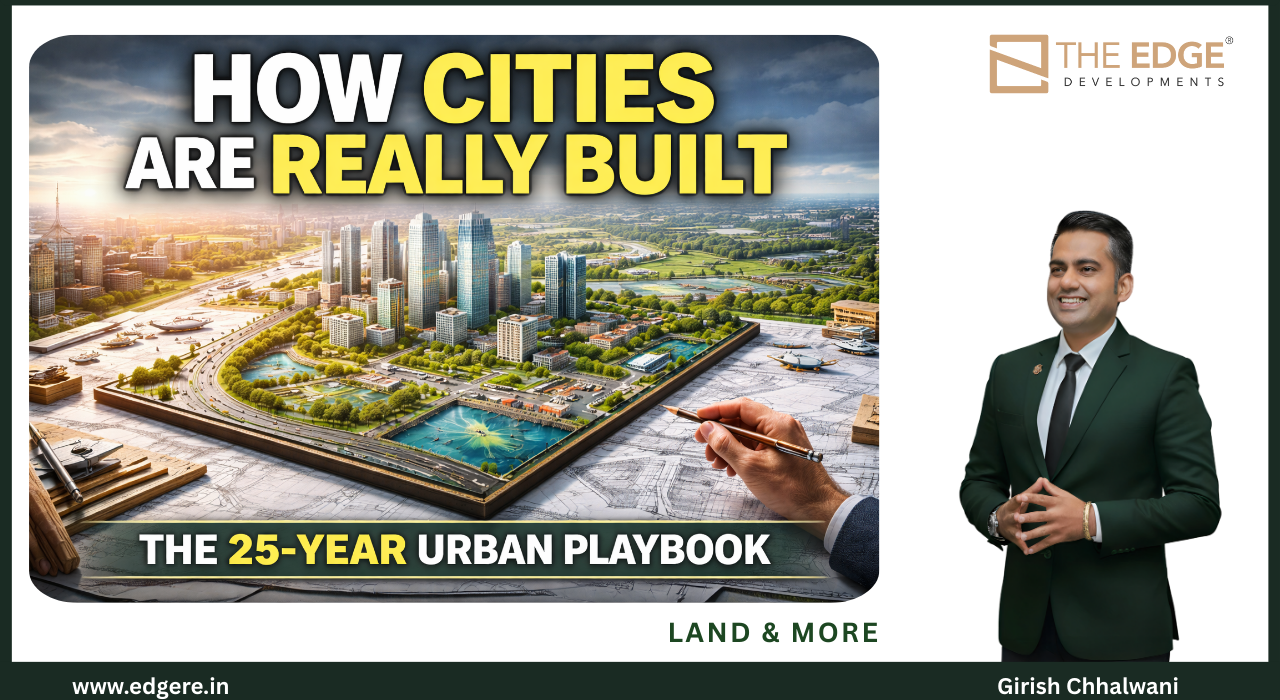
How Cities Are Really Built: A 25-Year Urban Playbook
Short answer:
Cities are not built by buildings, policies, or real estate cycles. They are built over decades through the alignment of land, infrastructure, economics, human behaviour, and governance. When these forces move in the right sequence, cities thrive. When they don’t, cities struggle—no matter how tall they grow.
This is the long game of urban development.
And it always follows a pattern.
Why Most Conversations About Cities Are Incomplete
Urban discussions usually focus on:
Housing supply
Property prices
Infrastructure announcements
Smart city branding
These are visible layers.
But cities are shaped much earlier, at levels most people never see.
Cities are not reactions.
They are outcomes.
Understanding how they are really built requires looking at time, not trends.
The 5 Forces That Build Every City
Every successful city—historically and globally—emerges from the interaction of five forces.
1. Land (The Foundation)
Land is the first decision—and the most irreversible one.
Land determines:
Density
Mobility
Infrastructure feasibility
Cost of living
Environmental resilience
When land is planned early, cities scale gracefully.
When land is misused, cities are forced into congestion and correction.
Land is not an asset class.
It is the DNA of the city.
2. Infrastructure (The Skeleton)
Infrastructure gives land purpose.
Roads, rail, ports, airports, utilities, and digital networks define:
How people move
Where jobs locate
How far cities can stretch
Whether growth is inclusive or fractured
Crucially, cities succeed when infrastructure comes before density, not after.
This sequencing alone decides whether a city becomes efficient or exhausting.
3. Economics (The Engine)
Cities exist because of work.
Economic anchors—trade, manufacturing, services, logistics, finance, tourism—give cities relevance.
Without a clear economic role:
Housing becomes speculative
Infrastructure underutilised
Migration unstable
Cities that last are built around function, not aspiration.
4. Human Behaviour (The Catalyst)
This is the most underestimated force.
People decide cities’ futures through:
Where they choose to live
How far they’re willing to commute
What they value (time, air, space, health)
How they balance work and life
Infrastructure reshapes behaviour.
Behaviour reshapes cities.
When planning ignores human psychology, cities grow—but people leave.
5. Governance (The Glue)
Governance doesn’t create cities.
But poor governance can destroy them.
Cities need:
Predictable policy
Long-term vision
Institutional continuity
Discipline in land use and zoning
The best cities are boring administratively—and brilliant structurally.
The 25-Year City-Building Timeline
Cities don’t appear overnight.
They mature in phases.
Years 0–5: Land & Infrastructure Alignment
Land consolidation
Connectivity planning
Economic intent defined
Years 5–10: Economic Anchoring
Jobs arrive
Logistics and services cluster
Early migration begins
Years 10–15: Residential Formation
Housing demand stabilises
Social infrastructure develops
Communities form
Years 15–20: Urban Identity
Culture emerges
Institutions strengthen
City gains recognition
Years 20–25: Maturity or Stress
Well-planned cities scale
Poorly planned cities congest
Cities don’t fail suddenly.
They fail when early decisions compound badly.
Why Most Cities Get It Wrong
Common mistakes include:
Treating land as inventory, not foundation
Allowing density before infrastructure
Chasing real estate before employment
Ignoring environmental limits
Underestimating behaviour shifts
These mistakes don’t show immediately.
They surface 10–15 years later, when correction becomes painful.
Why the Next Cities Will Look Different
Future cities will not compete on:
Height
Population
Density
They will compete on:
Livability
Air quality
Mobility
Time efficiency
Economic resilience
They will be:
Multi-nodal
Lower density
Infrastructure-first
Regionally connected
Human-centred
Growth will spread, not stack.
The Investor and Planner’s Reality Check
Answer-first truth:
Cities reward patience, not speed.
The best city-linked opportunities:
Appear boring early
Mature slowly
Compound quietly
Endure structurally
Speculation chases headlines.
City-building follows fundamentals.
What This Means for the Next Generation
The cities that succeed over the next 25 years will be those that:
Respect land
Sequence infrastructure correctly
Anchor economies thoughtfully
Design for behaviour
Govern with restraint
Everything else is decoration.
Final Thought
Cities are not built by ambition alone.
They are built by:
Decisions made early
Sequencing done right
Patience held consistently
Skylines may define a moment.
But cities are shaped by decades of invisible discipline.
Those who understand this don’t just invest in cities.
They help create them.