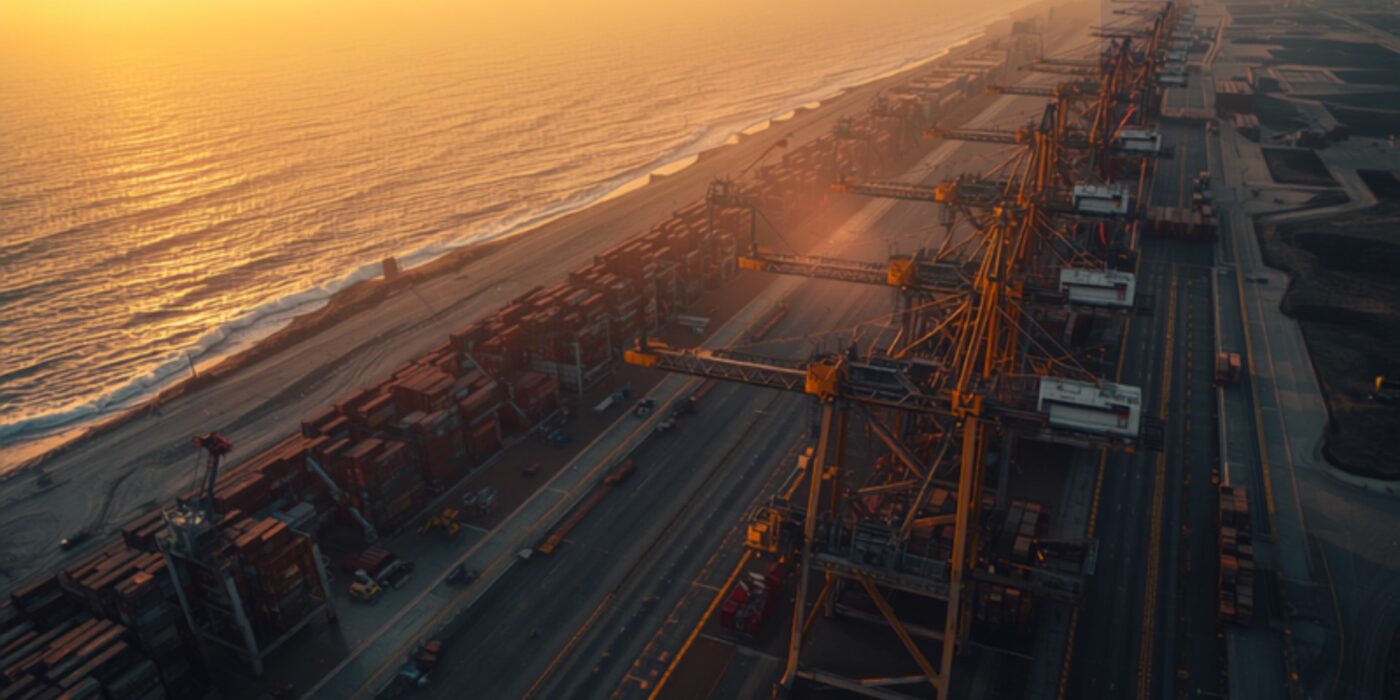
Aerial view of a large container port at sunrise with rows of cargo cranes and stacked shipping containers along a coastline
CategoriesMumbai 3.0

Vadhavan Port & North MMR Land Values: Investment Analysis 2026–2034

Reading time: 14 minutes | Last updated: July 2026 | Author: Girish Chhalwani, Founder & CEO, THE EDGE Developments

TL;DR — Key Takeaways

  • Vadhavan Port, near Dahanu in Palghar district, is India’s largest greenfield deep-water port project — approved at a total build cost of ₹76,220 crore, with the first phase (~₹45,000 crore, including ₹25,000 crore for land reclamation) already under construction since the groundbreaking by PM Narendra Modi on 30 August 2024.
  • It will be built and owned through a joint venture — Jawaharlal Nehru Port Authority (74%) and Maharashtra Maritime Board (26%) — with a designed capacity of 23.2 million TEUs and 298 MMT of cargo a year, making it larger than JNPT at full build-out.
  • Four of nine container terminals are targeted for commissioning by 2029; full completion is expected by 2034.
  • Connectivity is being built in parallel: a ₹2,881 crore, ~25 km road link to NH48 via Tarapur–Boisar/Chinchani–Vangaon/Dahanu (Bharatmala Pariyojana), a 12 km rail spur to the Western Dedicated Freight Corridor at New Palghar, and a ₹2,528.90 crore, 104.89 km freight expressway connecting the port directly to the Samruddhi Mahamarg at Bharvir (Nashik district).
  • This converts Dahanu–Boisar–Palghar–Vangaon from a low-density coastal belt into a logistics-and-industrial growth corridor — the same infrastructure-first sequencing that repriced Karjat, Uran, and Panvel over the last decade.
  • Land in Boisar currently trades around ₹1,500–4,200/sq.ft; interior Palghar/Vangaon parcels are available from roughly ₹500/sq.ft — a wide entry-price band that will compress as construction milestones (terminal commissioning, expressway opening) land between 2026 and 2029.

Executive Summary

Does Vadhavan Port change the investment case for land in Palghar district? Yes — Vadhavan Port is a ₹76,220 crore deep-water mega-port under construction near Dahanu, designed to handle 23.2 million TEUs a year, and it is being built alongside a dedicated freight rail spur, a new NH48 link road, and a 105 km expressway to the Samruddhi Mahamarg. Together, these projects create the same “infrastructure precedes density” pattern that has already repriced Karjat, Panvel, and Uran in the Mumbai Metropolitan Region (MMR) — except this time the growth corridor runs north, through Boisar, Dahanu, Vangaon, and Palghar town, not south-east.

For THE EDGE’s readership — land investors, second-home buyers, and developers tracking Mumbai 3.0’s outward expansion — Vadhavan Port is the single largest infrastructure catalyst in the northern MMR that does not yet have a dedicated body of investment research. This article maps the project’s engineering scope, its connectivity build-out, its realistic timeline, and — most importantly — which micro-markets around it are positioned to benefit, and on what schedule.

Introduction: Why a Port 120 KM from Mumbai Matters to MMR Land Investors

Every prior wave of Mumbai’s outward growth has followed the same sequence: a transport or logistics anchor gets sanctioned, connectivity infrastructure follows within a few years, and land values in the surrounding villages re-rate long before the anchor project itself is operational. The Navi Mumbai International Airport (NMIA) did this for Panvel, Uran, and Karjat. The Virar–Alibaug Multimodal Corridor is doing it for Karjat and Khopoli. Vadhavan Port is now doing it for the Palghar coastal belt — a region that, until the environment and defence ministries cleared the project in early 2025, had almost no institutional land-investment coverage.

Vadhavan is not a small port expansion. At a designed capacity of 23.2 million TEUs, it would rank among the ten largest container ports in the world once fully built — larger than the existing Jawaharlal Nehru Port (JNPT) it is designed to relieve. Unlike JNPT, which sits inside the increasingly congested Navi Mumbai–Uran industrial belt, Vadhavan is being built on greenfield coastal land specifically because it offers natural deep draft (allowing the largest container vessels to dock without dredging) and space for large-scale reclamation.

What Is Vadhavan Port? Key Facts at a Glance

Attribute Detail
Location Vadhavan village, Dahanu taluka, Palghar district, Maharashtra
Project type Greenfield all-weather deep-water container port
Total build cost ₹76,220 crore (Phase 1 estimated at ~₹45,000 crore, including ₹25,000 crore for land reclamation)
Ownership structure Jawaharlal Nehru Port Authority (JNPA) — 74%; Maharashtra Maritime Board — 26% (public-private partnership)
Designed capacity 23.2 million TEUs/year; 298 MMT cumulative cargo/year
Groundbreaking 30 August 2024 (Prime Minister Narendra Modi)
Phase 1 terminals 4 of 9 container terminals targeted by 2029
Full completion 2034 (remaining 5 terminals)
Primary road link ~25 km, ₹2,881 crore link to NH48 via Tarapur–Boisar / Chinchani–Vangaon / Dahanu (Bharatmala Pariyojana)
Rail link 12 km spur connecting to the Western Dedicated Freight Corridor at the proposed New Palghar station
Expressway link 104.89 km, ₹2,528.90 crore high-speed freight corridor to the Samruddhi Mahamarg at Bharvir, Nashik district (targeted within 3 years of sanction)

Sources: JNPA official project page; Ministry of Ports, Shipping and Waterways approvals; NHAI Bharatmala sanctions; Maharashtra government expressway approval, reported via Maritime Gateway and Free Press Journal.

Vadhavan vs India’s Other Major Container Ports

Port State Status (2026) Approx. annual capacity Water depth
Jawaharlal Nehru Port (JNPT) Maharashtra Operational since 1989, near capacity ~10 million TEUs Requires dredging; draft-limited for largest vessels
Mundra Port Gujarat Operational, India’s largest private port ~10+ million TEUs (all cargo types) Natural deep draft
Vadhavan Port Maharashtra Under construction (Phase 1) 23.2 million TEUs (designed, full build-out) Natural deep draft — no dredging required

Mumbai 3.0’s Northern Extension: Positioning Palghar in the MMR Growth Story

THE EDGE’s Mumbai 3.0 framework has tracked the Mumbai Metropolitan Region’s outward expansion primarily along its south-eastern axis — Karjat, Khopoli, Panvel, and Uran — driven by the Navi Mumbai International Airport and the Virar–Alibaug Multimodal Corridor. Vadhavan Port introduces a second, largely independent axis: the northern coastal corridor through Vasai-Virar, Palghar, Boisar, and Dahanu. Industry commentary has already begun referring to this as “Mumbai 4.0” — a separate growth wave layered on top of Mumbai 3.0, driven by port logistics and freight economics rather than aviation and residential decongestion.

Who Should Consider This Corridor

Investor profile Fit for Vadhavan corridor Notes
Long-horizon land investor (7–10+ years) Strong fit Aligns with the project’s own 2029/2034 milestone structure
Industrial/warehousing developer Strong fit, near-term Tarapur MIDC base plus new freight links create early demand even before port commissioning
Short-horizon flipper (1–3 years) Weak fit Re-rating is likely to track construction milestones over several years, not months
NRI investor seeking a second home Weak-to-moderate fit This is fundamentally an industrial/logistics corridor, not a lifestyle or weekend-home destination like Karjat or Alibaug
First-time land buyer without local legal support Proceed with caution Coastal Konkan title verification (CRZ, fragmented holdings) requires stronger legal diligence than inland MMR corridors

Step-by-Step Due Diligence Checklist Before Buying Near Vadhavan Port

  1. Pull the 7/12 extract (Satbara Utara) for the specific survey number from the Mahabhulekh portal to confirm current ownership, area, and land-use classification.
  2. Confirm NA (Non-Agricultural) status or convertibility — agricultural land cannot be legally built on or easily financed until converted.
  3. Obtain CRZ classification from the Maharashtra Coastal Zone Management Authority for the exact plot — this determines what, if anything, can be built.
  4. Cross-check the plot against NHAI, MMRDA, and Palghar collector project maps to rule out overlap with the port, expressway, or rail acquisition boundaries.
  5. Request a 30-year title search through a local advocate to rule out inheritance disputes, which are common in fragmented Konkan coastal holdings.
  6. Verify encumbrances via the Index II record and CERSAI mortgage database.
  7. Physically inspect the plot and its road access — brochure “port-adjacent” claims should always be checked against the actual sanctioned road alignment, not assumed.

Micro-Market Impact Map: Where the Opportunity Sits

Micro-market Distance from port site Current land rate (approx.) Primary driver Investment horizon
Boisar ~15–20 km ₹1,500–4,200/sq.ft Existing MIDC industrial base + direct expressway link Near-term (2026–2029)
Dahanu / Vadhavan periphery 0–10 km Wide range; port-adjacent land largely under acquisition/CRZ restriction Direct port employment and ancillary logistics Medium-term, acquisition-sensitive
Vangaon ~10–15 km From ~₹500/sq.ft (interior parcels) Road alignment (Chinchani–Vangaon link) + rail spur Early-stage, higher risk/reward
Palghar town ~20–25 km Mid-range, town-core premium DFC rail station, district administrative hub Medium-term
Tarapur (MIDC) ~15 km Established industrial rates Existing chemical/industrial cluster + new freight link Near-term, industrial-only

Expert Opinion

“Every large Indian port has followed the same repricing curve — the land 15 to 25 kilometres out moves first, on the connectivity build-out, well before the port itself is operational. Vadhavan is at the stage Uran was in 2016: the sanction is real, the connectivity contracts are being awarded, and the land is still priced for a coastal fishing belt, not a logistics corridor. That gap is the opportunity — and it is also exactly where the risks of unclear title and premature ‘confirmed port-adjacent’ claims from local brokers are highest.” — Girish Chhalwani, Founder & CEO, THE EDGE Developments

Pros and Cons of Investing Near Vadhavan Port Today

Pros Cons / Risks
Confirmed central government approval and active construction (not a proposal stage) Full port completion is 2034 — this is a long-horizon thesis, not a 2–3 year flip
Three independent connectivity projects (road, rail, expressway) create multiple re-rating triggers, not just one CRZ (Coastal Regulation Zone) restrictions apply to large stretches of port-adjacent land, limiting buildability
Entry prices in Vangaon and interior Palghar remain low relative to comparable pre-infrastructure MMR corridors Land acquisition for the port and expressway has faced local opposition — creates local sentiment and delay risk
Existing Tarapur MIDC industrial base provides an established economic anchor Title verification is materially harder in coastal Konkan belts — always confirm NA status and CRZ classification before purchase

Risk Factors Investors Must Verify Before Buying

  • CRZ classification: Coastal Regulation Zone rules restrict construction close to the shoreline. Always obtain the CRZ classification of a specific plot before assuming buildability.
  • NA (Non-Agricultural) conversion status: As with any Maharashtra land purchase, agricultural land cannot be legally built on, sold to non-farmers in most cases, or bank-financed until converted to NA status.
  • Acquisition overlap: Confirm the specific plot is not inside a notified land-acquisition boundary for the port, expressway, or rail corridor.
  • Broker “port-adjacent” claims: Verify actual distance, road alignment, and CRZ status independently rather than relying on brochure maps.
  • Execution risk: Large infrastructure projects in India frequently see multi-year slippage. Treat the 2029/2034 dates as directional, not contractual.

Actionable Insights for Land Investors

  1. Prioritise the connectivity corridor over the port boundary. Land along the confirmed road alignment carries lower acquisition-overlap risk than land immediately adjacent to the port.
  2. Verify CRZ and NA status before any commitment — this single step eliminates the majority of coastal-belt land disputes.
  3. Treat 2026–2029 as the accumulation window, based on the JNPT-Uran precedent, where connectivity milestones drove the sharpest re-rating.
  4. Favour NA-converted or conversion-ready plots with clean title over speculative “future port-adjacent” agricultural parcels.
  5. Track the Samruddhi Mahamarg freight-link progress as a leading indicator of Vadhavan’s expanding industrial catchment.

Conclusion

Vadhavan Port is the largest and least-covered infrastructure catalyst currently reshaping Maharashtra’s coastal land map. It will not transform Palghar overnight — full commissioning stretches to 2034 — but the connectivity infrastructure being built in parallel is a near-term, verifiable, and already-funded trigger. For investors applying the same infrastructure-first discipline that has worked in Karjat, Uran, and Panvel, the Boisar–Vangaon–Palghar corridor deserves the same rigorous, document-first due diligence — and belongs on the watchlist for Mumbai 3.0’s next growth wave.

Frequently Asked Questions

What is Vadhavan Port and where is it located?

Vadhavan Port is a greenfield deep-water container port being built near Vadhavan village in Dahanu taluka, Palghar district, Maharashtra, roughly 120 km north of Mumbai.

How much does the Vadhavan Port project cost?

The full build-out is estimated at ₹76,220 crore, with the initial phase (including ₹25,000 crore for land reclamation) estimated around ₹45,000 crore.

When will Vadhavan Port be completed?

Four of nine planned container terminals are targeted for commissioning by 2029, with full completion of all nine terminals expected by 2034.

Which areas will benefit most from Vadhavan Port?

Boisar, Dahanu, Vangaon, Palghar town, and the existing Tarapur MIDC belt are the primary micro-markets positioned to benefit, largely along the confirmed road and rail alignments.

What are current land prices near Vadhavan Port?

Boisar land trades around ₹1,500–4,200/sq.ft; more interior parcels in areas like Vangaon are available from roughly ₹500/sq.ft, though prices vary widely by proximity to sanctioned infrastructure.

Should I buy land right next to the port, or further inland?

The more replicable, lower-risk opportunity — based on how JNPT and Uran actually repriced — lies 10–25 km out along the confirmed connectivity corridor, not directly at the port boundary.

What is the realistic investment horizon for this corridor?

Given the 2029/2034 milestone dates, this is a 7–10 year structural thesis, with the 2026–2029 window most relevant for entry based on connectivity-linked re-rating.

Citations & Sources

  1. Jawaharlal Nehru Port Authority — official Vadhavan Port project page (jnport.gov.in)
  2. The Week — “Unpacking Vadhavan port: How India’s new mega port is being built and financed” (September 2025)
  3. Upstox — “Centre approves ₹76,200 crore Vadhavan Port Project in Maharashtra”
  4. Maritime Gateway — “Last mile connectivity to Vadhavan Port”
  5. Free Press Journal — “NHAI Approves ₹2,360 Crore Vadhavan Port Expressway In Palghar”; “Mumbai 4.0 Takes Shape In Palghar”
  6. 99acres — Boisar, Palghar property rate trends 2026

Explore the Vadhavan Corridor with Local Expertise

THE EDGE Developments tracks infrastructure-led land opportunities across the Mumbai Metropolitan Region, including the emerging Palghar coastal corridor.

Contact: connect@theedgedevelopments.com | +91-9664662938 | edgere.in


Title slide over a dusk Mumbai cityscape: 'Land Price Forecast Near Mumbai 2026–2031' (THE EDGE) with 'DEVELOPMENTS' text subtly visible.
CategoriesMumbai 3.0

Land Price Forecast Near Mumbai 2026–2031: What Infrastructure Data Predicts

THE EDGE — Direct Answer

Land prices near Mumbai are forecast to appreciate 14–22% CAGR through 2031, driven by five funded infrastructure projects: the Navi Mumbai International Airport (now operational), the Virar–Alibaug Multimodal Corridor (VAMC, 60% built, due 2028–2030), the Second Mumbai–Pune Expressway (45% built, due 2027–2029), the Thane–Diva–Panvel rail corridor, and Metro Line 12. Every major MMR infrastructure opening in the last 30 years — Bandra–Worli Sea Link, Eastern Freeway, JNPT expansion — triggered a 25–65% price step-change in adjacent land within 24–36 months of completion. Karjat leads the forecast at 18–22% CAGR (three simultaneous catalysts), followed by Khopoli at 16–20%, Panvel–Uran at 14–18%, and Alibaug at 12–16%. Investors who enter before a project completes capture the full appreciation curve — mid-2026 is still pre-completion for the VAMC and Second Expressway.

TL;DR — KEY TAKEAWAYS

  • Land near Mumbai is forecast to appreciate 14–22% CAGR through 2031 across the main infrastructure corridors.
  • Karjat leads the base case (18–22% CAGR) with three simultaneous catalysts — VAMC, Second Expressway, and NMIA.
  • Every past MMR infrastructure opening triggered a 25–65% price step-change within 24–36 months.
  • Main risks: infrastructure delays, economic slowdown, and interest-rate spikes.

Land prices near Mumbai are forecast to appreciate 14–22% CAGR through 2031 across the primary infrastructure corridors — driven by the VAMC, the Second Mumbai–Pune Expressway, NMIA maturation, and continued NRI demand. The forecasts are not speculative — they are derived from infrastructure delivery timelines, historical price correlation with MMR project completions, and current market fundamentals.

Reading time: 13 minutes | Last updated: July 2026 | Author: Girish Chhalwani, Founder & CEO, THE EDGE Developments

Every major infrastructure completion event in MMR history has been followed by a 25–50% land price step-change in the immediately adjacent corridor within 24 months of project opening. The Bandra–Worli Sea Link appreciated Worli and Lower Parel real estate 60–80% in its first 3 years post-opening. The Eastern Freeway did the same for Chembur and Mankhurd. NMIA is now live. VAMC is next. — Source: ANAROCK Historical Infrastructure Impact Analysis, NIC Research 2025

What is Mumbai 3.0 and why does it matter?

Mumbai 3.0 is the third spatial expansion of the city — from the island core (1.0) to Navi Mumbai (2.0) and now into Karjat, Alibaug, Pen, Uran and Khopoli (3.0). It is being enabled entirely by infrastructure, which makes the expansion — and the land appreciation that follows it — largely inevitable.

  • Mumbai 1.0 (Pre-2000): Island city + immediate suburbs (Dadar, Andheri, Thane)
  • Mumbai 2.0 (2000–2020): Navi Mumbai, Kharghar, Panvel, Dombivali, Badlapur
  • Mumbai 3.0 (2020–2035): Karjat, Alibaug, Pen, Uran, Khopoli, Virar North, Vasai–Virar expansion

Mumbai 3.0 is being enabled entirely by infrastructure. Without the VAMC, the Second Expressway, and NMIA, this expansion would not be happening. With them, it is inevitable.

What are the 5 infrastructure triggers and their timelines?

Five funded projects drive the forecast — NMIA (operational), the VAMC (60% built), the Second Expressway (45%), the Thane–Diva–Panvel rail corridor, and Metro Line 12 — each with a mapped impact zone and expected price step-change.

Project Status (July 2026) Completion Est. Primary Impact Zone Expected Price Impact
Navi Mumbai International Airport Operational (Phase 1) Phase 2: 2028 Panvel, Uran, Dronagiri, Karjat 30–50% step-change already begun
Virar–Alibaug Multimodal Corridor Under construction (60%) 2028–2030 Alibaug, Pen, Karjat, Khopoli, Panvel 40–60% step-change expected at completion
Second Mumbai–Pune Expressway Under construction (45%) 2027–2029 Karjat, Khalapur, Khopoli 25–40% step-change expected
Thane–Diva–Panvel Rail Corridor Under construction 2027–2028 Thane, Panvel, Diva 15–25% step-change
Metro Line 12 (Kalyan–Taloja) Under development 2028–2030 Kalyan, Ambernath, Taloja 20–35% step-change

What are the location-specific forecasts for 2026–2031?

Karjat leads at 18–22% CAGR, Khopoli 16–20%, Panvel–Uran 14–18%, and Alibaug 12–16% — with lower-entry corridors offering the highest percentage upside.

Karjat: Base Case 18–22% CAGR

Three simultaneous infrastructure tailwinds (VAMC, Second Expressway, NMIA proximity) make Karjat the strongest forecast corridor for 2026–2031. The base case assumes both VAMC and Second Expressway deliver by 2029–2030. Current entry prices of ₹900–2,500/sq.ft for NA plots are forecast to reach ₹2,500–6,500/sq.ft by 2031 in the base case.

Panvel–Uran: Base Case 14–18% CAGR

With NMIA now live, the step-change has already begun. Significant further upside remains as Phase 2 capacity and commercial ecosystem builds around the airport. Residential land at ₹2,500–6,000/sq.ft is forecast at ₹5,500–12,000/sq.ft by 2031.

Alibaug: Base Case 12–16% CAGR

Strong demand floor from HNI/celebrity market. VAMC connectivity will unlock wider residential demand. Entry prices are already high; moderate CAGR with strong absolute price growth expected. ₹5,000–10,000/sq.ft forecast to ₹10,000–22,000/sq.ft by 2031.

Khopoli: Base Case 16–20% CAGR

The Second Expressway is the primary catalyst. Lower entry price means higher percentage upside. Currently ₹600–1,500/sq.ft, forecast to ₹1,500–3,500/sq.ft by 2031.

What does historical infrastructure data show about price formation?

Five verified MMR case studies confirm the pattern — each major project opening drove a 45–200% appreciation in its adjacent corridor.

  1. Bandra-Worli Sea Link (2009): Worli sea-facing properties appreciated 65% within 36 months
  2. Eastern Freeway (2013): Chembur residential land appreciated 45% within 24 months
  3. JNPT Expansion (2017–2020): Uran, Dronagiri land appreciated 80–120% as JNPT scaled
  4. Metro Line 1 Versova–Andheri–Ghatkopar (2014): Ghatkopar commercial 60% appreciation within 5 years
  5. Navi Mumbai CBD / Kharghar (2005–2015): CIDCO-developed areas appreciated 200%+ as infrastructure completed

What are the risks to this forecast?

Forecasts are not guarantees. The key downside risks are infrastructure delays, an economic slowdown, an interest-rate spike, and regulatory or zoning changes.

  • Infrastructure delays: VAMC and Second Expressway are large, complex projects. Delays of 2–3 years are possible.
  • Economic slowdown: A global or India-specific recession could dampen NRI investment and domestic demand
  • Interest rate spike: If RBI rates rise sharply, plot loan affordability reduces
  • Regulatory risk: New environmental restrictions, forest protection orders, or zoning changes could affect certain micro-markets

Frequently Asked Questions

What will land prices near Mumbai be in 2031?

Under the base case (14–20% CAGR), NA plot prices in Karjat are forecast to reach ₹2,500–6,500/sq.ft by 2031, up from ₹900–2,500 in 2026. Panvel corridor plots could reach ₹5,500–12,000/sq.ft. These are projections based on infrastructure timelines and historical correlations — not guarantees.

Which area near Mumbai will appreciate the most by 2031?

Based on infrastructure timing and current price entry points, Karjat and Khopoli offer the highest percentage appreciation potential by 2031. Panvel–Uran offers the most reliable appreciation given the already-operational NMIA, but current prices are higher.

How does infrastructure affect land prices?

Infrastructure reduces effective distance — when travel time from a peripheral location to Mumbai drops from 90 minutes to 45 minutes, that location effectively moves “closer” to Mumbai. This expansion of the effective economic boundary creates demand for a fixed supply of land, directly driving up prices. Historical MMR case studies show a 25–65% appreciation step-change within 24–36 months of major infrastructure opening.

Is it too late to invest near Mumbai before VAMC completes?

No — mid-2026 is still in the construction phase of the VAMC. The largest appreciation events historically occur in the 12–24 months before and after completion. Investors entering now are still ahead of the completion-event step-change.

About the Author — Girish Chhalwani

Girish Chhalwani is the Founder & CEO of THE EDGE Developments, a RERA-registered plotted-development company in the Karjat–MMR corridor. With 20+ years in Maharashtra land acquisition, NA conversion, and infrastructure-led land investment, he advises HNI and NRI investors on land strategy near Mumbai.

 ·  About THE EDGE Developments

Position Ahead of the Mumbai 3.0 Infrastructure Wave

THE EDGE Developments offers RERA-registered plots in the Karjat corridor — at the intersection of VAMC, the Second Expressway, and NMIA. Speak with our team about entering before the completion step-change.

Book a Consultation →

Aerial of Karjat river valley and green plots amid Sahyadri mountains — Karjat land prices 2026 forecast
CategoriesLand Investment

Karjat Land Prices 2026: Current Rates, Micro-Market Breakdown and 5-Year Forecast

THE EDGE — Direct Answer

Karjat NA plot prices in July 2026 range from ₹700 to ₹3,500 per sq.ft depending on micro-market: the town core and Ulhas riverfront command the highest prices (₹2,000–3,500), while emerging pockets like Palasdari–Ambivli and Shedung–Chowk offer entry at ₹700–1,500. Agricultural land in Karjat trades at ₹180–800/sq.ft — but NRIs cannot buy agricultural land and banks will not finance it. Karjat land appreciated 120–180% between 2020 and 2025 (18–24% CAGR), outperforming the Nifty 50. The 5-year base-case forecast is 14–18% CAGR, taking NA plots to ₹2,200–5,500/sq.ft by 2031, driven by the VAMC, Second Mumbai–Pune Expressway, and NMIA maturation. RERA-registered projects command a 20–35% premium over comparable private plots due to legal certainty and better resale liquidity.

TL;DR — KEY TAKEAWAYS

  • Karjat NA plots cost ₹900–3,500/sq.ft in 2026; agricultural land is ₹200–600/sq.ft.
  • Prices rose 120–180% over 2020–2025 (18–24% CAGR), outperforming the Nifty 50.
  • Town core and Ulhas riverfront are priciest; Palasdari–Ambivli and Shedung–Chowk are the cheapest entry.
  • Base-case 2026–2031 forecast: 14–18% CAGR, reaching ₹2,200–5,500/sq.ft.

Karjat NA plot prices in 2026 range from ₹900 to ₹3,500 per sq.ft, depending on location within the Karjat micro-market, project type, amenities, and proximity to the key infrastructure corridors. Agricultural land in Karjat trades at ₹200–600/sq.ft. This guide gives you a complete micro-market breakdown and a data-backed 5-year forecast.

Reading time: 12 minutes | Last updated: July 2026 | Author: Girish Chhalwani, Founder & CEO, THE EDGE Developments

Karjat land prices have appreciated 120–180% between 2020 and 2025, delivering 18–24% CAGR — outperforming the Nifty 50 and all major alternative asset classes over the same period. This appreciation is not speculative — it is backed by documented infrastructure investment, RERA project registrations, and measurable transaction volume growth. — Source: THE EDGE Developments Market Research, Maharashtra IGR Transaction Data 2025

What are current Karjat land prices by micro-market in 2026?

NA plots run ₹700–3,500/sq.ft across Karjat: highest in the town core and Ulhas riverfront belt, lowest in emerging pockets like Palasdari–Ambivli and Shedung–Chowk.

Micro-Market / Area NA Plot (₹/sq.ft) Agri Land (₹/sq.ft) Infrastructure Access
Karjat Town Core ₹2,000–3,500 ₹500–800 Rail station, NH-48 access
Neral–Matheran Foothills ₹1,500–2,500 ₹400–600 Matheran tourist draw, Neral rail
Ulhas Riverfront Belt ₹1,800–3,000 ₹400–700 Premium location, scenic demand
Karjat–Khopoli Highway Corridor ₹900–1,800 ₹200–450 Mumbai–Pune Expressway proximity
Khalapur–Karjat Junction ₹1,200–2,200 ₹300–550 Second expressway corridor
Palasdari–Ambivli ₹800–1,500 ₹200–400 Quieter, emerging, lower price
Shedung–Chowk ₹700–1,300 ₹180–380 Early stage, speculative upside

What drives price variation within Karjat?

Four factors move Karjat prices: rail-station proximity, RERA developer branding, river frontage, and road connectivity.

1. Rail Station Proximity

Karjat is on the Central Line of Mumbai’s suburban rail network — one of only two locations in the MMR hinterland with direct rail access from CST. Plots within 2–3 km of the rail station command a 30–50% premium over comparable plots 8–10 km away.

2. RERA Developer Projects

Branded RERA-registered projects carry a 20–35% premium over comparable private/unorganised plots. This premium reflects amenities (clubhouse, pool, landscaping), legal certainty, developer brand, and better resale liquidity.

3. River and Water Frontage

Ulhas River frontage commands a significant premium — 40–80% above inland plots in the same micro-market. This is driven by lifestyle demand from HNIs and NRIs seeking scenic settings.

4. Road Connectivity

Plots on or near NH-48 (Mumbai–Pune Highway) or the Karjat–Murbad road have better access and accordingly higher prices. Plots in interior villages with unpaved roads are significantly cheaper but carry access and development risk.

What is the 5-year price forecast for Karjat (2026–2031)?

The base case is 14–18% CAGR, taking NA plots to ₹2,200–5,500/sq.ft by 2031; the bull case (early infrastructure completion) reaches ₹3,000–8,000/sq.ft.

Scenario Driver Forecast 5-Yr CAGR 2031 NA Plot Price (₹/sqft)
Bull Case VAMC + 2nd Expressway complete by 2028; NMIA growth triggers 20–25% ₹3,000–8,000
Base Case Infrastructure delivers on current timeline; steady demand growth 14–18% ₹2,200–5,500
Bear Case Infrastructure delays; economic slowdown; NRI demand softens 8–12% ₹1,600–3,800

Forecasts are based on infrastructure project timelines, historical correlation between MMR infrastructure completion and land appreciation, and current demand indicators. Not financial advice.

What do Karjat transaction trends show (2023–2026)?

  • 2023: Post-pandemic momentum sustains; 840 registered land transactions in Karjat taluka (Q1–Q4)
  • 2024: RERA project launches accelerate; transaction volume +28% YoY; new developers entering from Pune and Nashik
  • 2025: NRI buyer segment becomes significant — estimated 22% of transactions by NRI buyers (NRE bank transfer data)
  • 2026 H1: Monsoon seasonality; prices holding firm; land supply in premium micro-markets increasingly restricted

What can you buy at different budgets in Karjat (2026)?

Budget What You Can Buy in Karjat
₹15–25 lakh Agricultural plot (5,000–10,000 sq.ft) in emerging micro-market; NA conversion needed
₹25–40 lakh NA plot 2,000 sq.ft in branded project (Palasdari–Ambivli or Karjat–Khopoli corridor)
₹40–60 lakh NA plot 2,500–3,000 sq.ft in mid-range branded project with amenities
₹60–100 lakh Premium NA plot near Ulhas River or station area; larger plots 3,000–5,000 sq.ft
₹1 crore+ Riverfront plot, luxury branded project, or large 10,000–25,000 sq.ft private land parcel

How do you research and verify Karjat land prices?

Check actual registered transactions on IGR Maharashtra, compare against jantri values, cross-check multiple RERA projects, and engage a local broker for live data.

  1. Check IGR Maharashtra: igrmaharashtra.gov.in — search recent registered transactions in Karjat taluka to see actual sold prices (more reliable than asking prices)
  2. Jantri (Ready Reckoner) values: Government’s minimum valuation base — actual market prices are typically 1.5–3x jantri values in Karjat
  3. Cross-check multiple projects: Compare at least 3 RERA projects with similar specifications
  4. Engage a local broker: Karjat has an active secondary market; local brokers have real transaction data

Frequently Asked Questions

What is the current price of land in Karjat per acre in 2026?

NA land in Karjat ranges from ₹40 lakh/acre (peripheral micro-markets) to ₹1.5 crore+/acre (riverfront and station-area plots). Agricultural land ranges from ₹8–25 lakh/acre depending on location and irrigation status. One acre = 43,560 sq.ft.

Has Karjat land already appreciated too much to invest in 2026?

Karjat’s appreciation has been real, but pre-VAMC completion pricing means the single largest catalyst — full corridor connectivity — has not yet been priced in. Buyers entering in 2026 are still ahead of the infrastructure completion step-change in value.

What is the price difference between NA plot and agricultural land in Karjat?

NA plots in Karjat command 3–5x the price of agricultural land in the same micro-market. This premium reflects construction rights, legal clarity, NRI purchase eligibility, and bank loan availability. The premium is real and justified.

Are there any Karjat plots available in a RERA project under ₹30 lakh?

In 2026, it is difficult but not impossible. Entry-level RERA-registered plots in Karjat start around ₹25–35 lakh for the smallest sizes (1,500–2,000 sq.ft) in emerging micro-markets like Palasdari and Ambivli. Verify RERA registration before any payment.

About the Author — Girish Chhalwani

Girish Chhalwani is the Founder & CEO of THE EDGE Developments, a RERA-registered plotted-development company in the Karjat–MMR corridor. With 20+ years in Maharashtra land acquisition, NA conversion, and infrastructure-led land investment, he advises HNI and NRI investors on land strategy near Mumbai.

 ·  About THE EDGE Developments

Explore RERA-Registered Plots in Karjat

THE EDGE Developments offers legally clear, NA-converted plots across Karjat’s prime micro-markets — priced in the pre-completion infrastructure window. Speak with our team for current rates and a guided site visit.

Get Current Karjat Rates →