
Multigenerational wealthy Indian family on a vast land estate at sunset — how India's wealthiest build wealth through land
CategoriesMarket Insights

How India’s Wealthiest Families Build Wealth Through Land: The Playbook Most Miss

THE EDGE — Direct Answer

India’s wealthiest families build land wealth through five consistent moves: buy agricultural land in the future path of infrastructure (not where it currently exists), hold for 15–40 years with negligible carrying cost, wait for government-funded roads, metro lines, or ports to arrive, then develop via a Joint Development Agreement or sell at peak infrastructure premium. The critical differentiators are patience and legal discipline — impeccable, undisputed title maintained across generations is non-negotiable. A family that bought in Kharghar in the 1980s at ₹50/sq.ft now holds land worth ₹12,000–18,000/sq.ft — a 240–360x return over 40 years. The same logic applies at any budget: a ₹50 lakh plot in today’s VAMC corridor is positioned exactly the same way. Buy ahead of infrastructure, not after it arrives.

TL;DR — KEY TAKEAWAYS

  • The wealthy buy in the future path of infrastructure, not where it already exists — that is the whole edge.
  • They never sell under compulsion — only at infrastructure-completion peaks — and hold across 2–3 generations.
  • Impeccable, undisputed legal title is non-negotiable; title disputes are the biggest land-wealth destroyer.
  • Joint Development Agreements (JDAs) let landowners develop without deploying capital — the least-understood lever.

India’s wealthiest families — from the Birlas and Ambanis to lesser-known regional dynasties — share one asset in common: large, strategically held land banks. The land wealth playbook is not taught in business schools, rarely discussed publicly, and almost never visible to outsiders — until a project is announced and a family’s land holding suddenly becomes a headline. This is that playbook, decoded.

Reading time: 14 minutes | Last updated: July 2026 | Author: Girish Chhalwani, Founder & CEO, THE EDGE Developments

In India, land is not just an asset — it is a ledger of patience. The families that own the most valuable urban land in India today bought most of it 40–60 years ago, when it was agricultural periphery that “nobody wanted.” What changed was not the land — it was the city that moved toward the land. The playbook is simply this: buy where the city is going, not where it already is. — Girish Chhalwani, THE EDGE Developments

How is multi-generational land wealth actually built?

The same five-move pattern repeats across India’s richest families: enter early at agricultural prices, hold for decades with negligible carrying cost, wait for infrastructure to arrive, develop or sell at the peak, then reinvest further along the city’s future edge.

  1. Early entry at agricultural prices: Acquire large parcels of land at agricultural value — typically ₹50–200/sq.ft in today’s terms — far ahead of infrastructure development
  2. Long holding with zero carrying pressure: Hold without any development or sale for 15–40 years; land taxes are negligible
  3. Infrastructure arrives: Government-funded infrastructure (roads, airports, metros, SEZs) moves toward the land — usually 10–25 years after purchase
  4. Strategic development or sale: The family either develops commercially (capturing the highest value) or sells at peak infrastructure premium
  5. Reinvest and repeat: Capital goes back into the next forward-looking land position — further from the city’s current edge, waiting for the next infrastructure wave

What are the 5 principles of the Indian land wealth playbook?

Buy ahead of infrastructure; never sell under compulsion; keep legal title impeccable; use JDAs to develop without capital; and treat land as generational balance sheet, not income. Each is explained below.

Principle 1: Buy Where the Infrastructure Is Going, Not Where It Is

The most common mistake of middle-class investors is buying land in areas where infrastructure already exists — where the price has already moved. The wealthy buy in the infrastructure’s future path, not its present location.

In the MMR context, the families who bought in Kharghar and Dronagiri in the 1980s — when it was literally bare field — held through the development of Navi Mumbai and saw 200–500x appreciation over 30 years.

Today’s equivalent: the land immediately adjacent to the VAMC corridor’s planned stations and interchanges — still priced as peripheral land, but positioned in the path of the next infrastructure wave.

Principle 2: Never Sell Land Under Compulsion

India’s wealthiest families have strong balance sheets. They are never forced to sell land because they need the money. They sell only when the time is strategically right — at or near infrastructure completion peaks.

Middle-class investors often sell at exactly the wrong time — when they need liquidity, which is usually during market slowdowns. The wealth-building power of land disappears when you sell under compulsion. This is why land investing requires what the wealthy have: financial slack.

Principle 3: Legal Clarity Is Non-Negotiable

Wealthy family offices employ dedicated legal teams whose only job is to maintain impeccable land records. They never rely on the seller’s advocate. They run independent 30-year title searches, verify every mutation, and update records immediately after every transaction.

Title disputes are the single most effective wealth destroyer in Indian land. The families who maintain clean, undisputed, properly recorded titles for decades are the ones who convert land into multi-generational wealth. The ones with disputed titles spend that wealth on lawyers.

Principle 4: Use JDA (Joint Development Agreements) to Scale Without Capital

One of the most powerful — and least understood — tools in the Indian land wealth playbook is the Joint Development Agreement. A JDA allows a landowner to develop their land without deploying capital by partnering with a developer who brings construction capital, project management, and sales infrastructure.

Typical JDA structure: Landowner contributes land, developer contributes capital and construction. Split: typically 40–50% for developer (built units/revenue), 50–60% for landowner. At the end, the landowner has multiple developed units (or cash) without having invested any additional capital beyond the original land cost.

The wealthiest land families have used JDAs to develop everything from residential townships to commercial complexes — converting raw land holdings worth ₹10–50 crore into developed assets worth ₹200–500 crore.

Principle 5: Land as Multi-Generational Capital, Not Income Asset

The wealthiest Indian families do not treat land as something to monetise quickly. They treat it as generational capital — passed from parents to children, building wealth across 2–3 generations. A 30-acre holding acquired for ₹5 crore in 1985 becomes worth ₹500 crore by 2025 — and the family simply kept paying ₹2–5 lakh/year in land taxes for 40 years.

This mindset shift — from land as investment to land as family balance sheet — is the single biggest difference in how the wealthy think about it.

How can the middle class apply this playbook?

You do not need 30 acres and three generations. At a ₹30–100 lakh entry level, the same principles translate directly: buy ahead of the VAMC/Second Expressway, don’t use money you’ll need soon, insist on RERA-clear title, keep JDA optionality, and hold across cycles.

  • Buy in the VAMC and Second Expressway corridor now — not after both projects complete. Buy ahead of the infrastructure, not behind it.
  • Do not buy with capital you may need in 5 years. Land compulsion-selling is wealth destruction. Only deploy what you can lock away.
  • Obsess over legal title. A RERA-registered branded project with clean NA title is non-negotiable. Do not cut corners.
  • Think about JDA optionality. A 10,000–15,000 sq.ft plot acquired now could qualify for a JDA arrangement with a boutique developer in 7–10 years as the area develops.
  • Intend to hold across market cycles. The land near Mumbai that delivers 15–22% CAGR is not traded in 18-month windows — it is held through one or two complete real estate cycles.

Where is Indian land wealth being built today?

The next Kharghar-style stories are forming along the MMR periphery, new state-capital and smart-city corridors, Bharatmala highway nodes, and greenfield-airport radii.

  • MMR periphery (VAMC, Second Expressway, NMIA): The next Kharghar story is being written in Karjat, Alibaug, and Pen-Roha today
  • Amaravati, Telangana, Dholera corridors: State capitals and smart city projects create similar infrastructure-driven appreciation across India
  • Highway corridors (Bharatmala): 34 economic corridors under Bharatmala program are creating land appreciation nodes across India
  • Greenfield airports (NMIA, Jewar, Bhogapuram): Each new greenfield airport creates a 30–50 km appreciation radius

Frequently Asked Questions

How do rich families in India use land to build wealth?

Through early entry at agricultural prices ahead of infrastructure, multi-decade patient holding, maintenance of impeccable legal title, deployment of JDA (Joint Development Agreements) for development without capital, and treating land as generational balance sheet rather than trading asset. The principles are replicable at any scale — patience and legal discipline are the differentiators.

What is a JDA (Joint Development Agreement) in real estate?

A JDA is an agreement between a landowner and a developer where the landowner contributes land and the developer contributes capital and construction. The output (built units or revenue) is shared — typically 50–60% for landowner, 40–50% for developer. It allows landowners to develop their land without further capital investment.

Why is land considered the best asset for generational wealth in India?

Land: does not depreciate structurally (unlike buildings), has extremely low carrying costs (small annual land tax), cannot be manufactured or increased in supply, benefits directly from infrastructure investment funded by taxpayers, and compounds in value with urban economic growth. These properties make it uniquely suited to multi-generational wealth preservation.

Where should I invest in land in India in 2026 to build long-term wealth?

Following the land wealth playbook: invest in the path of upcoming infrastructure, not established locations. The VAMC corridor (Karjat, Khopoli, Pen-Roha), Panvel-Uran (NMIA proximity), and greenfield airport corridors (Jewar in NCR, Bhogapuram in AP) are the 2026 equivalents of buying in Kharghar in the 1980s.

About the Author — Girish Chhalwani

Girish Chhalwani is the Founder & CEO of THE EDGE Developments, a RERA-registered plotted-development company in the Karjat–MMR corridor. With 20+ years in Maharashtra land acquisition, NA conversion, and infrastructure-led land investment, he advises HNI and NRI investors on land strategy near Mumbai.

· About THE EDGE Developments

Buy Ahead of the Next Infrastructure Wave

THE EDGE Developments offers RERA-registered, NA-converted plots positioned in the path of the VAMC, the Second Expressway, and NMIA — the 2026 version of the playbook. Speak with our team for current pricing and a guided site visit.

Book a Consultation →

Title slide over a dusk Mumbai cityscape: 'Land Price Forecast Near Mumbai 2026–2031' (THE EDGE) with 'DEVELOPMENTS' text subtly visible.
CategoriesMumbai 3.0

Land Price Forecast Near Mumbai 2026–2031: What Infrastructure Data Predicts

THE EDGE — Direct Answer

Land prices near Mumbai are forecast to appreciate 14–22% CAGR through 2031, driven by five funded infrastructure projects: the Navi Mumbai International Airport (now operational), the Virar–Alibaug Multimodal Corridor (VAMC, 60% built, due 2028–2030), the Second Mumbai–Pune Expressway (45% built, due 2027–2029), the Thane–Diva–Panvel rail corridor, and Metro Line 12. Every major MMR infrastructure opening in the last 30 years — Bandra–Worli Sea Link, Eastern Freeway, JNPT expansion — triggered a 25–65% price step-change in adjacent land within 24–36 months of completion. Karjat leads the forecast at 18–22% CAGR (three simultaneous catalysts), followed by Khopoli at 16–20%, Panvel–Uran at 14–18%, and Alibaug at 12–16%. Investors who enter before a project completes capture the full appreciation curve — mid-2026 is still pre-completion for the VAMC and Second Expressway.

TL;DR — KEY TAKEAWAYS

  • Land near Mumbai is forecast to appreciate 14–22% CAGR through 2031 across the main infrastructure corridors.
  • Karjat leads the base case (18–22% CAGR) with three simultaneous catalysts — VAMC, Second Expressway, and NMIA.
  • Every past MMR infrastructure opening triggered a 25–65% price step-change within 24–36 months.
  • Main risks: infrastructure delays, economic slowdown, and interest-rate spikes.

Land prices near Mumbai are forecast to appreciate 14–22% CAGR through 2031 across the primary infrastructure corridors — driven by the VAMC, the Second Mumbai–Pune Expressway, NMIA maturation, and continued NRI demand. The forecasts are not speculative — they are derived from infrastructure delivery timelines, historical price correlation with MMR project completions, and current market fundamentals.

Reading time: 13 minutes | Last updated: July 2026 | Author: Girish Chhalwani, Founder & CEO, THE EDGE Developments

Every major infrastructure completion event in MMR history has been followed by a 25–50% land price step-change in the immediately adjacent corridor within 24 months of project opening. The Bandra–Worli Sea Link appreciated Worli and Lower Parel real estate 60–80% in its first 3 years post-opening. The Eastern Freeway did the same for Chembur and Mankhurd. NMIA is now live. VAMC is next. — Source: ANAROCK Historical Infrastructure Impact Analysis, NIC Research 2025

What is Mumbai 3.0 and why does it matter?

Mumbai 3.0 is the third spatial expansion of the city — from the island core (1.0) to Navi Mumbai (2.0) and now into Karjat, Alibaug, Pen, Uran and Khopoli (3.0). It is being enabled entirely by infrastructure, which makes the expansion — and the land appreciation that follows it — largely inevitable.

  • Mumbai 1.0 (Pre-2000): Island city + immediate suburbs (Dadar, Andheri, Thane)
  • Mumbai 2.0 (2000–2020): Navi Mumbai, Kharghar, Panvel, Dombivali, Badlapur
  • Mumbai 3.0 (2020–2035): Karjat, Alibaug, Pen, Uran, Khopoli, Virar North, Vasai–Virar expansion

Mumbai 3.0 is being enabled entirely by infrastructure. Without the VAMC, the Second Expressway, and NMIA, this expansion would not be happening. With them, it is inevitable.

What are the 5 infrastructure triggers and their timelines?

Five funded projects drive the forecast — NMIA (operational), the VAMC (60% built), the Second Expressway (45%), the Thane–Diva–Panvel rail corridor, and Metro Line 12 — each with a mapped impact zone and expected price step-change.

Project Status (July 2026) Completion Est. Primary Impact Zone Expected Price Impact
Navi Mumbai International Airport Operational (Phase 1) Phase 2: 2028 Panvel, Uran, Dronagiri, Karjat 30–50% step-change already begun
Virar–Alibaug Multimodal Corridor Under construction (60%) 2028–2030 Alibaug, Pen, Karjat, Khopoli, Panvel 40–60% step-change expected at completion
Second Mumbai–Pune Expressway Under construction (45%) 2027–2029 Karjat, Khalapur, Khopoli 25–40% step-change expected
Thane–Diva–Panvel Rail Corridor Under construction 2027–2028 Thane, Panvel, Diva 15–25% step-change
Metro Line 12 (Kalyan–Taloja) Under development 2028–2030 Kalyan, Ambernath, Taloja 20–35% step-change

What are the location-specific forecasts for 2026–2031?

Karjat leads at 18–22% CAGR, Khopoli 16–20%, Panvel–Uran 14–18%, and Alibaug 12–16% — with lower-entry corridors offering the highest percentage upside.

Karjat: Base Case 18–22% CAGR

Three simultaneous infrastructure tailwinds (VAMC, Second Expressway, NMIA proximity) make Karjat the strongest forecast corridor for 2026–2031. The base case assumes both VAMC and Second Expressway deliver by 2029–2030. Current entry prices of ₹900–2,500/sq.ft for NA plots are forecast to reach ₹2,500–6,500/sq.ft by 2031 in the base case.

Panvel–Uran: Base Case 14–18% CAGR

With NMIA now live, the step-change has already begun. Significant further upside remains as Phase 2 capacity and commercial ecosystem builds around the airport. Residential land at ₹2,500–6,000/sq.ft is forecast at ₹5,500–12,000/sq.ft by 2031.

Alibaug: Base Case 12–16% CAGR

Strong demand floor from HNI/celebrity market. VAMC connectivity will unlock wider residential demand. Entry prices are already high; moderate CAGR with strong absolute price growth expected. ₹5,000–10,000/sq.ft forecast to ₹10,000–22,000/sq.ft by 2031.

Khopoli: Base Case 16–20% CAGR

The Second Expressway is the primary catalyst. Lower entry price means higher percentage upside. Currently ₹600–1,500/sq.ft, forecast to ₹1,500–3,500/sq.ft by 2031.

What does historical infrastructure data show about price formation?

Five verified MMR case studies confirm the pattern — each major project opening drove a 45–200% appreciation in its adjacent corridor.

  1. Bandra-Worli Sea Link (2009): Worli sea-facing properties appreciated 65% within 36 months
  2. Eastern Freeway (2013): Chembur residential land appreciated 45% within 24 months
  3. JNPT Expansion (2017–2020): Uran, Dronagiri land appreciated 80–120% as JNPT scaled
  4. Metro Line 1 Versova–Andheri–Ghatkopar (2014): Ghatkopar commercial 60% appreciation within 5 years
  5. Navi Mumbai CBD / Kharghar (2005–2015): CIDCO-developed areas appreciated 200%+ as infrastructure completed

What are the risks to this forecast?

Forecasts are not guarantees. The key downside risks are infrastructure delays, an economic slowdown, an interest-rate spike, and regulatory or zoning changes.

  • Infrastructure delays: VAMC and Second Expressway are large, complex projects. Delays of 2–3 years are possible.
  • Economic slowdown: A global or India-specific recession could dampen NRI investment and domestic demand
  • Interest rate spike: If RBI rates rise sharply, plot loan affordability reduces
  • Regulatory risk: New environmental restrictions, forest protection orders, or zoning changes could affect certain micro-markets

Frequently Asked Questions

What will land prices near Mumbai be in 2031?

Under the base case (14–20% CAGR), NA plot prices in Karjat are forecast to reach ₹2,500–6,500/sq.ft by 2031, up from ₹900–2,500 in 2026. Panvel corridor plots could reach ₹5,500–12,000/sq.ft. These are projections based on infrastructure timelines and historical correlations — not guarantees.

Which area near Mumbai will appreciate the most by 2031?

Based on infrastructure timing and current price entry points, Karjat and Khopoli offer the highest percentage appreciation potential by 2031. Panvel–Uran offers the most reliable appreciation given the already-operational NMIA, but current prices are higher.

How does infrastructure affect land prices?

Infrastructure reduces effective distance — when travel time from a peripheral location to Mumbai drops from 90 minutes to 45 minutes, that location effectively moves “closer” to Mumbai. This expansion of the effective economic boundary creates demand for a fixed supply of land, directly driving up prices. Historical MMR case studies show a 25–65% appreciation step-change within 24–36 months of major infrastructure opening.

Is it too late to invest near Mumbai before VAMC completes?

No — mid-2026 is still in the construction phase of the VAMC. The largest appreciation events historically occur in the 12–24 months before and after completion. Investors entering now are still ahead of the completion-event step-change.

About the Author — Girish Chhalwani

Girish Chhalwani is the Founder & CEO of THE EDGE Developments, a RERA-registered plotted-development company in the Karjat–MMR corridor. With 20+ years in Maharashtra land acquisition, NA conversion, and infrastructure-led land investment, he advises HNI and NRI investors on land strategy near Mumbai.

 ·  About THE EDGE Developments

Position Ahead of the Mumbai 3.0 Infrastructure Wave

THE EDGE Developments offers RERA-registered plots in the Karjat corridor — at the intersection of VAMC, the Second Expressway, and NMIA. Speak with our team about entering before the completion step-change.

Book a Consultation →

Aerial of Karjat river valley and green plots amid Sahyadri mountains — Karjat land prices 2026 forecast
CategoriesLand Investment

Karjat Land Prices 2026: Current Rates, Micro-Market Breakdown and 5-Year Forecast

THE EDGE — Direct Answer

Karjat NA plot prices in July 2026 range from ₹700 to ₹3,500 per sq.ft depending on micro-market: the town core and Ulhas riverfront command the highest prices (₹2,000–3,500), while emerging pockets like Palasdari–Ambivli and Shedung–Chowk offer entry at ₹700–1,500. Agricultural land in Karjat trades at ₹180–800/sq.ft — but NRIs cannot buy agricultural land and banks will not finance it. Karjat land appreciated 120–180% between 2020 and 2025 (18–24% CAGR), outperforming the Nifty 50. The 5-year base-case forecast is 14–18% CAGR, taking NA plots to ₹2,200–5,500/sq.ft by 2031, driven by the VAMC, Second Mumbai–Pune Expressway, and NMIA maturation. RERA-registered projects command a 20–35% premium over comparable private plots due to legal certainty and better resale liquidity.

TL;DR — KEY TAKEAWAYS

  • Karjat NA plots cost ₹900–3,500/sq.ft in 2026; agricultural land is ₹200–600/sq.ft.
  • Prices rose 120–180% over 2020–2025 (18–24% CAGR), outperforming the Nifty 50.
  • Town core and Ulhas riverfront are priciest; Palasdari–Ambivli and Shedung–Chowk are the cheapest entry.
  • Base-case 2026–2031 forecast: 14–18% CAGR, reaching ₹2,200–5,500/sq.ft.

Karjat NA plot prices in 2026 range from ₹900 to ₹3,500 per sq.ft, depending on location within the Karjat micro-market, project type, amenities, and proximity to the key infrastructure corridors. Agricultural land in Karjat trades at ₹200–600/sq.ft. This guide gives you a complete micro-market breakdown and a data-backed 5-year forecast.

Reading time: 12 minutes | Last updated: July 2026 | Author: Girish Chhalwani, Founder & CEO, THE EDGE Developments

Karjat land prices have appreciated 120–180% between 2020 and 2025, delivering 18–24% CAGR — outperforming the Nifty 50 and all major alternative asset classes over the same period. This appreciation is not speculative — it is backed by documented infrastructure investment, RERA project registrations, and measurable transaction volume growth. — Source: THE EDGE Developments Market Research, Maharashtra IGR Transaction Data 2025

What are current Karjat land prices by micro-market in 2026?

NA plots run ₹700–3,500/sq.ft across Karjat: highest in the town core and Ulhas riverfront belt, lowest in emerging pockets like Palasdari–Ambivli and Shedung–Chowk.

Micro-Market / Area NA Plot (₹/sq.ft) Agri Land (₹/sq.ft) Infrastructure Access
Karjat Town Core ₹2,000–3,500 ₹500–800 Rail station, NH-48 access
Neral–Matheran Foothills ₹1,500–2,500 ₹400–600 Matheran tourist draw, Neral rail
Ulhas Riverfront Belt ₹1,800–3,000 ₹400–700 Premium location, scenic demand
Karjat–Khopoli Highway Corridor ₹900–1,800 ₹200–450 Mumbai–Pune Expressway proximity
Khalapur–Karjat Junction ₹1,200–2,200 ₹300–550 Second expressway corridor
Palasdari–Ambivli ₹800–1,500 ₹200–400 Quieter, emerging, lower price
Shedung–Chowk ₹700–1,300 ₹180–380 Early stage, speculative upside

What drives price variation within Karjat?

Four factors move Karjat prices: rail-station proximity, RERA developer branding, river frontage, and road connectivity.

1. Rail Station Proximity

Karjat is on the Central Line of Mumbai’s suburban rail network — one of only two locations in the MMR hinterland with direct rail access from CST. Plots within 2–3 km of the rail station command a 30–50% premium over comparable plots 8–10 km away.

2. RERA Developer Projects

Branded RERA-registered projects carry a 20–35% premium over comparable private/unorganised plots. This premium reflects amenities (clubhouse, pool, landscaping), legal certainty, developer brand, and better resale liquidity.

3. River and Water Frontage

Ulhas River frontage commands a significant premium — 40–80% above inland plots in the same micro-market. This is driven by lifestyle demand from HNIs and NRIs seeking scenic settings.

4. Road Connectivity

Plots on or near NH-48 (Mumbai–Pune Highway) or the Karjat–Murbad road have better access and accordingly higher prices. Plots in interior villages with unpaved roads are significantly cheaper but carry access and development risk.

What is the 5-year price forecast for Karjat (2026–2031)?

The base case is 14–18% CAGR, taking NA plots to ₹2,200–5,500/sq.ft by 2031; the bull case (early infrastructure completion) reaches ₹3,000–8,000/sq.ft.

Scenario Driver Forecast 5-Yr CAGR 2031 NA Plot Price (₹/sqft)
Bull Case VAMC + 2nd Expressway complete by 2028; NMIA growth triggers 20–25% ₹3,000–8,000
Base Case Infrastructure delivers on current timeline; steady demand growth 14–18% ₹2,200–5,500
Bear Case Infrastructure delays; economic slowdown; NRI demand softens 8–12% ₹1,600–3,800

Forecasts are based on infrastructure project timelines, historical correlation between MMR infrastructure completion and land appreciation, and current demand indicators. Not financial advice.

What do Karjat transaction trends show (2023–2026)?

  • 2023: Post-pandemic momentum sustains; 840 registered land transactions in Karjat taluka (Q1–Q4)
  • 2024: RERA project launches accelerate; transaction volume +28% YoY; new developers entering from Pune and Nashik
  • 2025: NRI buyer segment becomes significant — estimated 22% of transactions by NRI buyers (NRE bank transfer data)
  • 2026 H1: Monsoon seasonality; prices holding firm; land supply in premium micro-markets increasingly restricted

What can you buy at different budgets in Karjat (2026)?

Budget What You Can Buy in Karjat
₹15–25 lakh Agricultural plot (5,000–10,000 sq.ft) in emerging micro-market; NA conversion needed
₹25–40 lakh NA plot 2,000 sq.ft in branded project (Palasdari–Ambivli or Karjat–Khopoli corridor)
₹40–60 lakh NA plot 2,500–3,000 sq.ft in mid-range branded project with amenities
₹60–100 lakh Premium NA plot near Ulhas River or station area; larger plots 3,000–5,000 sq.ft
₹1 crore+ Riverfront plot, luxury branded project, or large 10,000–25,000 sq.ft private land parcel

How do you research and verify Karjat land prices?

Check actual registered transactions on IGR Maharashtra, compare against jantri values, cross-check multiple RERA projects, and engage a local broker for live data.

  1. Check IGR Maharashtra: igrmaharashtra.gov.in — search recent registered transactions in Karjat taluka to see actual sold prices (more reliable than asking prices)
  2. Jantri (Ready Reckoner) values: Government’s minimum valuation base — actual market prices are typically 1.5–3x jantri values in Karjat
  3. Cross-check multiple projects: Compare at least 3 RERA projects with similar specifications
  4. Engage a local broker: Karjat has an active secondary market; local brokers have real transaction data

Frequently Asked Questions

What is the current price of land in Karjat per acre in 2026?

NA land in Karjat ranges from ₹40 lakh/acre (peripheral micro-markets) to ₹1.5 crore+/acre (riverfront and station-area plots). Agricultural land ranges from ₹8–25 lakh/acre depending on location and irrigation status. One acre = 43,560 sq.ft.

Has Karjat land already appreciated too much to invest in 2026?

Karjat’s appreciation has been real, but pre-VAMC completion pricing means the single largest catalyst — full corridor connectivity — has not yet been priced in. Buyers entering in 2026 are still ahead of the infrastructure completion step-change in value.

What is the price difference between NA plot and agricultural land in Karjat?

NA plots in Karjat command 3–5x the price of agricultural land in the same micro-market. This premium reflects construction rights, legal clarity, NRI purchase eligibility, and bank loan availability. The premium is real and justified.

Are there any Karjat plots available in a RERA project under ₹30 lakh?

In 2026, it is difficult but not impossible. Entry-level RERA-registered plots in Karjat start around ₹25–35 lakh for the smallest sizes (1,500–2,000 sq.ft) in emerging micro-markets like Palasdari and Ambivli. Verify RERA registration before any payment.

About the Author — Girish Chhalwani

Girish Chhalwani is the Founder & CEO of THE EDGE Developments, a RERA-registered plotted-development company in the Karjat–MMR corridor. With 20+ years in Maharashtra land acquisition, NA conversion, and infrastructure-led land investment, he advises HNI and NRI investors on land strategy near Mumbai.

 ·  About THE EDGE Developments

Explore RERA-Registered Plots in Karjat

THE EDGE Developments offers legally clear, NA-converted plots across Karjat’s prime micro-markets — priced in the pre-completion infrastructure window. Speak with our team for current rates and a guided site visit.

Get Current Karjat Rates →

Maharashtra green hills with a rising market graph at golden hour — right time to buy land in 2026
CategoriesMarket Insights

Is Now the Right Time to Buy Land in Maharashtra? 2026 Market Timing Guide

TL;DR — KEY TAKEAWAYS

  • Yes — mid-2026 is a strong entry point for MMR land, but location selectivity now matters more than it did in 2019.
  • The best window is during infrastructure construction — Karjat/Khopoli are in it (VAMC and the Second Expressway aren’t complete yet).
  • 2026 signals are bullish: rising Karjat prices, +42% RERA registrations, +28% NRI demand, tightening inventory.
  • Wait only if you need liquidity within 3 years or cannot fund proper due diligence.

Yes — mid-2026 is a compelling entry point for land investment in Maharashtra’s MMR corridor, but the window for easy appreciation is narrowing. This is not 2019 where any plot in any location delivered 15%+ CAGR. In 2026, location selectivity and infrastructure timing matter more than ever. This guide breaks down exactly what the market signals are telling you.

Reading time: 12 minutes | Last updated: July 2026 | Author: Girish Chhalwani, Founder & CEO, THE EDGE Developments

The optimal window to invest in land adjacent to major infrastructure is during the construction phase — not before ground breaks (speculative), not after completion (priced in). Maharashtra’s infrastructure pipeline is currently mid-construction on ₹3 lakh crore of projects, placing 2026 squarely in the highest-potential appreciation window. — Source: MSRDC, MMRDA Infrastructure Pipeline Status Q2 2026

Why is 2026 a critical moment on the infrastructure clock?

Land appreciation near infrastructure moves through four stages — and the biggest, safest gains come during the construction phase. NMIA is already operational (priced in), but the VAMC and Second Expressway are mid-construction, putting Karjat and Khopoli in the ideal entry window.

  1. Announcement: 5–15% initial price bump on news; speculative stage
  2. Construction: Steady appreciation as confidence builds; best risk-adjusted entry window
  3. Pre-completion: Accelerated appreciation as opening date nears; premium entry cost
  4. Post-completion: Step-change price jump; high entry, moderate further upside

The Navi Mumbai International Airport is now in Stage 4 (operational) — Panvel land has already re-priced significantly.

The Virar–Alibaug Multimodal Corridor (VAMC) and the Second Mumbai–Pune Expressway are in Stage 2–3 — still under construction, approaching completion. This is the ideal entry window for Karjat and Khopoli.

What do the 2026 market signals show?

Nearly every indicator is bullish — rising Karjat prices, a 42% jump in RERA registrations, 28% higher NRI demand, and tightening inventory — with interest rates neutral.

Signal What It Shows Bullish or Bearish?
Karjat NA plot prices Q1 2026 ₹1,200–2,200/sq.ft (up from ₹800–1,400 in 2023) Bullish — steady appreciation
RERA new project registrations MMR 2025 +42% YoY increase in plotted development registrations Bullish — developer confidence rising
NRI investment in MMR land H1 2026 +28% over H1 2025 Bullish — NRI demand accelerating
NMIA operational status Now operational; T1 handling regional flights Bullish — demand driver active
Interest rates (RBI repo rate) Stable at 6.5%; plot loan rates ~8.5–9.5% Neutral — manageable financing
Unsold inventory near Karjat Lower than 2022; absorption rate improving Bullish — supply tightening

What is the case FOR buying now?

You are still in the pre-completion infrastructure window, NRI demand is a structural tailwind, land is an inflation hedge, and RERA has de-risked the market.

1. You Are Still in the Pre-Completion Infrastructure Window

The VAMC — which will transform connectivity across a 126 km west MMR corridor — has not completed. Karjat and Khopoli land prices have not yet reflected full VAMC value. That benefit is ahead of you, not behind you.

2. NRI Demand Is a Structural Tailwind

NRI investment in Indian real estate has grown every year since 2019. With the Indian rupee having weakened approximately 20–25% against major currencies since 2015, Indian land is structurally cheap for NRI buyers — and their demand provides a price floor that does not exist in many other markets.

3. Inflation Hedge in an Inflationary Environment

Construction cost inflation (steel, cement, labour) has been running at 8–12% annually in Maharashtra. Land prices for developable plots benefit directly from this — as building costs rise, the replacement cost of any developed project increases, pulling land values upward.

4. Post-RERA Legal Clarity

The Maharashtra RERA ecosystem has matured. MahaRERA-compliant plotted development projects now provide first-time buyers with legal protections, escrow-backed payments, and developer accountability that simply did not exist pre-2017. The risk-adjusted profile of land investment has improved substantially.

What is the case AGAINST buying right now?

Hold off if you need to exit within five years, cannot afford due diligence, or are being drawn into speculative pre-RERA projects.

1. If You Need to Exit in Under 5 Years

Land remains illiquid regardless of market conditions. If your personal financial situation requires flexibility within 3–4 years, this is not the right time for you — even if market conditions are favourable.

2. If You Cannot Afford Due Diligence

Entry prices have risen enough that cutting corners on legal verification is more dangerous than ever. A title dispute on a ₹50 lakh plot is devastating. Do not buy if you cannot afford ₹15,000–30,000 for a proper title search and legal verification.

3. If You Are Chasing Speculative Early-Stage Projects

Pre-RERA projects with only “promise of NA conversion” or without any RERA registration are traps. As the market has matured and attracted more buyers, it has also attracted more sophisticated fraud. Stick with RERA-registered projects.

Why is “waiting for a better price” usually wrong?

In 20 years of tracking MMR land markets, there has never been a 2-year window where buyers who waited for a pullback found prices materially lower. Land near Mumbai has never had a meaningful price crash — it has had slowdowns (2013–2019 in particular) but not crashes.

The cost of waiting in a land market is not just the price increase you miss. It is also:

  • Missing the specific plot or project you wanted (land is not fungible)
  • Higher construction costs when you eventually develop
  • Lost rental income if you intended weekend home use

The best time to buy land near Mumbai was 5 years ago. The second best time is now.

Who should act now vs who should wait?

Profile Recommendation
5–10 year investor, RERA project, Karjat Act now — compelling entry in the infrastructure window
NRI with ₹50L–₹2Cr budget Act now — currency advantage + structure demand
First-time buyer, weekend home focus Act now if budget is in place — prices will not wait
Investor who needs exit <3 years Wait — land is not suited for your horizon
Buyer without savings for due diligence Wait — save first, buy second
Buyer without legal verification funds Wait — do not compromise on due diligence

Frequently Asked Questions

Will land prices near Mumbai fall in 2026?

A significant price correction in MMR land is unlikely given structural demand drivers: NMIA operations, ongoing infrastructure construction, NRI demand, and fixed land supply. Short-term softening in less-preferred micro-markets is possible, but broad price decline is not the base case.

Is 2026 a good year to invest in real estate in India?

For long-term investors (5+ years), 2026 remains a good entry year in infrastructure-led corridors like Karjat, Panvel, and the VAMC belt. For short-term flipping, current entry prices make quick profits harder than 2020–2022. Selectivity is the key differentiator in 2026.

Should I wait for land prices to drop before buying near Mumbai?

Historical data across 2000–2026 shows MMR land never experienced a sustained price correction greater than 10–15% even in the weakest market periods (2013–2019). The opportunity cost of waiting — missing the pre-VAMC-completion window — is likely higher than any marginal price benefit from waiting.

What is the best time of year to buy land near Mumbai?

March–May (post-budget, pre-monsoon) typically sees the most developer launches and inventory availability. October–December (festive season) has higher buyer activity and developer discounts. Monsoon (June–September) is strategically quiet — a good time to negotiate as fewer buyers are active.

About the Author — Girish Chhalwani

Girish Chhalwani is the Founder & CEO of THE EDGE Developments, a RERA-registered plotted-development company in the Karjat–MMR corridor. With 20+ years in Maharashtra land acquisition, NA conversion, and infrastructure-led land investment, he advises HNI and NRI investors on land strategy near Mumbai.

 ·  About THE EDGE Developments

Explore RERA-Registered Plots in the Karjat–MMR Corridor

THE EDGE Developments offers legally clear, NA-converted plotted developments in Mumbai’s fastest-growing infrastructure corridor — priced in the pre-completion window. Speak with our team for current pricing and a guided site visit.

Book a Consultation →

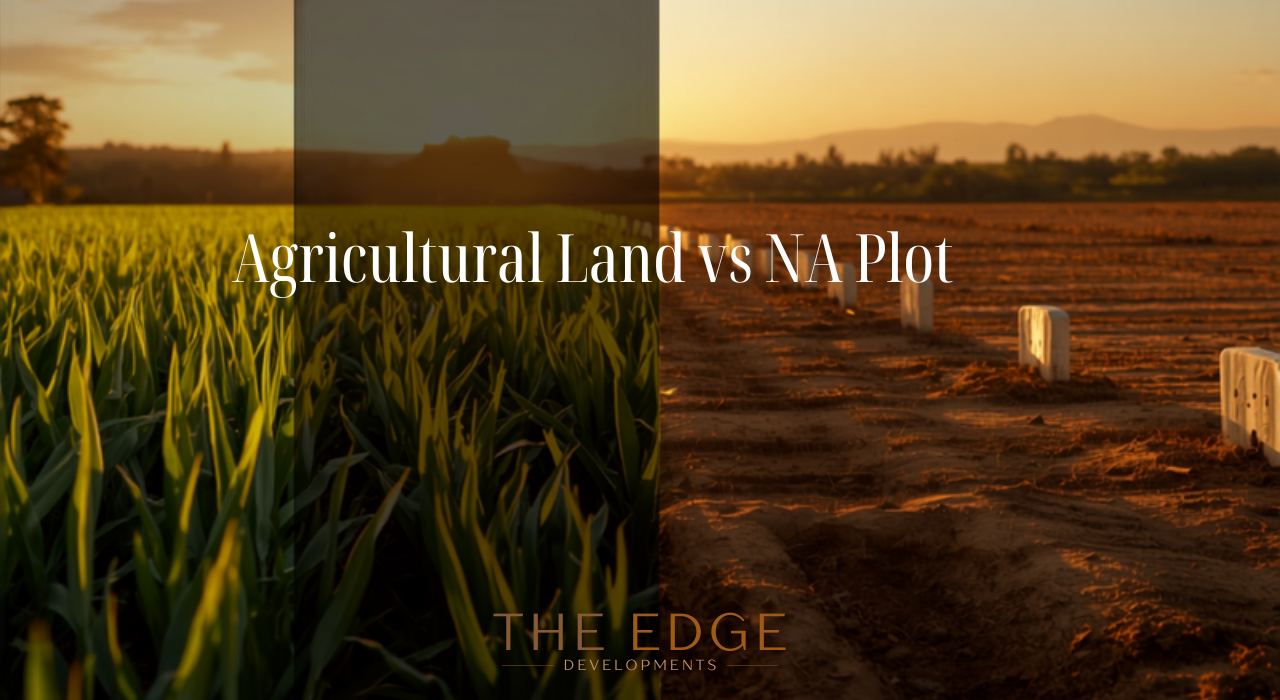
Split image of green agricultural farmland versus a demarcated NA plot — agricultural land vs NA plot Maharashtra
CategoriesLand Investment

Agricultural Land vs NA Plot: What’s the Difference and Which Should You Buy?

TL;DR — KEY TAKEAWAYS

  • Agricultural land = farmland (cultivation only); NA plot = legally converted for building. That difference decides everything.
  • You cannot build, sell to an NRI, or get a home loan on agricultural land — only on an NA plot.
  • NA plots cost 3–5x more than agricultural land, but carry legal certainty and immediate construction rights.
  • NA conversion takes 6–24 months and can be rejected — a strategy for experienced investors only.

Agricultural land is government-classified farmland that can only be used for cultivation. An NA (Non-Agricultural) plot is land that has been legally converted for residential, commercial, or industrial use by the District Collector. The difference determines what you can build, who can buy it, how you can finance it, and how much it is worth. This guide explains everything you need to know before deciding which to buy.

Reading time: 10 minutes | Last updated: July 2026 | Author: Girish Chhalwani, Founder & CEO, THE EDGE Developments

In Maharashtra, approximately 78% of the land area is classified as agricultural under the Maharashtra Land Revenue Code. Converting agricultural land to NA status requires formal approval from the District Collector and takes 6–24 months. Buying agricultural land without understanding this distinction is one of the most common — and costly — mistakes first-time land buyers make. — Source: Maharashtra Revenue Department 2025

What is the core difference between agricultural land and an NA plot?

Agricultural land is restricted to farming with no construction, no NRI purchase, and only agri loans; an NA plot allows building, NRI purchase, and home/plot loans — at 3–5x the price. The table shows every difference.

Parameter Agricultural Land NA Plot
Legal use Farming, cultivation only Residential / commercial / industrial
Construction allowed? No (except farm shed) Yes (as per FSI and building rules)
NRI purchase allowed? No (needs RBI approval) Yes (free purchase under FEMA)
Bank loan available? Agri loan only Home loan / plot loan available
RERA applicability No Yes (if part of project)
Price per sq.ft (Karjat) ₹200–600 ₹800–2,500
Development timeline Requires NA conversion first Can start construction immediately
7/12 classification “Jirayat” or “Bagayat” “NA” or “Sanad”

What is agricultural land in Maharashtra?

Under the Maharashtra Land Revenue Code (MLRC) 1966, agricultural land is any land used or capable of being used for cultivation. It is classified in the 7/12 extract as:

  • Jirayat: Unirrigated dry land (rain-fed cultivation)
  • Bagayat: Irrigated land (perennial water source)
  • Khajan: Low-lying salt water or marshy land

What you CAN do with agricultural land:

  • Farm, cultivate, grow produce
  • Build a small farm shed (with Gram Panchayat permission)
  • Lease it to farmers
  • Apply for NA conversion to change its use

What you CANNOT do:

  • Build a house, villa, or commercial structure
  • Sell it to an NRI without RBI permission
  • Register it as a RERA project
  • Subdivide and sell plots legally to the general public

What is an NA plot in Maharashtra?

An NA (Non-Agricultural) plot is land that has received formal conversion permission from the District Collector under Section 44 of the MLRC. The NA order specifies:

  • The permitted use (residential NA, commercial NA, industrial NA)
  • The plot area and survey number
  • Conditions of the conversion (completion timeline, development conditions)

After NA conversion, the 7/12 extract is updated to reflect the new status. Construction plans can be submitted to local authorities (Gram Panchayat, MMRDA, Municipal Council) for building permission.

Can you buy agricultural land and convert it to NA?

Yes — this is a common investment strategy. Buying agricultural land at lower prices (₹200–600/sq.ft) with the intention of converting to NA (and increasing value to ₹800–2,500/sq.ft) can deliver significant returns. However:

  • Timeline: NA conversion takes 6–24 months, sometimes longer
  • Approval is not guaranteed: The Collector can reject based on zone classification, proximity to forests, or development plan restrictions
  • Carrying cost: You are holding a non-income-generating asset during the conversion period
  • Risk: If conversion is rejected, you are left with agricultural land at a premium price

Recommendation: Agricultural land conversion is suitable for experienced investors with legal expertise, not for first-time buyers seeking a safe entry into land investment. See THE EDGE’s complete NA conversion process guide for the full filing procedure, realistic timelines, and true cost per acre.

Who should buy agricultural land?

  • Farmers or agri-entrepreneurs wanting farmland for cultivation
  • Experienced investors with legal expertise and patience for NA conversion
  • Developers who have already identified viable NA conversion prospects
  • Agri-tourism operators looking for large land parcels at competitive prices

Who should buy NA plots?

  • First-time land investors wanting legal clarity and immediate development rights
  • NRIs (the only legally unrestricted option under FEMA)
  • Weekend home buyers wanting to start construction without waiting for conversion
  • Anyone buying in a RERA-registered branded plotted development

What is the NA conversion process in Maharashtra?

You apply to the District Collector, who routes it to the Tehsildar for inspection; after zoning and clearance checks the Collector issues the NA order, you pay NA tax, update the 7/12, and apply for building permission.

  1. Apply to District Collector with 7/12 extract, property card, site plan, and reason for conversion
  2. Collector sends to Tehsildar (Talathi) for field inspection and report
  3. Revenue Department verifies zoning, forest adjacency, water body proximity
  4. Collector issues NA order (or rejection with reasons)
  5. Pay NA tax and development charges
  6. Update 7/12 extract with new NA classification
  7. Apply for building permission with local authority

Why does NA status multiply value?

NA conversion typically lifts value 3–4x because it unlocks construction rights, NRI eligibility, and bank finance. Karjat 2026 data:

Land Type Price Range (₹/sq.ft) Value Multiplier Post-NA
Agricultural (good location) ₹250–600 3–4x after NA conversion
NA (basic, no amenities) ₹800–1,500 Baseline
NA (branded project, RERA) ₹1,500–3,000 Premium on legal certainty + amenities

The value jump from agricultural to NA is real and significant. The risk is in the conversion timeline and approval uncertainty.

Frequently Asked Questions

Can I build a house on agricultural land in Maharashtra?

No. You cannot legally construct a residential building on agricultural land without first obtaining NA conversion from the District Collector. Structures built on agricultural land without NA status are liable for demolition by revenue authorities.

Can an NRI buy agricultural land in India?

No. Under FEMA regulations, NRIs cannot purchase agricultural land, farmhouses, or plantation properties in India without prior approval from the Reserve Bank of India. NRIs can freely purchase NA plots, residential properties, and commercial properties.

How long does NA conversion take in Maharashtra?

NA conversion typically takes 6–18 months in Maharashtra, depending on the taluka, district workload, and any objections raised during the verification process. In some cases, particularly near forest or water bodies, it can take longer or be denied.

Is agricultural land cheaper than NA plots?

Yes, typically 3–4 times cheaper per sq.ft. Agricultural land in Karjat is available at ₹250–600/sq.ft while NA plots trade at ₹800–2,500/sq.ft. The price difference compensates for the NA conversion cost, risk, and time — and the premium buyers pay for legal certainty and immediate construction rights.

What is the safest type of land to buy as a first-time investor?

An NA plot in a RERA-registered branded plotted development is the safest entry point for first-time land investors. It combines clear legal title, NA status, escrow protection, developer accountability, and planned infrastructure.

About the Author — Girish Chhalwani

Girish Chhalwani is the Founder & CEO of THE EDGE Developments, a RERA-registered plotted-development company in the Karjat–MMR corridor. With 20+ years in Maharashtra land acquisition, NA conversion, and infrastructure-led land investment, he advises HNI and NRI investors on land strategy near Mumbai.

 ·  About THE EDGE Developments

Explore RERA-Registered NA Plots in the Karjat–MMR Corridor

THE EDGE Developments offers legally clear, NA-converted plots — no conversion wait, no title guesswork — in Mumbai’s fastest-growing infrastructure corridor. Speak with our team for current pricing and a guided site visit.

Book a Consultation →

Aerial view of green land plots near Mumbai with Sahyadri mountains at golden sunrise — land investment 2026
CategoriesMarket Insights

Is Buying Land Near Mumbai a Good Investment in 2026?

THE EDGE — DIRECT ANSWER

Yes—buying land near Mumbai is a compelling investment in 2026, but only with a 5+ year holding horizon, clear legal title, and proper due diligence. NA plots in infrastructure corridors (Karjat, Khopoli, VAMC belt) delivered 15–25% CAGR between 2020–2025, outperforming Nifty 50. Five drivers converge now: the operational NMIA, the VAMC corridor, fixed land supply, post-pandemic weekend-home demand, and NRI capital inflows. Avoid if you need liquidity within 3 years or skip due diligence. The next appreciation wave is driven by infrastructure completion events through 2028.

TL;DR — KEY TAKEAWAYS

  • Yes — land near Mumbai is a good 2026 investment in infrastructure corridors, with clear title and a 5+ year hold.
  • NA plots in the Karjat/Khopoli/VAMC belt delivered 15–25% CAGR (2020–2025), beating the Nifty 50.
  • The next appreciation wave is driven by NMIA, the VAMC, and the Second Expressway reaching completion.
  • Avoid it if you need liquidity within 3 years or will not do proper legal due diligence.

Yes — buying land near Mumbai is a good investment in 2026, but only in the right locations, with clear legal title, and a minimum 5-year holding horizon. NA plots in infrastructure-adjacent corridors like Karjat, Khopoli, and the VAMC belt have delivered 15–25% CAGR over the last five years, outperforming equity markets and traditional real estate.

Reading time: 12 minutes | Last updated: July 2026 | Author: Girish Chhalwani, Founder & CEO, THE EDGE Developments

Land near Mumbai in infrastructure-growth corridors has appreciated 40–80% between 2020 and 2025. The Navi Mumbai International Airport (NMIA), Virar–Alibaug Multimodal Corridor, and the Second Mumbai–Pune Expressway are reshaping economic geography across the MMR, creating predictable land appreciation zones within 50–100 km of Mumbai. — Source: MSRDC Reports 2025, THE EDGE Developments Market Research

Why is Mumbai’s land market structurally different?

Because Mumbai is physically constrained and can only grow outward, a fixed supply of developable land meets relentless demand. Over ₹3 lakh crore of funded MMR infrastructure is now permanently expanding the city’s economic boundary — and land in its path gets absorbed.

Mumbai is India’s economic engine — generating over 6% of India’s GDP from a geography that is physically constrained. The island city cannot expand. Its suburbs have saturated. The only direction left is outward — into the Mumbai Metropolitan Region (MMR).

Over ₹3 lakh crore of infrastructure investment is being deployed across the MMR between 2022 and 2030. This is not speculative spending — these are under-construction, funded projects that are literally restructuring how far people can live from Mumbai and still commute efficiently. When infrastructure reduces travel time from 90 minutes to 40 minutes, it does not just save commute time — it permanently expands the economic boundary of the city.

Land that was beyond the boundary gets absorbed. Prices follow.

What does the 5-year data show on land appreciation near Mumbai?

NA plots in prime MMR corridors appreciated 80–200% between 2020 and 2025 — 12–25% CAGR depending on location — outperforming the Nifty 50’s ~14% over the same period.

Location 2020 Price (₹/sq.ft) 2025 Price (₹/sq.ft) 5-Yr Appreciation CAGR
Karjat (NA Plot) ₹400–600 ₹900–2,000 ~120–180% ~18–24%
Khopoli ₹350–500 ₹700–1,500 ~100–150% ~15–20%
Alibaug (coastal) ₹1,800–3,000 ₹5,000–10,000 ~150–200% ~20–25%
Panvel corridor ₹900–1,500 ₹2,500–4,500 ~100–150% ~18–22%
Igatpuri / Shahapur ₹180–300 ₹400–700 ~80–120% ~12–18%

For context: Nifty 50 delivered approximately 14% CAGR over the same period. Premium land near Mumbai has outperformed India’s benchmark equity index — with lower correlation to stock market volatility.

What are the 5 drivers making land near Mumbai compelling in 2026?

Five structural forces converge: the operational NMIA, the VAMC corridor, fixed land supply, post-pandemic weekend-home demand, and NRI capital inflows.

1. The Navi Mumbai International Airport (NMIA)

India’s largest greenfield airport — 60 million passengers per year capacity — is operational at Panvel. Every airport in modern history has generated a 30–50 km radius of sustained real estate appreciation. Karjat, Khopoli, Pen, and Uran all fall within this zone. The value creation from NMIA is in its early stages.

2. Virar–Alibaug Multimodal Corridor (VAMC)

The 126 km, ₹80,000 crore corridor will connect Virar in the north to Alibaug in the south, passing through the entire western MMR including Karjat and Khopoli. When complete, it will reduce end-to-end travel time from 4+ hours to under 90 minutes. Land along this spine is in its highest-appreciation window right now — during construction, before completion.

3. Fixed Land Supply

Unlike flats — where a developer can always add another floor — land near Mumbai cannot be manufactured. The area of legally developable, NA-converted land within 80 km of Mumbai is finite. As infrastructure reduces effective distance, demand for this finite supply accelerates.

4. Post-Pandemic Weekend Home Demand

The desire for clean air, open space, and personal retreats has permanently shifted upper-middle-class buyer preferences. This is not a passing trend — it is a lifestyle restructuring that has created structural demand for land and weekend homes within 60–90 minutes of Mumbai.

5. NRI Capital

NRIs invested over ₹1.5 lakh crore in Indian real estate in 2024. With the rupee offering 20–30% effective currency discount versus 2015 levels, Indian land represents significant value for dollar, dirham, and pound earners. NRI demand provides a strong floor under MMR land prices.

When is land near Mumbai a bad investment?

Land is the wrong choice if you need liquidity within 2–3 years, skip due diligence, over-rely on infrastructure promises, or buy from unregistered projects.

  • If you need liquidity within 2–3 years: Land is illiquid. Plan for minimum 5-year hold.
  • If you skip due diligence: Maharashtra’s land records are complex. Fraudulent NA claims, disputed titles, and encumbrances are common.
  • If you buy purely on infrastructure promise: Projects get delayed. Don’t be financially stretched by a timeline that extends.
  • If you buy from unregistered projects: Always verify RERA registration before any payment.

Who should buy land near Mumbai in 2026?

It suits 5–10 year investors, NRIs wanting India exposure, HNIs seeking an appreciating weekend home, and developers/JDA partners.

  • Investors with a 5–10 year horizon who want inflation-beating, real asset returns
  • NRIs wanting India exposure with lifestyle optionality
  • HNIs seeking a weekend home that also appreciates
  • Developers and JDA partners entering a development opportunity

What type of land should you buy in 2026?

Prioritise a RERA-registered NA plot for safety, a clear-title private NA plot for returns with rigorous verification, or agricultural land with conversion potential only if you are experienced.

  1. NA Plot in a RERA-registered branded project — highest legal safety, best for first-time buyers
  2. NA Plot (private sale with clear title) — good returns, requires thorough legal verification
  3. Agricultural land with conversion potential — highest upside, highest complexity; only for experienced investors

The Verdict

2026 is not too late to buy land near Mumbai — but the easy money from the lowest entry points (2019–2021) has already been made. The next wave of appreciation will be driven by infrastructure completion events: NMIA operations, VAMC opening, and expressway commissioning. Investors entering in 2026 with a 5–7 year view will still benefit meaningfully — but selectivity matters more now than it did five years ago.

Frequently Asked Questions

Is buying land a better investment than buying a flat near Mumbai?

For capital appreciation with a 5+ year horizon, land has historically outperformed flats in MMR peripheral markets. Flats offer rental income but structurally depreciate. Land appreciates and gives development optionality. Choose based on your liquidity needs and holding capacity.

What is the minimum budget to buy land near Mumbai in 2026?

NA plots in the Karjat–Khopoli corridor start from ₹25–40 lakh for 2,000–3,000 sq.ft. Premium branded plotted developments begin at ₹50–75 lakh. Agricultural land parcels can be found from ₹15–20 lakh, but carry higher legal complexity.

Which area near Mumbai has the best land ROI in 2026?

The Karjat–Khopoli–VAMC corridor offers the best risk-adjusted returns for 2026 entry. Panvel and Uran are also strong on NMIA demand. Alibaug remains premium but entry prices are now high. Karjat combines affordability, infrastructure timing, and lifestyle credentials.

Is it safe to buy land near Mumbai?

Yes, with proper due diligence. Verify the 7/12 extract, property card, encumbrance certificate, NA conversion order, and RERA registration. Engage a local property advocate. A RERA-registered branded project significantly reduces legal risk for first-time buyers.

What returns can I expect from land near Mumbai over 5 years?

Based on historical data from 2019–2024, NA plots in high-growth MMR corridors delivered 15–25% CAGR. Projections for 2026–2031, given infrastructure completion events, suggest similar or slightly lower appreciation of 12–20% CAGR in well-chosen locations.

Explore RERA-Registered Plots in the Karjat–MMR Corridor

THE EDGE Developments offers legally clear, NA-converted plotted developments in Mumbai’s fastest-growing infrastructure corridor. Speak with our team for current pricing and a guided site visit.

Book a Consultation →