
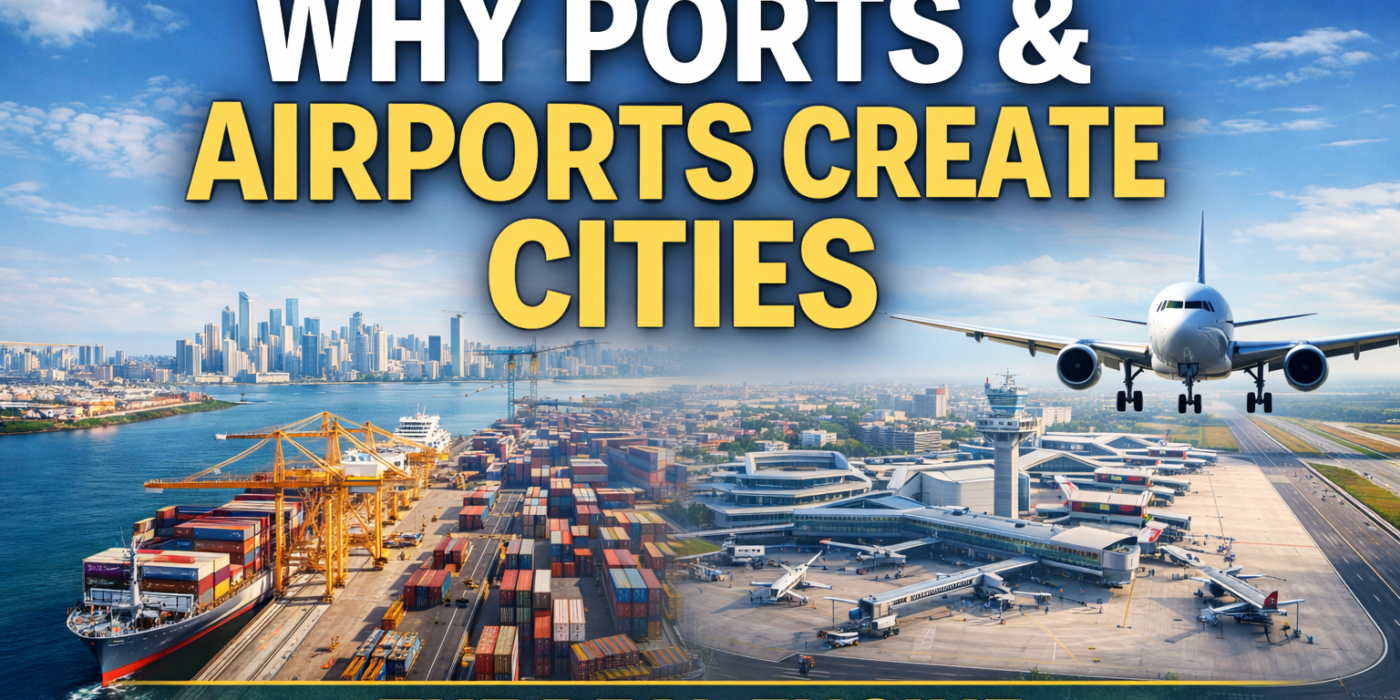
Why Ports and Airports Create Cities: The Hidden Architecture of Urban Growth
Cities are not accidents.
They are outcomes.
Long before skylines appear, before housing demand rises, and before real estate prices move, cities are quietly shaped by two forces that rarely make headlines but always decide destiny:
Ports and Airports.
Throughout history, every major global city has shared one common trait —
access to movement.
Movement of goods.
Movement of people.
Movement of opportunity.
Where movement concentrates, cities emerge.
The Old Truth We Keep Rediscovering
Trade created civilisation.
From ancient ports to modern aviation hubs, economic history repeats a simple pattern:
Where goods move efficiently, people follow.
Where people follow, cities are born.
Ports and airports are not infrastructure projects.
They are economic magnets.
They compress distance, reduce friction, and turn geography into advantage.
Ports: The Original City Builders
Before roads, before railways, before highways — there were ports.
Some of the world’s greatest cities began as simple trading posts:
Mumbai
Singapore
Shanghai
Rotterdam
London
Ports enabled:
Trade
Employment
Industry
Migration
Wealth circulation
Once trade stabilised, cities layered themselves around ports:
Warehousing and logistics
Manufacturing and processing
Worker housing
Markets, institutions, governance
Ports didn’t just support cities.
They created them.
Airports: The Modern Accelerators
If ports were the builders of old cities, airports are the accelerators of modern ones.
Airports collapse time.
A city that is one flight away becomes:
A business destination
A logistics hub
A tourism centre
A services economy
Airports don’t just move passengers.
They move capital, talent, and decision-makers.
This is why every global city invests heavily in airport-led development:
Airport cities
Aerotropolises
Logistics and cargo hubs
Business districts within 30–60 minutes of runways
Airports turn peripheral land into strategic real estate.
Why Ports and Airports Always Create Real Estate Demand
The sequence is predictable:
Infrastructure is built
Economic activity increases
Jobs are created
Migration begins
Housing demand rises
Social infrastructure follows
Cities formalise
Real estate demand is not the cause —
it is the consequence.
That’s why the smartest investors track:
Freight movement
Cargo capacity
Connectivity corridors
Policy focus on logistics and trade
Not advertisements.
Not hype.
India’s Shift: From City-Centric to Infrastructure-Led Growth
India is entering a phase where growth is no longer limited to a few metros.
The strategy is clear:
Decongest existing cities
Build new economic nodes
Anchor them around ports and airports
Let cities emerge organically
Projects like:
Port-led development corridors
New international airports
Dedicated freight corridors
Multimodal logistics parks
are not random investments.
They are city-making tools.
Mumbai as the Living Example
Mumbai itself is the proof.
The city didn’t grow because of real estate.
It grew because:
It was a port
It connected India to the world
Trade created opportunity
Opportunity attracted people
Today, Mumbai is repeating history — consciously.
Mumbai 3.0, Navi Mumbai Airport, port-led development in Konkan, and logistics corridors are all part of the same philosophy:
Let infrastructure lead. Cities will follow.
Why This Matters for the Next 20 Years
The next generation of Indian cities will not look like the old ones.
They will be:
Multi-nodal
Spread out
Infrastructure-first
Livability-driven
Logistics-backed
And at the centre of each will be either:
A port
An airport
Or both
This is not speculation.
It is urban economics.
The Investor’s Lens (Without the Hype)
For those who understand cycles, ports and airports signal one thing clearly:
Long-term inevitability.
They don’t promise overnight returns.
They promise structural growth.
Land around ports and airports appreciates not because of emotion —
but because demand becomes permanent.
The Bigger Insight
Cities don’t grow because people want to live there.
People live where:
They can work
They can trade
They can move
They can connect
Ports and airports make all four possible.
Everything else follows.
Final Thought
If you want to understand where cities will emerge tomorrow,
don’t look at skylines.
Look at:
Runways
Docks
Freight routes
Shipping lanes
That is where the future is being quietly built.
Cities are not imagined.
They are engineered by movement.