
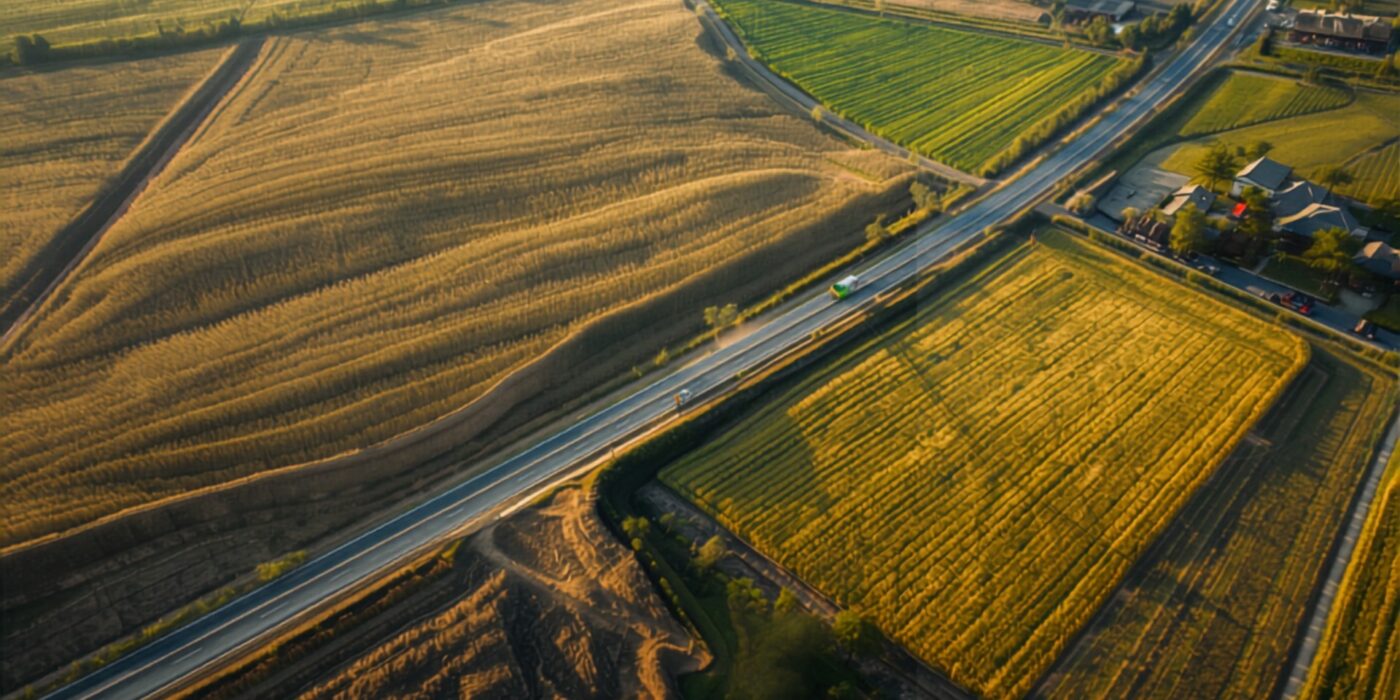
- The Baliraja Panand Raste Yojana is a Maharashtra government scheme focused on developing and formally recording “panand rastas” — farm access roads that connect individual agricultural plots to the main village road network.
- Many agricultural plots historically relied on informal, undocumented access paths, which has created disputes when neighboring landholders block or alter these paths.
- Formalizing panand rasta records under this scheme, pushed forward as part of Revenue Minister Chandrashekhar Bawankule’s 2026 initiatives, gives farmers documented legal access rights, not just customary use.
- For land buyers, confirming that a plot has a formally recorded access road — not just an informal path — is an important and often overlooked due-diligence item, especially for interior agricultural plots.
Reading time: 6 min | Last updated: July 2026 | By Girish Chhalwani, Founder & CEO, THE EDGE Developments
The Baliraja Panand Raste Yojana addresses a practical but often overlooked problem in Maharashtra’s rural land ecosystem: many agricultural plots depend on informal farm access roads (panand rastas) that were never formally recorded, leaving farmers vulnerable to access disputes when a neighboring landholder blocks or alters the path. As part of Revenue Minister Chandrashekhar Bawankule’s 2026 land record push, formalizing these access roads has direct relevance not just to farmers using them daily, but to anyone buying interior agricultural land that depends on such a path for basic access.
What Is a Panand Rasta?
A panand rasta is a farm access road or path — often informal, sometimes just a customary right-of-way across or between plots — that connects individual agricultural fields to the main village road network. These paths have traditionally existed by convention rather than formal legal documentation, which has worked reasonably well in stable rural communities but creates real problems when land changes hands, family disputes arise, or a neighboring landholder decides to obstruct the path.
What the Scheme Aims to Do
| Focus | Benefit |
|---|---|
| Physical road development | Improving the actual condition of farm access roads for better usability, especially during monsoon |
| Formal record-keeping | Documenting the access road’s existence and route in land records, giving it legal standing |
| Dispute reduction | Reducing access-blocking disputes by giving farmers documented rights rather than relying on informal custom |
Why This Matters for Land Buyers
- Interior plots depend entirely on access. A plot with excellent soil and location is worth far less if there’s no reliable, legally recognized way to reach it — confirming a formally recorded access road is essential due diligence, not a minor detail.
- Informal access is a real risk. If a plot’s only access is an informal path across a neighbor’s land with no documentation, that access can be legally challenged or physically blocked after purchase, leaving the buyer with a landlocked or difficult-to-reach plot.
- Formal records add resale value. A plot with documented, legally recognized access is inherently more marketable and bankable than one relying on undocumented customary use.
“Access is one of those things buyers assume is fine because they drove up to the plot during a site visit. But if that access road isn’t formally recorded, it can be contested or blocked later, and you’d be surprised how often that happens between neighbors who don’t get along. Ask specifically whether the access path to an interior plot is documented, not just whether it currently exists.” — Girish Chhalwani, Founder & CEO, THE EDGE Developments
How to Check Access Road Status Before Buying
- Confirm whether the plot’s access road is formally recorded in land records or under the Baliraja Panand Raste Yojana specifically.
- If informal, ask the seller and, ideally, the local Talathi about the history and stability of that access arrangement.
- Cross-check the access route against the Bhunaksha map to understand exactly how the path relates to neighboring survey numbers.
- For interior plots with no confirmed formal access, factor this risk explicitly into your valuation and negotiation.
Access Roads as Part of the Broader Pre-Purchase Verification Push
Farm access road documentation sits alongside two other 2026 reforms that share the same underlying goal: confirming physical, on-ground reality before a transaction closes rather than after. The “measure first, register later” sequencing reform applies this exact logic to plot boundaries and area — verify the physical facts, then register. Water body boundaries are undergoing the same treatment under the Water 7/12 initiative. Buyers evaluating an interior agricultural plot should treat access road status as one item on the same due-diligence checklist as boundary and water-body verification — none of these checks are optional extras; together they confirm the plot is actually what it appears to be on paper.
FAQ
What is the Baliraja Panand Raste Yojana?
It’s a Maharashtra government scheme focused on developing and formally recording farm access roads (panand rastas) that connect agricultural plots to the main road network.
What is a panand rasta?
A panand rasta is a farm access road or path, often informal, connecting individual agricultural fields to the village road network.
Why does formal documentation of access roads matter?
Without formal records, access paths rely on informal custom, which can be disputed or blocked by neighboring landholders, leaving a plot difficult to reach.
How do I check if a plot has documented access?
Verify with the local Talathi office and cross-check the access route against a Bhunaksha map before purchasing an interior agricultural plot.
Should I be concerned about buying land with only informal access?
Yes — informal, undocumented access carries real risk of future disputes or obstruction, and should be factored into your due diligence and valuation.
Citations & Sources
- Maharashtra Revenue & Forest Department, 2026 policy announcements
- Office of the Revenue Minister, Government of Maharashtra
Related Reading
- Start here (pillar): Maharashtra Land Records Portals: The Complete Directory of Government Websites
- Bhunaksha Maharashtra: Verifying Land Boundaries & Survey Maps via Government GIS
- First-Time Land Buyer’s Checklist: 10 Due Diligence Steps
- Common Land Disputes in Maharashtra: Patterns, Causes & How to Avoid Them
- Case study: Infrastructure-Triggered Land Appreciation: Karjat Corridor Case Study
- Gunthewari Regularisation in Maharashtra: What It Means for Unauthorized Layouts
- Measure First, Register Later: Bawankule’s 2026 Sequencing Reform for Land Transactions
- Talk to us: Contact THE EDGE
Interior Plot? We Verify Access Before You Buy
THE EDGE Developments confirms formal access road status on every interior agricultural plot we recommend.
connect@theedgedevelopments.com | Phone: +91-9664662938