
TL;DR — KEY TAKEAWAYS
- India’s eco-luxury real estate segment grew 35-40% CAGR from 2021-2025, driven by HNI and NRI demand for sustainable second homes.
- Genuine eco-luxury commands a 25-40% price premium over conventional villas, rising to 50% for NRI buyers seeking certified green credentials.
- Five categories exist — sustainable private villas, farm communities, nature retreat communities, eco-resort residential, and regenerative farm estates — spanning ₹50 lakh to ₹8 Cr.
- Eco-luxury rental yields run 7-10% per annum near Karjat, with Airbnb rates 30-50% above standard villas in the same location.
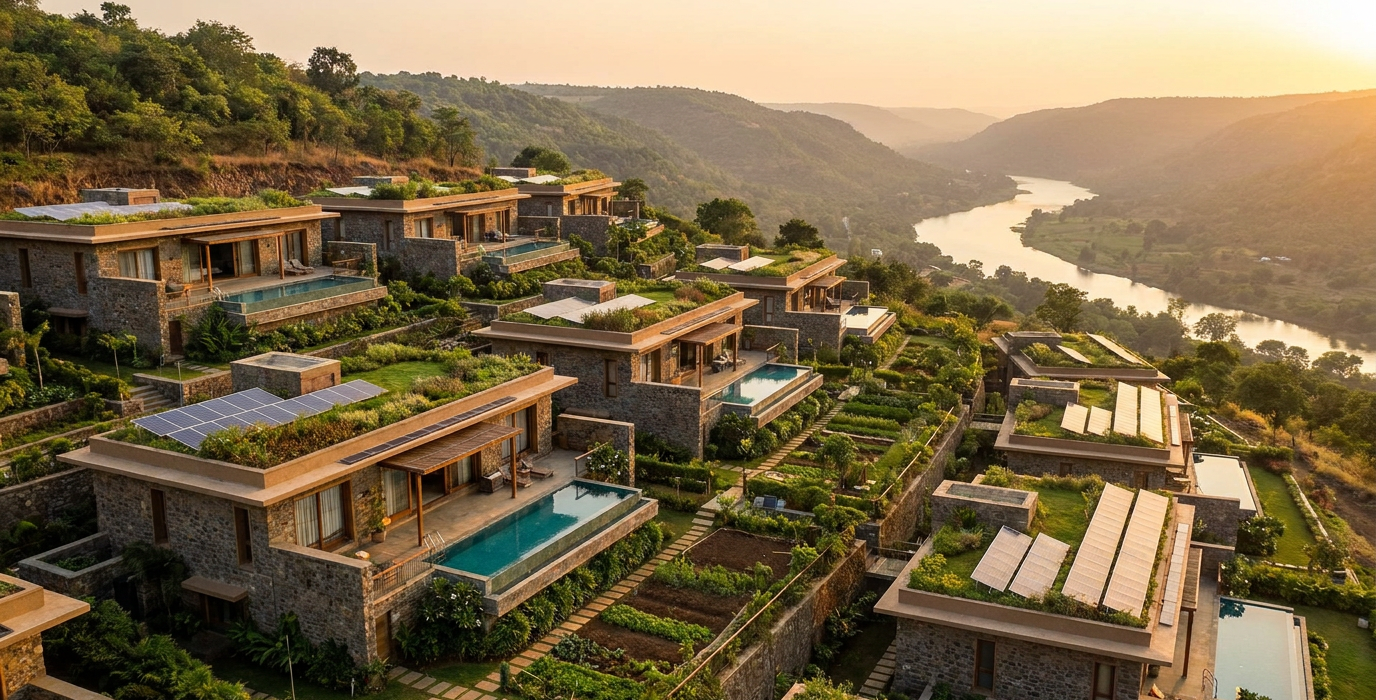
There is a segment of Indian real estate buyers who are no longer choosing between luxury and sustainability — they are demanding both. They want spaces that feel expensive and feel responsible. They want swimming pools, but solar-heated. Villas, but built with locally sourced materials. Weekend retreats, but designed to reduce their carbon footprint rather than expand it.
This is eco-luxury real estate — and it is India’s fastest-growing second-home segment.
Reading time: 13 minutes | Last updated: July 2026 | Author: Girish Chhalwani, Founder & CEO, THE EDGE Developments
India’s eco-luxury real estate segment — comprising sustainable villas, farm communities, nature retreats, and eco-resort-style residential developments — grew at a 35–40% CAGR between 2021 and 2025, driven by post-pandemic lifestyle reorientation, rising HNI and NRI demand for “meaningful” second homes, and growing buyer willingness to pay a 25–40% premium for genuine sustainability credentials over conventional villas. The Karjat–Khopoli–Alibaug corridor near Mumbai is the primary geography for this segment’s growth in Maharashtra. — Source: ANAROCK Second Home & Luxury Report 2024; JLL India Sustainable Real Estate Report 2024
What Is Eco-Luxury Real Estate — and What Isn’t It?
Eco-luxury is premium residential design combined with genuine sustainability features — not a marketing label slapped on standard construction.
Eco-luxury is NOT:
- A developer putting “eco” in the project name without any sustainability features
- Standard villas with a few solar panels added as an afterthought
- Greenwashing — sustainability claims that don’t survive basic scrutiny
Eco-luxury IS:
- Design that integrates with the natural environment rather than clearing it
- Materials that are locally sourced, recycled, or have low embodied carbon
- Energy systems that are predominantly renewable (solar, wind, biogas)
- Water systems that are circular — rainwater harvesting, greywater recycling
- Waste management that achieves near-zero landfill output
- A premium experiential offering that makes buyers feel good AND do good
What Are the 5 Categories of Eco-Luxury Real Estate Near Mumbai?
The five categories range from sustainable private villas to large regenerative farm estates, spanning roughly ₹50 lakh to ₹8 Cr.
1. Sustainable Private Villas
Custom-built or developer-built villas on NA plots using sustainable construction practices. Features include green roofs, passive cooling design, solar electricity, rainwater harvesting, and organic gardens. Price range in Karjat corridor: ₹1.5–5 Cr.
2. Farm Communities
Curated communities of 20–50 families sharing a working farm. Residents own individual plots/villas while farming infrastructure (greenhouses, orchards, equipment) is shared. The appeal: genuine farm-to-table experience with luxury amenities. Price range: ₹50 lakh–2 Cr for plot + farm share.
3. Nature Retreat Communities
Developments designed around a specific natural asset — a river, forest, hilltop, or valley. Architecture is low-rise, non-intrusive, and designed to enhance the natural experience. Amenities focus on outdoor experiences — trekking, kayaking, birdwatching — rather than conventional club facilities.
4. Eco-Resort Residential
Resort-branded residential developments where the eco-resort manages the property, provides housekeeping and F&B services, and the owner participates in a rental pooling arrangement. Blends vacation ownership with income-generating investment.
5. Regenerative Farm Estates
The most premium category — large estates (3–10 acres) operated on regenerative agriculture principles with full-time farm management. Owners receive organic produce, carbon offset credits, and a nature-immersive lifestyle. Limited supply ensures strong appreciation.
The premium attached to genuine eco-luxury features in Indian residential real estate is now measurable and substantial. Projects with third-party green certification (GRIHA, IGBC Green Homes), solar energy systems achieving ≥70% energy independence, and certified organic farming components command 25–40% premium over conventional projects in the same location. Buyers in the NRI segment pay up to 50% premium for eco-luxury credentials — driven by alignment with global sustainability standards and the belief that green assets will attract stronger future buyers. — Source: JLL India Sustainable Real Estate Report 2024; IGBC Rating Data 2024
Where Is Eco-Luxury Real Estate Concentrated Near Mumbai?
Karjat, Alibaug, Lonavala-Mulshi, and Igatpuri-Nashik are the four primary geographies, each built around a distinct natural asset.
| Location | Natural Asset | Eco-Luxury Niche | Price Range |
|---|---|---|---|
| Karjat (river-facing) | Ulhas River, hills, forests | River retreat, nature community, farm villa | ₹80 lakh–2.5 Cr |
| Alibaug (sea-facing) | Arabian Sea, coconut groves | Coastal eco-villa, farm-to-table estate | ₹2–8 Cr |
| Lonavala–Mulshi | Sahyadri ghats, lakes | Hilltop eco-retreat, forest community | ₹1.5–5 Cr |
| Igatpuri–Nashik | Vineyards, waterfalls, tribal forests | Vineyard estate, off-grid farm retreat | ₹60 lakh–3 Cr |
How Do Eco-Luxury Weekend Homes Perform as Rental Assets?
Eco-luxury weekend homes near Karjat generate 7-10% annual rental yield, with Airbnb rates 30-50% above comparable standard villas.
- Eco-luxury properties on Airbnb command a 30–50% premium over standard villas in the same location
- Guests actively filter for “eco-friendly” properties — demand exceeds supply in the Karjat–Lonavala belt
- Farm communities and river-facing properties attract a guest profile with 40–60% higher booking frequency and longer average stays than conventional villas
- Rental yield for a well-operated eco-luxury villa near Karjat: 7–10% per annum
What Should You Verify Before Buying Eco-Luxury Real Estate?
Verify documented green claims, third-party certification, CRZ compliance, genuine farm management, and a real post-handover maintenance model — not just marketing language.
- Demand documentation of all green claims — solar capacity in kW, % energy independence, water recycling system specifications
- Check if any third-party certification is in place or committed (GRIHA, IGBC) — not just aspirational
- Verify that CRZ (Coastal Regulation Zone) restrictions don’t apply if buying near a river, sea, or wetland
- Confirm that the “organic farm” is maintained by a qualified team — not just a kitchen garden
- Understand the maintenance model — eco-luxury operations require skilled management; ensure the developer has this in place post-handover
FAQs: Eco-Luxury Real Estate India
- What is eco-luxury real estate in India?
- Eco-luxury real estate combines premium residential design with genuine sustainability features — solar energy, rainwater harvesting, locally sourced materials, organic farming, and nature-integrated architecture. In India, the segment is primarily concentrated near Mumbai (Karjat, Alibaug, Lonavala), Goa, and the Nilgiris. It commands a 25–50% price premium over conventional villas in the same location.
- What is a farm community in Indian real estate?
- A farm community is a curated residential development — typically 20–60 families — sharing a working farm infrastructure (greenhouse, orchards, kitchen garden, composting) while each family owns a private villa and plot. Residents receive farm produce, participate in farming activities, and enjoy a farm-to-table lifestyle with premium amenities. This concept has grown rapidly near Mumbai post-2020.
- Do eco-luxury properties deliver better rental income than standard villas?
- Yes. Eco-luxury properties on Airbnb command 30–50% higher nightly rates than comparable standard villas, have 20–30% higher booking rates, and attract guests with longer average stays. Certified organic farm access, river-facing locations, and genuine solar/off-grid credentials are the features that most strongly drive Airbnb premiums in the Mumbai corridor.
- What certifications should I look for in eco-luxury real estate in India?
- Third-party sustainability certifications to look for: IGBC Green Homes rating (Indian Green Building Council), GRIHA rating (Green Rating for Integrated Habitat Assessment), and LEED India certification. Specific eco-features to verify: solar energy achieving ≥60% energy independence, zero-liquid discharge water systems, and verified organic farming practices.
Eco-Luxury Living Near Mumbai — Designed by THE EDGE
THE EDGE Developments integrates eco-luxury principles into all projects in the Karjat corridor — river-facing sites, sustainable construction, solar-ready infrastructure, and organic landscaping. Explore current project availability.
Contact: info@edgerea.com | +91-9664662938 | edgere.in