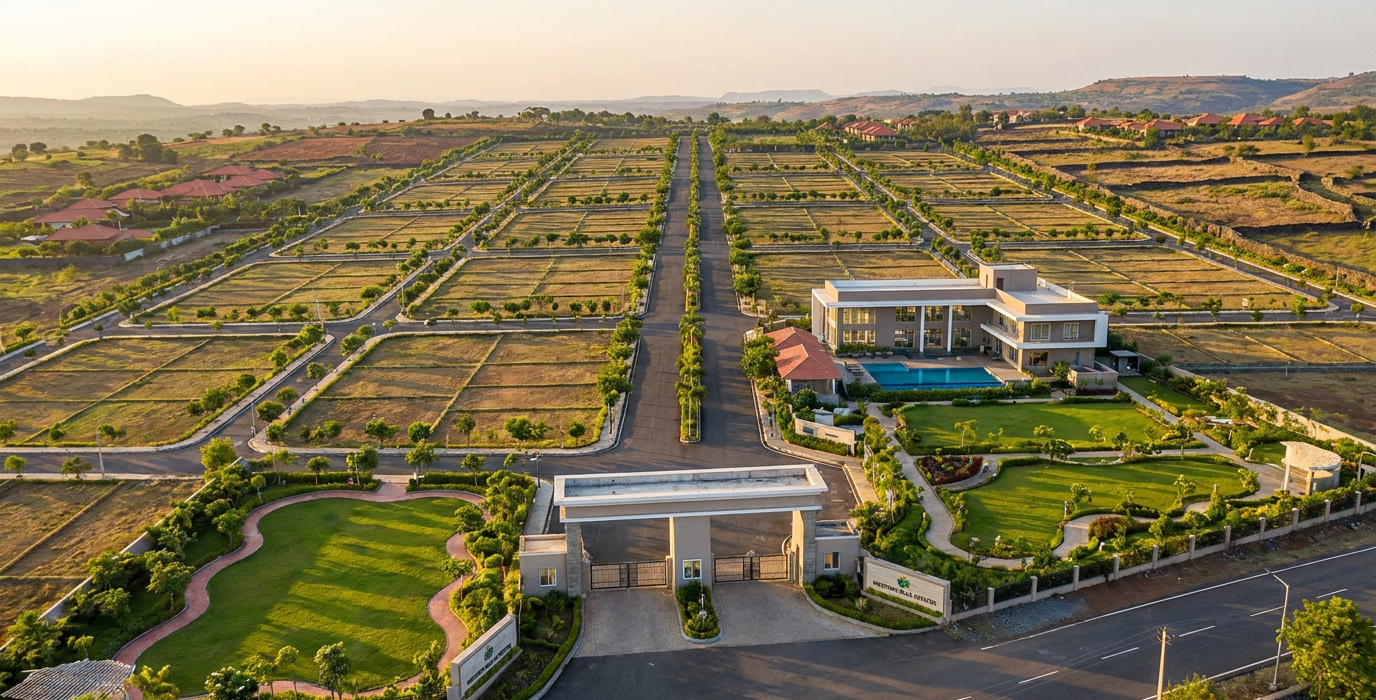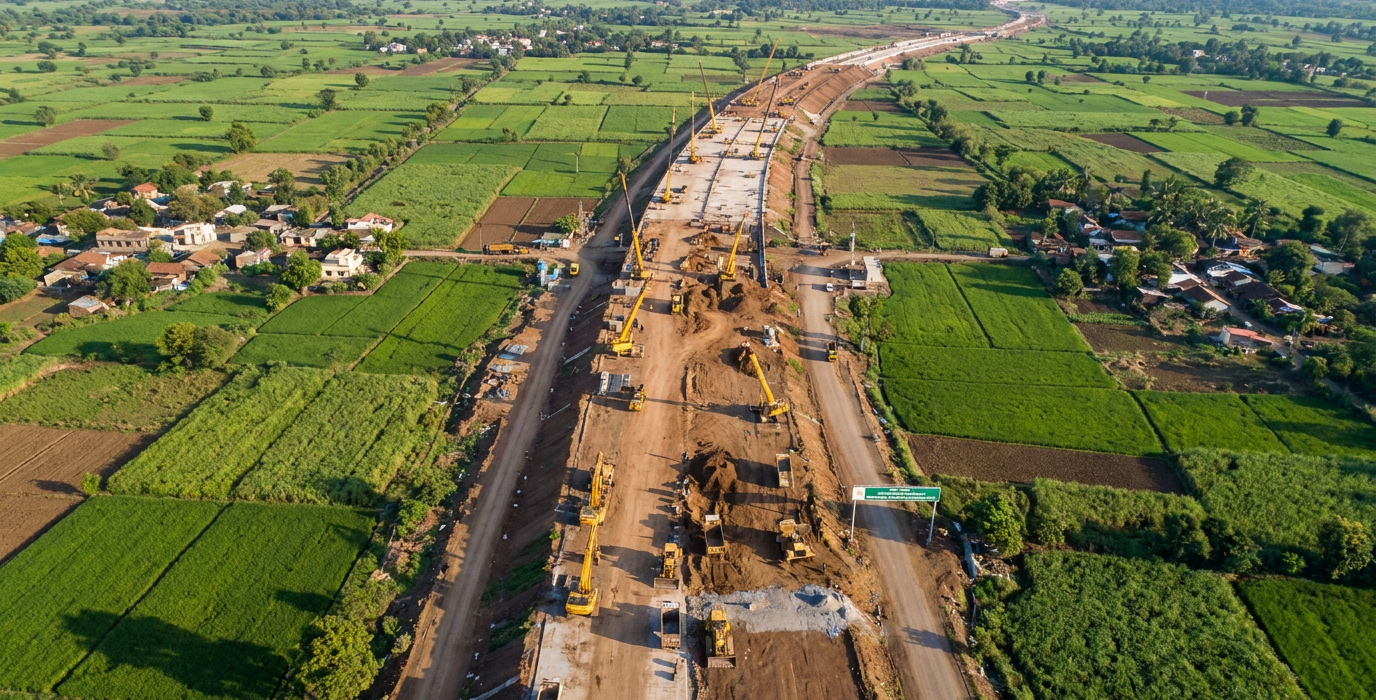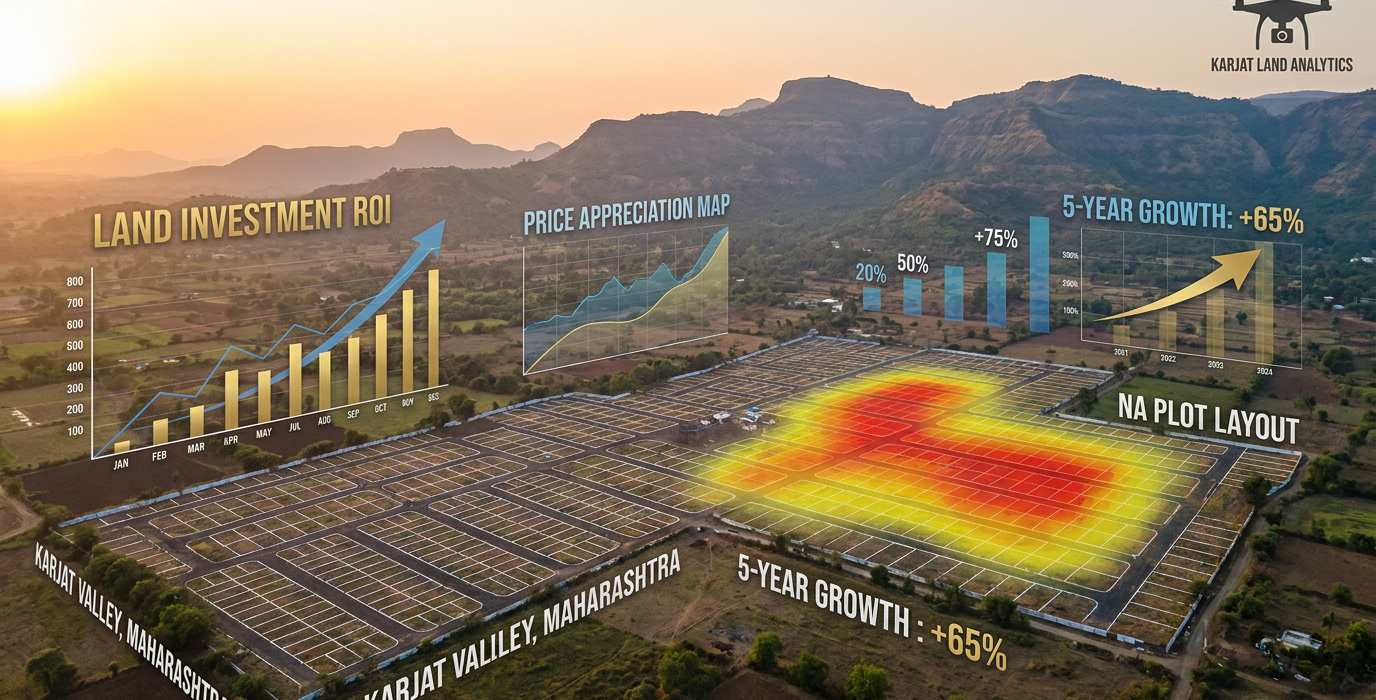
Aerial view of patchwork green farmland at sunset with location pins and the title about NA Plots and non-agricultural land in Marashir
CategoriesLand Investment Mumbai 3.0 Uncategorized

What is an NA Plot? The Complete Guide to Non-Agricultural Land in Maharashtra

TL;DR — KEY TAKEAWAYS

  • NA (Non-Agricultural) status is government permission to build on land — without it, land near Mumbai cannot be legally developed, financed, or freely resold.
  • Agricultural land can’t be sold to non-farmers, bank-financed, or built on; NA plots can.
  • Verify NA status on the 7/12 extract (NA order number) at mahabhulekh.maharashtra.gov.in — never trust a broker’s word.
  • NA plots cost 15–30% more than agricultural land but carry far lower legal risk — for investors, the only safe choice.

If you are researching land investment near Mumbai, you will encounter the term “NA plot” repeatedly — it is the single most important legal classification that separates a safe, investable land parcel from one that carries legal risk. Yet most buyers — even experienced investors — cannot clearly explain what NA means, how it works, or why it matters.

This is the definitive guide to NA plots in Maharashtra, based on over two decades of land transactions across the Mumbai Metropolitan Region.

Reading time: 11 minutes | Last updated: July 2026 | Author: Girish Chhalwani, Founder & CEO, THE EDGE Developments

What does NA mean in real estate?

NA stands for Non-Agricultural. In Maharashtra, all land is classified under the Maharashtra Land Revenue Code (MLRC). By default, land outside city limits is classified as agricultural land — it can only be used for farming, and its sale to non-farmers is heavily restricted.

An NA order is a government permission that converts a plot from agricultural use to non-agricultural use — allowing it to be used for residential, commercial, or industrial purposes. Once a plot receives NA status, it can be legally purchased by anyone (including non-farmers), developed for construction, and freely sold without restriction.

In simple terms: NA status is what makes land investable and developable. Without it, a “land deal” near Mumbai may be legally unbuildable and almost impossible to resell.

Why does NA status matter for land investment near Mumbai?

Maharashtra’s land classification system creates a critical distinction between two types of plots commonly sold near Mumbai:

  • Agricultural land (7/12 shows “Jirayat” or “Bagayat”): Restricted. Cannot be sold to non-farmers without government permission. Cannot be legally developed. Cannot be bank-financed.
  • NA plot (7/12 shows NA order number): Unrestricted. Can be sold to anyone. Can be developed per DP/TP zoning. Eligible for bank home loans and construction finance.

Buyers who purchase agricultural land thinking it is equivalent to an NA plot discover — often years later — that their land cannot be developed, mortgaged, or easily resold. This is one of the most common and costly mistakes in Maharashtra land investment.

What are the types of NA orders in Maharashtra?

Not all NA plots are the same. The type of NA order determines what you can build:

  • NA Residential: Permitted for residential construction — bungalows, villas, plotted layouts. The most common type sought by second-home and villa buyers in Karjat, Alibaug, and Lonavala.
  • NA Commercial: Permitted for shops, offices, hotels, and hospitality. Relevant for tourism projects and resort developments.
  • NA Industrial: Permitted for factories, warehouses, and manufacturing. Found in MIDC areas and logistics corridors.
  • NA Farm House: A specific category permitting a farm house of defined size on larger agricultural holdings — different from full NA residential conversion.

How do you verify NA status on a plot in Maharashtra?

Check the 7/12 extract for the NA order number, obtain the original NA order certificate from the Collector, cross-check the 8-A for ownership, and confirm everything at source on the Bhulekh portal.

  1. 7/12 Extract (Satbara Utara): The revenue record that shows the plot’s land use classification. An NA plot will show the NA order number in the “Other Rights” (Itar Hakk) column or the mutation entries.
  2. NA Order Certificate: The original government order converting the land to NA status. Must be issued by the District Collector or relevant authority.
  3. 8-A Extract: Shows ownership records — confirm the seller’s name matches the 7/12 and sale documents.
  4. RERA Certificate: For plotted layouts and villa projects, RERA registration confirms the project has undergone regulatory scrutiny including NA verification.
  5. Property Card (Milkat Patrak): For plots within municipal limits — confirms urban land classification.

Pro tip: Always verify NA status directly on the Maharashtra government’s Bhulekh portal (mahabhulekh.maharashtra.gov.in) and cross-reference with the original NA order. Never rely solely on a broker’s verbal assurance.

NA plot vs agricultural land: key differences

Feature NA Plot Agricultural Land
Who can buy Anyone Only farmers (restricted)
Construction permitted Yes Only farm structures
Bank finance available Yes Very limited
Resale ease High Low (restricted buyer pool)
RERA applicable Yes (layouts) No
Price premium Higher (15-30% vs agri) Lower base price
Legal risk Low (if verified) High (if sold to non-farmer)

Where are the best locations for NA plots near Mumbai?

The best locations for legally clear NA plots with strong appreciation potential near Mumbai are:

  1. Karjat — NA residential plots with 15-25% CAGR, 55 minutes from Navi Mumbai Airport. THE EDGE Developments’ Edge County Estate offers RERA-compliant NA plots with full title clearance.
  2. Khopoli-Khalapur — NA residential and commercial plots in the Second Mumbai-Pune Expressway corridor.
  3. Alibaug — Premium NA plots for second homes and eco-resorts, 1.5 hours from South Mumbai by ferry.
  4. Panvel — NA plots in the airport influence zone, strong commercial and residential appreciation expected.
  5. Shrivardhan — Early-stage NA plots on the Konkan coast, significant appreciation potential ahead of Dighi Port development.

Most disputes in Maharashtra land investment trace back to one error: the buyer assumed NA status without verifying the order on the 7/12. An NA certificate shown by a broker is not the same as an NA order recorded on the revenue document. Always verify at source — the Bhulekh portal doesn’t lie, people do. — Girish Chhalwani, Founder & CEO, THE EDGE Developments

Frequently Asked Questions

Can I convert agricultural land to NA myself?

Yes. The process involves filing an application with the District Collector under Section 42 or 44 of the Maharashtra Land Revenue Code. However, conversion is not guaranteed — it depends on the land’s location relative to development zones, CRZ status (coastal areas), forest reservations, and local development plans. See THE EDGE’s complete NA conversion process guide for the full step-by-step filing procedure.

How much does NA conversion cost?

NA conversion fees in Maharashtra depend on the district, land area, and intended use. Typically, conversion fees range from ₹50 to ₹300 per square metre, plus stamp duty on the conversion order. Legal and consultancy fees add to this. Total NA conversion costs for a 10,000 sq.ft. plot in Raigad district typically range from ₹2 to ₹10 lakh.

Is an NA plot safe to buy for investment?

A properly verified NA plot with clear title, registered sale deed, RERA-compliant project documentation, and a valid NA order is one of the safest real estate investments available in Maharashtra. The key is verification — which is why THE EDGE Developments conducts rigorous legal due diligence on every plot in its portfolio before offering it to investors.

How do I check if a plot is NA in Maharashtra?

Download the 7/12 extract from mahabhulekh.maharashtra.gov.in and look for the NA order number in the “Other Rights” column, then cross-check it against the original NA order certificate from the Collector’s office. For projects, also verify MahaRERA registration.

Buy Verified NA Plots Near Mumbai

THE EDGE Developments offers RERA-registered, NA-verified plots with full title clearance across the Karjat–MMR corridor. We do the due diligence so you buy with zero NA-status risk.

Contact: connect@theedgedevelopments.com | +91-9664662938 | edgere.in

Modern hillside villas with private pools and lush landscaping overlooking a river valley and distant mountains.
CategoriesEco Living Uncategorized Weekend Homes

Sustainable Living Near Mumbai: Top Locations, Lifestyle & Investment Guide 2025

TL;DR — KEY TAKEAWAYS

  • Sustainable living near Mumbai means clean air (AQI below 60), water independence, food production space, natural building materials, and like-minded community — not just a lifestyle label.
  • Karjat leads the category, with AQI consistently 40–65, high groundwater tables, and temperatures 3–5°C below Mumbai, backed by established rail connectivity.
  • Sustainable eco-luxury properties near Mumbai command a 20–35% price premium over conventional construction in the same micro-location, and the premium is widening.
  • Five locations stand out for different reasons — Karjat for overall investment, Bhimashankar-Chowk for deep eco living, Shrivardhan-Murud for coastal lifestyle, Alibaug for established luxury, and Khopoli-Khandala for elevation living.

Sustainable living near Mumbai means choosing a location and building approach that delivers clean air, water independence, food-growing capacity, natural materials, and genuine community — while staying within reach of the city. The concept has moved from fringe ideology to mainstream investment thesis. In 2025, more Mumbai families than ever are actively searching for ways to live more intentionally — with clean air, organic food sources, natural building materials, and genuine community — while remaining within reach of the city for work and family.

This guide by Girish Chhalwani, Founder & CEO of THE EDGE Developments, maps the best sustainable living destinations near Mumbai, what “sustainable” actually means in the context of near-Mumbai real estate, and how eco-conscious living overlaps with sound investment strategy.

Reading time: 12 minutes | Last updated: July 2026 | Author: Girish Chhalwani, Founder & CEO, THE EDGE Developments


What Does Sustainable Living Near Mumbai Actually Mean?

Sustainable living near Mumbai rests on five non-negotiables: air quality, water independence, food production capacity, natural building materials, and community. In the context of near-Mumbai real estate, sustainable living encompasses several dimensions that buyers increasingly treat as non-negotiable:

  • Air quality: Living where the AQI is below 60 (Good category) year-round — a threshold Mumbai’s urban core rarely meets. Karjat, Alibaug, and Bhimashankar-Chowk all qualify.
  • Water independence: Access to borewell water, rainwater harvesting, or natural springs — not dependence on municipal supply that can be intermittent and chemically treated.
  • Food production: Space to grow vegetables, herbs, or fruit trees. Even a 3,000 sq.ft. NA plot can support meaningful kitchen garden production.
  • Natural building materials: Bamboo, stone, lime plaster, and timber — structures that breathe, regulate temperature naturally, and carry no toxic off-gassing from synthetic construction materials.
  • Community: Living among like-minded families with shared values around nature, children’s education, and intentional lifestyle choices.

What Are the Top Locations for Sustainable Living Near Mumbai?

Karjat, Bhimashankar-Chowk, Shrivardhan-Murud, Alibaug, and Khopoli-Khandala each offer a distinct version of sustainable living near Mumbai.

1. Karjat — Best Overall for Sustainable Living Investment

Karjat leads the near-Mumbai sustainable living landscape for a compelling combination of reasons: AQI consistently below 65, river valley setting with abundant ground water, cooler temperatures (3-5°C below Mumbai on summer days), well-established rail connectivity (Karjat railway station on the Central line), and a growing community of relocating urban families building their second and primary homes here.

THE EDGE Developments’ Edge County Estate is designed around sustainable luxury principles — bamboo and natural stone architecture, passive cooling design, and a site ecology that is enhanced rather than disrupted by development.

Sustainable living indicators: AQI 40-65, groundwater table high (3-8m depth in many areas), average summer temperature 32-35°C (vs. 38-42°C in Mumbai), river frontage available in multiple sub-locations.

2. Bhimashankar-Chowk Corridor — Best for Deep Eco Living

The Bhimashankar Wildlife Sanctuary and the Chowk valley below it represent the most genuinely wild, ecologically rich corridor within 3 hours of Mumbai. This is not mainstream real estate — it is for buyers who want deep immersion in forest living, wildlife proximity, and a near-complete disconnection from urban density.

Sustainable living here means: perennial streams, 100% renewable energy feasibility, organic farm potential on red-laterite soil, and air quality that is exceptional year-round (AQI 25-45). The trade-off: limited social infrastructure, no railway, and an investor market that is early-stage and illiquid.

3. Shrivardhan-Murud (Konkan Coast) — Best for Coastal Sustainable Living

For families drawn to the ocean, Shrivardhan and Murud on the Konkan coast offer a sustainable coastal lifestyle that is almost extinct within 4 hours of any major Indian city. Fishing villages, organic coconut and cashew cultivation, tidal creeks, and sea breezes create a genuinely different quality of life from anything available closer to Mumbai.

With Dighi Port development still in early stages, the pace of change here is slow — which is precisely its appeal for families seeking sustainable lifestyle over rapid urban development.

4. Alibaug — Best Established Sustainable Luxury

Alibaug has led the near-Mumbai eco-luxury market for two decades. Biodynamic farms, farm-to-table restaurants, wellness retreats, and a community of design-conscious, sustainably-minded families make it the most developed sustainable living ecosystem near Mumbai. Price reflects this maturity — but the lifestyle infrastructure is unmatched.

5. Khopoli-Khandala Hills — Best for Elevation Living

The elevated terrain between Khopoli and Khandala (550-780m above sea level) offers natural climate control that no other near-Mumbai location can match — temperatures 6-8°C below Mumbai even in peak summer, morning cloud cover, and dramatic Western Ghats scenery. The Second Mumbai-Pune Expressway is improving access dramatically.


What Does Sustainable Architecture Look Like for Near-Mumbai Homes?

The most forward-thinking sustainable homes near Mumbai in 2025 combine passive cooling design, natural materials, integrated water systems, solar energy, and on-site waste management.

  • Passive cooling: Orientation-optimised design that minimises east and west solar gain, cross-ventilated floor plans, verandah shading. Reduces or eliminates air conditioning requirement in Karjat and Konkan coastal settings.
  • Natural materials: Bamboo (the fastest-renewable structural material; tensile strength comparable to steel), locally quarried stone (shaley basalt in Raigad district), lime plaster (breathable, no VOC), and timber from certified sustainable sources.
  • Water systems: Rainwater harvesting integrated into roof and landscape design; greywater recycling; drip irrigation for food gardens; borewell as primary water source.
  • Energy: Solar PV with battery storage as primary power source — economically viable and increasingly affordable in 2025. Grid connection maintained as backup only.
  • Waste: Composting systems for organic waste; biogas from kitchen waste is viable at the scale of a family home; zero plastic construction materials.

Is Sustainable Living Near Mumbai a Good Investment?

Yes — the financial case has strengthened in recent years for three reasons: structural demand growth, supply scarcity, and widening price premiums.

  1. Demand growth: Post-pandemic research consistently shows that proximity to nature, clean air, and space are top-ranked factors in home-buying decisions for the upper-income segment. This demand is structural, not cyclical.
  2. Supply scarcity: Well-designed, genuinely sustainable eco-luxury properties near Mumbai are extremely scarce. Supply is limited by land availability, regulatory complexity, and the expertise required to execute authentic sustainable design.
  3. Premium pricing: Sustainable eco-luxury properties near Mumbai command a 20-35% premium over conventional construction in the same micro-location — and the premium is widening as awareness grows.

For investors, this means sustainable living properties near Mumbai are not just a lifestyle choice — they are a category with structural supply-demand imbalance favouring price appreciation.

Explore THE EDGE’s Sustainable Eco-Luxury Living

Edge County Estate in Karjat is designed around passive cooling, natural materials, and site ecology preserved rather than disrupted — a rare, genuinely sustainable eco-luxury villa project near Mumbai.

Contact: info@edgerea.com | +91-9664662938 | edgere.in

About the Author

Girish Chhalwani is the Founder & CEO of THE EDGE Developments, a Mumbai-based real estate strategist with 20+ years of experience across 45+ project launches and ₹8,500 Cr in influenced real estate transactions in the Mumbai Metropolitan Region. He specialises in land investment, NA plots, branded plotted developments, and eco-luxury villa advisory in Karjat and the wider MMR. Read Girish’s full profile →

THE EDGE Developments — Sustainable Living Near Mumbai

Girish Chhalwani, Founder & CEO of THE EDGE Developments, land investment and real estate expert in Mumbai
CategoriesLand Investment tips & tricks

Why Most Land Buyers Get Stuck

Why Most Land Buyers Get Stuck

Most land journeys don’t fail at the time of purchase.

They fail quietly — months or even years later — when everything looks fine on paper, yet nothing really moves forward.

That silent pause is what being stuck in land actually looks like.


Buying the wrong land is rarely the real problem

This often surprises people.

In reality, most buyers don’t buy bad land. They buy land with incomplete understanding.

The title is clear. The paperwork is done. The intent is genuine. The money is paid.

And then progress slows — or stops altogether.

Because land doesn’t respond to intent. It responds to preparedness.


Buying land feels like an end. It’s actually the beginning.

Many people treat land purchase as a finish line.

There’s a sense of relief:

“Now I own land. It will take care of itself.”

That assumption is where most journeys begin to stall.

Ownership introduces a new phase — one that requires:

  • Regulatory awareness

  • Ground-level understanding

  • Monitoring access and usability

  • Tracking infrastructure execution (not announcements)

  • Adapting to evolving development rules

When buyers disengage after purchase, land doesn’t move forward. It simply waits.


Why paperwork creates a false sense of security

Another common reason people get stuck is over-reliance on documentation.

Documents can be technically correct and still practically limiting.

What many buyers discover later:

  • Access exists legally, but not physically

  • Use is permitted, but restricted by conditions

  • Development is allowed, but not viable

  • Infrastructure is proposed, but not prioritised

Paperwork confirms legal ownership. It does not guarantee functional ownership.


Land demands decisions even during quiet phases

This is the hardest part for most people.

Land requires attention when:

  • Prices are flat

  • Development feels distant

  • There are no clear external triggers

Many owners wait for something to “happen” — a road, a policy change, a market cycle.

But land rarely rewards passive waiting.

It rewards timely alignment.


When emotional attachment becomes a limitation

This is an uncomfortable but important truth.

People often become emotionally attached to land — and stop reassessing it objectively.

They stop asking:

  • Is this still the right use for this land?

  • Has the surrounding context changed?

  • Is holding still the best decision right now?

Legacy ownership is not blind attachment. It is informed stewardship.

Sometimes progress means rethinking, not holding tighter.


The real reason most land buyers get stuck

It’s not lack of money. It’s not lack of opportunity.

It’s the gap between buying land and growing with it.

Land evolves. Regulations change. Infrastructure shifts. Markets mature.

If the owner doesn’t evolve alongside the land, stagnation follows.


How long-term landowners avoid getting stuck

Experienced landowners do a few disciplined things consistently:

  • They revisit assumptions regularly

  • They stay close to ground realities

  • They seek clarity before urgency

  • They remain flexible about outcomes

  • They understand that timing is dynamic

Most importantly, they don’t confuse patience with inaction.


Final thought

Land doesn’t trap people.

People trap themselves by assuming land is static.

Buying land requires confidence. Owning land requires continuous judgment.

Those who stay engaged move forward. Those who disengage often get stuck — quietly, expensively, and indefinitely.

By Girish Chhalwani

Mumbai 3.0 Land Investment
Why Ports and Airports Create Cities: The Real Engine of Urban Growth
CategoriesMumbai 3.0 tips & tricks

Why Ports and Airports Create Cities: The Real Engine of Urban Growth

Why Ports and Airports Create Cities: The Hidden Architecture of Urban Growth

Cities are not accidents.
They are outcomes.

Long before skylines appear, before housing demand rises, and before real estate prices move, cities are quietly shaped by two forces that rarely make headlines but always decide destiny:

Ports and Airports.

Throughout history, every major global city has shared one common trait —
access to movement.
Movement of goods.
Movement of people.
Movement of opportunity.

Where movement concentrates, cities emerge.


The Old Truth We Keep Rediscovering

Trade created civilisation.

From ancient ports to modern aviation hubs, economic history repeats a simple pattern:

Where goods move efficiently, people follow.
Where people follow, cities are born.

Ports and airports are not infrastructure projects.
They are economic magnets.

They compress distance, reduce friction, and turn geography into advantage.


Ports: The Original City Builders

Before roads, before railways, before highways — there were ports.

Some of the world’s greatest cities began as simple trading posts:

  • Mumbai

  • Singapore

  • Shanghai

  • Rotterdam

  • London

Ports enabled:

  • Trade

  • Employment

  • Industry

  • Migration

  • Wealth circulation

Once trade stabilised, cities layered themselves around ports:

  1. Warehousing and logistics

  2. Manufacturing and processing

  3. Worker housing

  4. Markets, institutions, governance

Ports didn’t just support cities.
They created them.


Airports: The Modern Accelerators

If ports were the builders of old cities, airports are the accelerators of modern ones.

Airports collapse time.

A city that is one flight away becomes:

  • A business destination

  • A logistics hub

  • A tourism centre

  • A services economy

Airports don’t just move passengers.
They move capital, talent, and decision-makers.

This is why every global city invests heavily in airport-led development:

  • Airport cities

  • Aerotropolises

  • Logistics and cargo hubs

  • Business districts within 30–60 minutes of runways

Airports turn peripheral land into strategic real estate.


Why Ports and Airports Always Create Real Estate Demand

The sequence is predictable:

  1. Infrastructure is built

  2. Economic activity increases

  3. Jobs are created

  4. Migration begins

  5. Housing demand rises

  6. Social infrastructure follows

  7. Cities formalise

Real estate demand is not the cause —
it is the consequence.

That’s why the smartest investors track:

  • Freight movement

  • Cargo capacity

  • Connectivity corridors

  • Policy focus on logistics and trade

Not advertisements.
Not hype.


India’s Shift: From City-Centric to Infrastructure-Led Growth

India is entering a phase where growth is no longer limited to a few metros.

The strategy is clear:

  • Decongest existing cities

  • Build new economic nodes

  • Anchor them around ports and airports

  • Let cities emerge organically

Projects like:

  • Port-led development corridors

  • New international airports

  • Dedicated freight corridors

  • Multimodal logistics parks

are not random investments.
They are city-making tools.


Mumbai as the Living Example

Mumbai itself is the proof.

The city didn’t grow because of real estate.
It grew because:

  • It was a port

  • It connected India to the world

  • Trade created opportunity

  • Opportunity attracted people

Today, Mumbai is repeating history — consciously.

Mumbai 3.0, Navi Mumbai Airport, port-led development in Konkan, and logistics corridors are all part of the same philosophy:

Let infrastructure lead. Cities will follow.


Why This Matters for the Next 20 Years

The next generation of Indian cities will not look like the old ones.

They will be:

  • Multi-nodal

  • Spread out

  • Infrastructure-first

  • Livability-driven

  • Logistics-backed

And at the centre of each will be either:

  • A port

  • An airport

  • Or both

This is not speculation.
It is urban economics.


The Investor’s Lens (Without the Hype)

For those who understand cycles, ports and airports signal one thing clearly:

Long-term inevitability.

They don’t promise overnight returns.
They promise structural growth.

Land around ports and airports appreciates not because of emotion —
but because demand becomes permanent.


The Bigger Insight

Cities don’t grow because people want to live there.

People live where:

  • They can work

  • They can trade

  • They can move

  • They can connect

Ports and airports make all four possible.

Everything else follows.


Final Thought

If you want to understand where cities will emerge tomorrow,
don’t look at skylines.

Look at:

  • Runways

  • Docks

  • Freight routes

  • Shipping lanes

That is where the future is being quietly built.

Cities are not imagined.
They are engineered by movement.

Mumbai 3.0 Land Investment
How India is building satellite cities before congestion — planned urban growth in MMR growth corridors
CategoriesMumbai 3.0 tips & tricks

How India Is Building Cities Before Congestion

Mumbai 3.0: How India Is Building Cities Before Congestion


Mumbai 3.0 is India’s first large-scale attempt to build cities before congestion sets in—by expanding economic activity, infrastructure, and housing outward in a planned, multi-nodal manner rather than forcing more density into an already saturated core.

This is not urban expansion by default.
It is urban expansion by design.


Why Mumbai Could Not Continue Growing the Old Way

Mumbai has always grown by absorbing pressure inward:

  • Taller buildings

  • Longer commutes

  • Heavier congestion

  • Rising costs

  • Declining quality of life

For decades, this worked because opportunity outweighed discomfort.

That balance no longer exists.

Today, Mumbai faces:

  • Extreme land scarcity

  • Infrastructure saturation

  • Unsustainable commute times

  • Environmental stress

  • Diminishing livability returns

At this stage, adding more people to the same geography doesn’t create growth—it creates friction.

Mumbai 3.0 is the response to that reality.


What Is Mumbai 3.0—In Practical Terms?

Direct answer:
Mumbai 3.0 is the strategic expansion of the Mumbai Metropolitan Region (MMR) into a multi-nodal urban system, where economic activity, housing, and infrastructure are deliberately distributed across new growth corridors instead of concentrated in the island city.

It is not one new city.
It is a system of cities.

Each node is designed to:

  • Host employment

  • Support housing

  • Enable mobility

  • Maintain livability

Before congestion forces reactive solutions.


The Most Important Shift: Infrastructure First, Density Later

This is where Mumbai 3.0 breaks from history.

Traditionally:

  1. People moved in

  2. Density increased

  3. Infrastructure struggled to catch up

Mumbai 3.0 reverses the sequence:

  1. Infrastructure is built first

  2. Connectivity is ensured

  3. Economic nodes are planned

  4. Housing follows demand

This sequencing alone determines whether a city thrives or chokes.


Why Multi-Nodal Cities Are the Future

Single-core cities fail at scale.

Multi-nodal cities succeed because they:

  • Shorten commute distances

  • Reduce pressure on one CBD

  • Spread economic opportunity

  • Improve resilience

  • Enable better quality of life

Mumbai 3.0 embraces this by developing multiple centres of gravity across MMR—each connected, but independently functional.

This is how global cities evolve when they reach maturity.


How Mumbai 3.0 Aligns With Human Behaviour

Urban planning fails when it ignores people.

Mumbai 3.0 works because it reflects how people now live and work:

  • Hybrid work is normal

  • Daily office commutes are less rigid

  • People value space, time, and air

  • Families are willing to move outward—if connectivity exists

When infrastructure supports lifestyle, migration becomes voluntary, not forced.

That’s how healthy cities grow.


Why This Is an Economic Strategy—Not a Real Estate One

It’s tempting to view Mumbai 3.0 through a property lens.
That would be a mistake.

At its core, Mumbai 3.0 is about:

  • Sustaining Mumbai’s role as India’s financial engine

  • Preventing productivity loss due to congestion

  • Creating new employment hubs

  • Attracting global capital and talent

  • Future-proofing urban growth

Real estate responds to these forces—it does not drive them.


What Makes Mumbai 3.0 Different From Past Expansions

Mumbai has expanded before.

What’s different now is alignment:

  • Policy intent

  • Infrastructure investment

  • Economic decentralisation

  • Lifestyle preference shifts

For the first time, expansion is anticipatory, not reactive.

That makes Mumbai 3.0 structurally stronger than previous growth cycles.


The Long-Term Impact on the Region

If executed consistently, Mumbai 3.0 will:

  • Reduce pressure on the island city

  • Improve average commute times

  • Create balanced urban ecosystems

  • Enable affordable, planned housing

  • Improve regional livability metrics

Most importantly, it ensures that Mumbai grows outward intelligently, instead of inward destructively.


Why Mumbai 3.0 Matters Beyond Mumbai

This is bigger than one city.

Mumbai 3.0 is a template:

  • For other Indian metros reaching saturation

  • For future infrastructure-led urbanisation

  • For building cities that scale without collapsing

India doesn’t just need bigger cities.
It needs better-designed ones.


Final Thought

Great cities fail when they stop planning ahead.

Mumbai 3.0 exists because Mumbai chose foresight over fatigue.

By building cities before congestion—not after—Mumbai is doing what mature global cities eventually must:

Reinvent growth, without losing relevance

Mumbai 3.0 Land Investment
Mumbai's land growth triangle — Karjat, Khopoli, and Panvel investment zones in the Mumbai 3.0 corridor
CategoriesMumbai 3.0 tips & tricks

Why the Next Billion-Dollar Cities Will Be Outside Today’s Metros

Why the Next Billion-Dollar Cities Will Be Outside Today’s Metros

The next billion-dollar cities will emerge outside today’s metros because large cities have exhausted land, livability, and infrastructure capacity—while growth, capital, and people are now moving toward regions where land, connectivity, and planning still allow scale.

This shift is not cyclical.
It is structural.


The End of Metro-Centric Growth

For decades, economic growth followed a predictable pattern:

Bigger city = bigger opportunity.

That equation no longer holds.

Most major metros today face the same constraints:

  • Severe land scarcity

  • Infrastructure saturation

  • High cost of living

  • Declining quality of life

  • Environmental stress

  • Long commute times

At a certain point, cities stop compounding advantage and start taxing productivity.

That tipping point has arrived.


What Actually Creates a Billion-Dollar City?

Direct answer:
A billion-dollar city is created when four conditions align simultaneously:

  1. Scalable land availability

  2. Infrastructure-led connectivity

  3. Economic decentralisation

  4. Livability that attracts people voluntarily

Most existing metros no longer meet all four.

Emerging regions do.


Why Land Is the First Deciding Factor

Cities don’t fail because they lack ambition.
They fail because they lack land flexibility.

Land determines:

  • Density limits

  • Infrastructure layout

  • Cost of housing

  • Quality of urban life

  • Speed of expansion

Without land, growth becomes vertical, expensive, and fragile.

Every future billion-dollar city will be built where land:

  • Exists at scale

  • Can be planned before congestion

  • Allows infrastructure to arrive first

This alone disqualifies most mature metros.


Infrastructure Is Now Being Built Before Cities

This is the most important change of our time.

Historically:

  • Cities grew first

  • Infrastructure chased demand

Now:

  • Infrastructure is built first

  • Cities grow around it

Airports, ports, logistics corridors, highways, rail networks, and industrial zones are being deliberately placed outside existing city cores.

Why?
Because that’s where growth can be controlled, scalable, and sustainable.

This single sequencing shift explains why future cities won’t be born inside today’s metros.


Economic Gravity Is Moving, Quietly

Jobs no longer need one postcode.

With:

  • Distributed manufacturing

  • Logistics-led industries

  • Digital services

  • Hybrid work

  • Global supply chains

Economic gravity has become mobile.

When jobs decentralise, people follow.
When people follow, housing forms.
When housing forms, cities emerge.

This is how satellite regions quietly become economic capitals within a decade.


Human Behaviour Has Permanently Changed

This is the most underestimated driver.

People today prioritise:

  • Time over proximity

  • Space over status

  • Air quality over pin codes

  • Quality of life over density

They are willing to move outward, not upward.

Once this behavioural shift happens at scale, it doesn’t reverse easily.

Cities grow where people want to live—not where they are forced to.


Why Capital Is Following This Shift

Institutional capital doesn’t chase headlines.
It chases inevitability.

Investors are increasingly backing:

  • Infrastructure corridors

  • Peripheral growth zones

  • Airport-influence regions

  • Port-led economies

  • New industrial clusters

Because these regions offer:

  • Lower entry cost

  • Longer growth runways

  • Lower execution risk

  • Policy alignment

Capital always arrives before cities are obvious.


This Is Not an “Urban Sprawl” Story

It’s important to clarify what this is not.

This is not uncontrolled sprawl.
This is planned decentralisation.

Future cities will be:

  • Multi-nodal

  • Infrastructure-anchored

  • Lower density

  • Digitally connected

  • Environmentally conscious

They won’t replace metros.
They will relieve them.


What History Tells Us (Without Nostalgia)

Every era produces its own cities.

  • Industrial era → port cities

  • Manufacturing era → factory towns

  • Service era → metro hubs

The next era—logistics, mobility, sustainability, and digital services—demands new geography.

That geography does not exist inside old city limits.


What This Means Going Forward

Clear answer:
The next billion-dollar cities will be born:

  • Where infrastructure arrives before congestion

  • Where land allows planning at scale

  • Where people choose to live, not endure

  • Where economics and livability align

They will sit outside today’s metros—but remain deeply connected to them.


Final Thought

Cities don’t die.
They evolve.

But evolution doesn’t happen in the same place forever.

The future of urban growth belongs to regions that can still breathe, plan, and scale.

That is why the next billion-dollar cities will not rise inside today’s metros—
they will rise beyond them.


Mumbai 3.0 Land Investment
How infrastructure changes human behaviour and drives real estate growth near ports and airports in Mumbai MMR
CategoriesMumbai 3.0 tips & tricks

How Infrastructure Changes Human Behaviour

How Infrastructure Changes Human Behaviour (Not Just Property Prices)

Short answer:
Infrastructure changes human behaviour by altering how people value time, distance, opportunity, and quality of life. When movement becomes easier and faster, people don’t just travel differently — they live differently.

This is why infrastructure doesn’t merely shift real estate prices.
It reshapes choices.


The Biggest Urban Myth We Still Believe

There is a persistent myth in urban conversations:

Infrastructure only impacts property prices.

That is surface-level thinking.

In reality, infrastructure influences:

  • Where people choose to live

  • How far they are willing to commute

  • What they consider “close” or “far”

  • How they balance work, family, and health

  • What they value in a home and a city

Prices are the last signal, not the first.


Why Distance Is Psychological, Not Just Physical

Before infrastructure:

  • 20 km feels far

  • 60 minutes feels unbearable

After infrastructure:

  • 40 km feels manageable

  • 60 minutes becomes productive time

When roads, rail, airports, and digital connectivity improve, mental maps collapse.

People stop asking:
“Is it far?”

They start asking:
“Is it connected?”

That shift alone changes settlement patterns.


How Infrastructure Alters Daily Life Decisions

Direct answer:
Infrastructure reduces friction — and friction dictates behaviour.

When friction drops:

  • People accept longer physical distances

  • Employers decentralise offices

  • Families move outward

  • Lifestyle becomes a deciding factor

  • Cities spread horizontally, not vertically

This is why new corridors grow even before housing stock catches up.

Behaviour moves first.
Construction follows later.


Why People Don’t Leave Cities — They Leave Friction

This is a crucial distinction.

People are not abandoning cities because they dislike opportunity.
They are leaving because of:

  • Long commutes

  • Congestion

  • Noise

  • Pollution

  • Lack of personal time

When infrastructure creates alternative geographies that offer:

  • Connectivity

  • Employment access

  • Better living conditions

Migration becomes a choice, not an escape.


Infrastructure and the Rise of Hybrid Living

Infrastructure has enabled a new behaviour pattern:
hybrid living.

People now:

  • Work part-time from offices

  • Travel fewer days per week

  • Choose homes based on lifestyle, not proximity

  • Optimise for health, space, and time

This behaviour would collapse without:

  • Reliable transport

  • Digital infrastructure

  • Predictable commute times

Cities that support hybrid behaviour grow faster — and more sustainably.


Why Infrastructure Changes What People Value in Property

Once connectivity improves, priorities shift.

People start valuing:

  • Space over pin codes

  • Air quality over address prestige

  • Community over congestion

  • Time over location

This is why land, plotted developments, and low-density housing gain demand after infrastructure upgrades.

Not because they are cheaper —
but because they align with evolved behaviour.


The Domino Effect: From Infrastructure to Urban Form

The sequence is consistent across regions:

  1. Infrastructure improves

  2. Travel time reduces

  3. Behaviour adapts

  4. Migration patterns shift

  5. Housing demand follows

  6. Urban form changes

Urban sprawl happens when this is unplanned.
Urban growth happens when it is anticipated.


Why This Matters for City Planning

Cities fail when planners focus only on buildings.

Cities succeed when planners understand:

  • Behavioural response to infrastructure

  • How people actually use cities

  • What makes movement tolerable

  • How lifestyle choices evolve

Infrastructure is not about concrete and steel.
It is about human psychology at scale.


The Long-Term Implication

As infrastructure networks expand:

  • Cities become multi-nodal

  • Workplaces decentralise

  • Housing spreads outward

  • Congestion reduces — if planned

  • Livability improves

The cities that thrive will be the ones that:
design for behaviour, not just density.


Final Thought

Infrastructure doesn’t tell people where to live.

It gives them permission to choose.

And when people are free to choose, they don’t choose congestion —
they choose connection, space, and quality of life.

That is how cities truly change

Mumbai 3.0 Land Investment
Girish Chhalwani is a visionary real estate leader known for his ability to identify, evaluate, and unlock land value with precision and foresight. A Business Management graduate from the University of Mumbai, he has strengthened his expertise with a PGDFM, an MBA in Marketing, and global certifications in Change Management, Strategy Management (IBMI, Germany), Digital Marketing (Google), and Strategic Sales Negotiation (Mercuri Goldman). This blend of academic rigour and on-ground experience gives him a rare combination of strategic clarity, operational depth, and market intelligence. Before establishing THE EDGE in 2017, Girish held leadership roles across renowned real estate organisations including Lodha Group, Bhairaav Group, and Adhiraj Capital City. He has successfully built and led diverse business verticals of Channel & Distribution Sales—also played a key role in Lodha Group’s expansion into the South East Asia & GCC market. As the founder of THE EDGE Developments, Girish specialises in land identification, acquisition processes, regulatory navigation, pricing structure, and market positioning. His deep understanding of land development enables the creation of plotted communities, villa estates, and large-scale developments that are aligned with future demand and long-term value creation. From Sales Manager to Business Architect His journey began on the ground — as a multi-ticket sales closer at Lodha. He soon moved into cross-functional leadership roles, contributing to channel strategy, international sales, product planning, and marketing — even generating significant revenue from regions like Southeast Asia and Dubai. By 2015, Girish had internalized the DNA of real estate scaling — and chose to channel that insight into building his own Business & Corporate Advisory. He has led over 45+ project launches, partnered with and executed 250+ marketing campaigns — directly or strategically influencing over ₹8,500 Cr in sales as Professional & Entrepreneur. As he founded a specialized Development vertical within The Edge, Girish also drives plotted developments, joint ventures, and luxury villa communities — especially in emerging markets like Karjat, Pali, Khopoli, and Raigad (Mumbai 3.0). His expertise in regulatory navigation, land structuring, and market mapping helps unlock long-term value for landowners and investors.
CategoriesEco Living tips & tricks

Why Clean Air Will Decide Where Cities Grow

AQI Is the New Luxury: Why Clean Air Will Decide Where Cities Grow


Clean air has become a scarce resource in modern cities. As air quality deteriorates in dense urban cores, people, capital, and future cities are increasingly moving toward regions that offer lower AQI, open land, and healthier living conditions.

Air is no longer invisible.
It is now decisive.


When Pollution Becomes Personal

For decades, pollution was treated as an abstract statistic — something governments measured and citizens tolerated.

That era is over.

Today, people track AQI the way they once tracked stock prices.
They plan weekends around it.
They choose homes, schools, and even careers based on it.

When air affects:

  • Children’s health

  • Elderly longevity

  • Daily energy levels

  • Mental well-being

It stops being an environmental issue.
It becomes a lifestyle decision.


Why AQI Is Now a Migration Trigger

Direct answer:
People don’t leave cities because of ambition loss.
They leave because pollution erodes quality of life faster than opportunity compensates.

When:

  • Asthma increases

  • Allergies worsen

  • Outdoor life disappears

  • Medical costs rise

The city starts extracting a hidden tax.

Once that tax becomes visible, migration follows.


The Shift From Proximity to Well-Being

Earlier generations chose cities for:

  • Jobs

  • Connectivity

  • Status

Today’s choices look different:

  • Health over hierarchy

  • Space over skyline

  • Air over address

  • Time over traffic

This doesn’t mean cities will empty.
It means growth will redirect.

Cities that cannot improve AQI will lose residents to places that already have what money can’t buy: clean air.


Why Clean Air Regions Are Becoming the Next Growth Zones

Regions with:

  • Lower population density

  • Natural buffers (forests, hills, coastlines)

  • Horizontal growth potential

  • Planned infrastructure

have a structural advantage.

They attract:

  • Families

  • Remote professionals

  • Wellness-driven communities

  • Long-term residents

This is why towns once considered “too far” are now seen as future-ready.

Not because they are cheaper —
but because they are healthier.


AQI and the Rise of Low-Density Urbanism

High-density cities struggle to fix AQI quickly.
Low-density regions protect it naturally.

This is pushing demand toward:

  • Plotted developments

  • Villa communities

  • Green townships

  • Nature-integrated housing

People are no longer impressed by towers if they can’t open windows.

Urban growth is slowly shifting from vertical density to horizontal dignity.


Why This Changes Real Estate Economics Permanently

Answer-first insight:
AQI converts environmental quality into economic value.

Land in cleaner regions appreciates because:

  • Demand is lifestyle-driven

  • Migration is end-user led

  • Supply remains limited

  • Retention is higher

This creates stable, long-term demand, not speculative spikes.

Air quality doesn’t fluctuate daily the way markets do.
Its impact compounds over time.


Why Governments Will Follow This Shift

Policy always follows people.

As migration patterns change, governments are forced to:

  • Invest in cleaner growth zones

  • Improve regional infrastructure

  • Encourage decentralisation

  • Reduce pressure on polluted cores

AQI is quietly shaping urban policy — even when it’s not openly acknowledged.


What This Means for the Future of Cities

Cities of the future will compete on:

  • Air quality

  • Water quality

  • Open space

  • Health infrastructure

  • Environmental resilience

GDP alone won’t define success.
Livability metrics will.

The most successful cities won’t just offer jobs.
They will offer longer, healthier lives.


The Hard Truth

You can’t filter air forever.
You can’t mask pollution with branding.
You can’t compensate poor health with higher income.

Eventually, people choose what sustains them.

That choice is reshaping where cities grow.


Final Thought

In the next decade, wealth will follow wellness.

And wellness begins with breath.

AQI is no longer an environmental statistic.
It is the new luxury signal — and the strongest predictor of where tomorrow’s cities will rise

Mumbai 3.0 Land Investment
Prime land near Navi Mumbai Airport in the Mumbai 3.0 growth corridor — investment opportunity by THE EDGE Developments
CategoriesMumbai 3.0 tips & tricks

What Exactly Is a Micro-City

Karjat, Dighi, Konkan: How Micro-Cities Are Born


Micro-cities are born when infrastructure, land availability, livability, and economic purpose align at the right moment. Regions like Karjat, Dighi Port, and the Konkan exemplify how small geographies evolve into self-sustaining urban ecosystems—quietly, structurally, and irreversibly.

This is not rapid urbanisation.
It is measured emergence.


What Exactly Is a Micro-City?

Direct answer:
A micro-city is a compact, connected, and purpose-driven urban node that offers employment access, livability, and services without the congestion of a mega metro.

Micro-cities are not suburbs.
They are independent urban organisms.

They typically feature:

  • Proximity to major infrastructure (ports, airports, highways, rail)

  • Available land for planned growth

  • Lower density and better environmental quality

  • A clear economic role (logistics, tourism, education, wellness, industry)

  • Strong connectivity to larger metros


Why Micro-Cities Are Replacing the Old Growth Model

Large metros don’t fail—they overload.

As cities mature:

  • Infrastructure lags

  • Land fragments

  • Commutes lengthen

  • AQI worsens

  • Quality of life erodes

Micro-cities emerge as pressure valves—absorbing growth that the core can no longer handle sustainably.

This is not decentralisation by abandonment.
It is decentralisation by design.


Karjat: From Getaway to Growth Node

Karjat is a textbook example of micro-city formation.

Why Karjat fits the pattern:

  • Strong rail and road connectivity

  • Proximity to major employment zones

  • Abundant land for low-density planning

  • Natural buffers that protect AQI

  • Rising demand for permanent and hybrid living

Karjat didn’t grow because of marketing.
It grew because people chose it—for space, health, and balance.

That choice created:

  • Residential demand

  • Education and hospitality services

  • Local employment

  • Stable, end-user-led growth

This is how micro-cities solidify.


Dighi: When Ports Seed Urban Ecosystems

Ports don’t just move goods.
They anchor economies.

Dighi Port illustrates how industrial and logistics infrastructure triggers micro-city dynamics.

The sequence is predictable:

  1. Port operations expand

  2. Logistics and warehousing cluster

  3. Employment rises

  4. Support housing and services follow

  5. Nearby towns urbanise organically

This growth is not speculative.
It is employment-backed—the most resilient form of urban expansion.


Konkan: The Quiet Geography of the Future

The Konkan region represents a broader micro-city canvas.

Its advantages are structural:

  • Coastline-driven trade and tourism

  • Cleaner air and lower density

  • Expanding road and port connectivity

  • Cultural continuity and livability

  • Large land parcels suitable for planned development

Konkan won’t become one mega city.
It will evolve into a network of micro-cities—each with a distinct role, connected but not congested.

That is modern urban resilience.


How Micro-Cities Actually Form (The Real Sequence)

Answer-first clarity:
Micro-cities do not begin with housing.
They begin with function.

The typical sequence:

  1. Infrastructure arrives

  2. Economic activity anchors

  3. People migrate by choice

  4. Housing follows demand

  5. Social infrastructure matures

  6. Identity forms

When this sequence is respected, cities grow with stability.
When it’s reversed, cities struggle.


Why Micro-Cities Attract Long-Term Capital

Capital seeks predictability, not noise.

Micro-cities offer:

  • Lower entry costs

  • Longer growth runways

  • End-user demand

  • Policy alignment

  • Environmental resilience

They don’t promise overnight returns.
They promise durability.

This is why patient capital enters early—and stays.


What This Means for India’s Urban Future

India doesn’t need more megacities.
It needs many well-designed micro-cities.

Cities that:

  • Breathe

  • Scale

  • Adapt

  • Absorb growth without collapsing

Karjat, Dighi, and the Konkan belt are not exceptions.
They are prototypes.


Final Thought

Cities are no longer born in one dramatic moment.

They form quietly—through movement, choice, and alignment.

The future belongs to places that grow small before they grow big.

That is how micro-cities are born.
And that is how India’s next urban chapter will be written

Mumbai 3.0 Land Investment
How cities are really built — infrastructure-led urban growth in the Mumbai Metropolitan Region
CategoriesMumbai 3.0 tips & tricks

How Cities Are Really Built

How Cities Are Really Built: A 25-Year Urban Playbook

Short answer:
Cities are not built by buildings, policies, or real estate cycles. They are built over decades through the alignment of land, infrastructure, economics, human behaviour, and governance. When these forces move in the right sequence, cities thrive. When they don’t, cities struggle—no matter how tall they grow.

This is the long game of urban development.
And it always follows a pattern.


Why Most Conversations About Cities Are Incomplete

Urban discussions usually focus on:

  • Housing supply

  • Property prices

  • Infrastructure announcements

  • Smart city branding

These are visible layers.
But cities are shaped much earlier, at levels most people never see.

Cities are not reactions.
They are outcomes.

Understanding how they are really built requires looking at time, not trends.


The 5 Forces That Build Every City

Every successful city—historically and globally—emerges from the interaction of five forces.

1. Land (The Foundation)

Land is the first decision—and the most irreversible one.

Land determines:

  • Density

  • Mobility

  • Infrastructure feasibility

  • Cost of living

  • Environmental resilience

When land is planned early, cities scale gracefully.
When land is misused, cities are forced into congestion and correction.

Land is not an asset class.
It is the DNA of the city.


2. Infrastructure (The Skeleton)

Infrastructure gives land purpose.

Roads, rail, ports, airports, utilities, and digital networks define:

  • How people move

  • Where jobs locate

  • How far cities can stretch

  • Whether growth is inclusive or fractured

Crucially, cities succeed when infrastructure comes before density, not after.

This sequencing alone decides whether a city becomes efficient or exhausting.


3. Economics (The Engine)

Cities exist because of work.

Economic anchors—trade, manufacturing, services, logistics, finance, tourism—give cities relevance.

Without a clear economic role:

  • Housing becomes speculative

  • Infrastructure underutilised

  • Migration unstable

Cities that last are built around function, not aspiration.


4. Human Behaviour (The Catalyst)

This is the most underestimated force.

People decide cities’ futures through:

  • Where they choose to live

  • How far they’re willing to commute

  • What they value (time, air, space, health)

  • How they balance work and life

Infrastructure reshapes behaviour.
Behaviour reshapes cities.

When planning ignores human psychology, cities grow—but people leave.


5. Governance (The Glue)

Governance doesn’t create cities.
But poor governance can destroy them.

Cities need:

  • Predictable policy

  • Long-term vision

  • Institutional continuity

  • Discipline in land use and zoning

The best cities are boring administratively—and brilliant structurally.


The 25-Year City-Building Timeline

Cities don’t appear overnight.
They mature in phases.

Years 0–5: Land & Infrastructure Alignment

  • Land consolidation

  • Connectivity planning

  • Economic intent defined

Years 5–10: Economic Anchoring

  • Jobs arrive

  • Logistics and services cluster

  • Early migration begins

Years 10–15: Residential Formation

  • Housing demand stabilises

  • Social infrastructure develops

  • Communities form

Years 15–20: Urban Identity

  • Culture emerges

  • Institutions strengthen

  • City gains recognition

Years 20–25: Maturity or Stress

  • Well-planned cities scale

  • Poorly planned cities congest

Cities don’t fail suddenly.
They fail when early decisions compound badly.


Why Most Cities Get It Wrong

Common mistakes include:

  • Treating land as inventory, not foundation

  • Allowing density before infrastructure

  • Chasing real estate before employment

  • Ignoring environmental limits

  • Underestimating behaviour shifts

These mistakes don’t show immediately.
They surface 10–15 years later, when correction becomes painful.


Why the Next Cities Will Look Different

Future cities will not compete on:

  • Height

  • Population

  • Density

They will compete on:

  • Livability

  • Air quality

  • Mobility

  • Time efficiency

  • Economic resilience

They will be:

  • Multi-nodal

  • Lower density

  • Infrastructure-first

  • Regionally connected

  • Human-centred

Growth will spread, not stack.


The Investor and Planner’s Reality Check

Answer-first truth:
Cities reward patience, not speed.

The best city-linked opportunities:

  • Appear boring early

  • Mature slowly

  • Compound quietly

  • Endure structurally

Speculation chases headlines.
City-building follows fundamentals.


What This Means for the Next Generation

The cities that succeed over the next 25 years will be those that:

  • Respect land

  • Sequence infrastructure correctly

  • Anchor economies thoughtfully

  • Design for behaviour

  • Govern with restraint

Everything else is decoration.


Final Thought

Cities are not built by ambition alone.

They are built by:

  • Decisions made early

  • Sequencing done right

  • Patience held consistently

Skylines may define a moment.
But cities are shaped by decades of invisible discipline.

Those who understand this don’t just invest in cities.
They help create them.

Mumbai 3.0 Land Investment