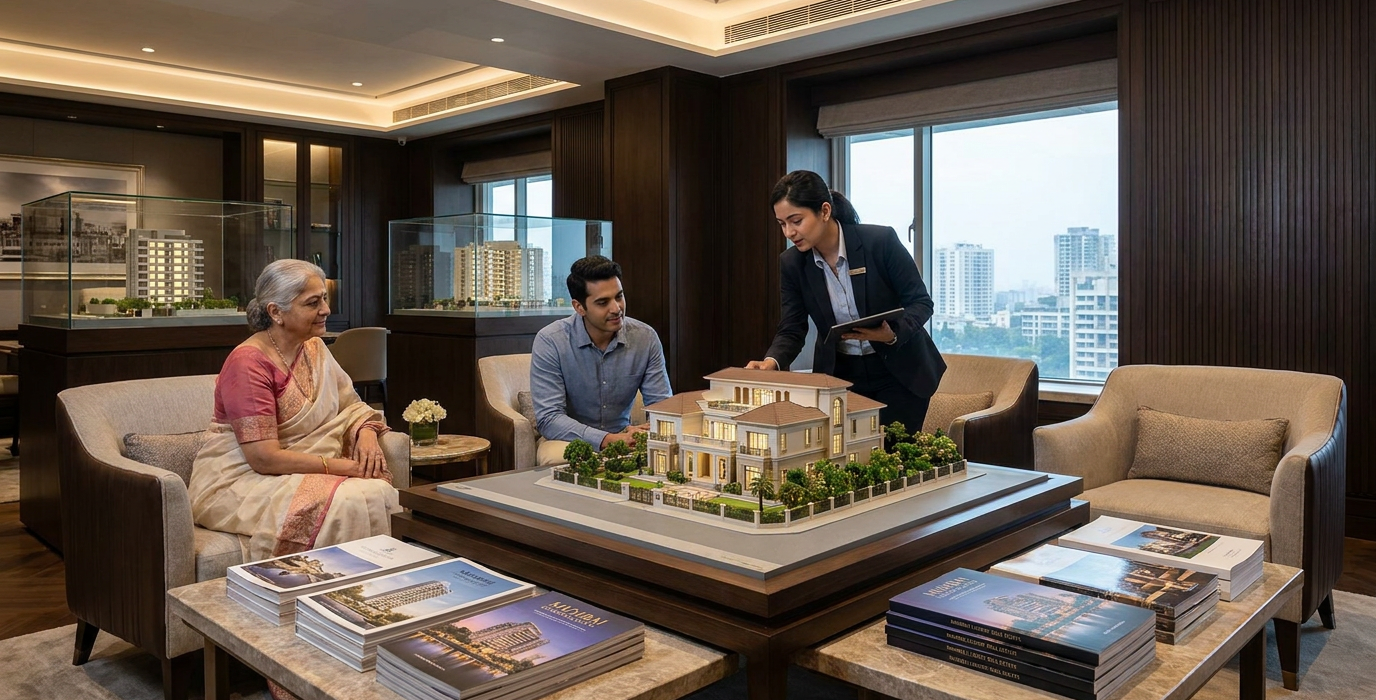
Three people in a modern showroom review a detailed villa model on a raised display table, with brochures nearby.
CategoriesMarket Insights

Real Estate Sales Psychology: How Buyers Actually Decide (And How Developers Can Influence It)

TL;DR — KEY TAKEAWAYS

  • 73% of Indian homebuyers say their final decision was driven by an emotional “feeling of rightness,” not a quantitative comparison, despite 5.2 weeks of average research.
  • Six emotions drive real estate purchases in India: safety, pride/status, FOMO, loss aversion, trust, and family legacy — each requiring a different sales approach.
  • Buyers move through 5 stages — awareness, interest, desire, intent, action — each needing different support from the developer.
  • Anchoring on price can shift average transaction values by 8-15%, and most “I’ll think about it” objections signal an emotional gap, not a data gap.

Real estate is sold on emotion and justified with logic — every experienced developer knows this. Yet most real estate sales teams are trained only on product features: plot size, location, price, amenities. They lose buyers at the 5-yard line because they never understood the emotional journey the buyer was on in the first place.

This guide breaks down the psychology of real estate buying in India, the six emotions that drive purchase decisions, the cognitive biases that either accelerate or derail closings, and how developers can ethically influence buyer decisions to convert faster.

Reading time: 14 minutes | Last updated: July 2026 | Author: Girish Chhalwani, Founder & CEO, THE EDGE Developments

Real estate purchase decisions in India involve an average of 5.2 weeks of active research, 3.4 site visits across competing properties, and 7–12 digital touchpoints before a booking is made. Despite this rational-seeming research process, 73% of Indian homebuyers report that the final decision to book was driven by an emotional “feeling of rightness” about the property or developer — not a quantitative comparison. Understanding this emotional decision layer is the most underinvested skill in Indian real estate sales. — Source: ANAROCK Consumer Sentiment Report 2024; Google India Real Estate Study 2024

What Are the 6 Emotions That Drive Real Estate Purchase Decisions in India?

Safety, pride, FOMO, loss aversion, trust, and family legacy are the six emotions that determine whether a buyer books — each needs a distinct sales message.

Emotion 1: Safety and Security

At its core, a property purchase is about anchoring yourself or your family in a safe, stable place. Buyers of weekend homes near Mumbai often articulate this as “a place to retreat to” — both physically (nature, fresh air) and emotionally (escape from city stress). For land investors, security comes from the tangible, immovable nature of land compared to volatile stocks.
Sales implication: Lead with the feeling of security — “clear title, RERA-registered, permanent asset” — before discussing returns.

Emotion 2: Pride and Status

Property is a status signal in India. The address, the developer brand, the type of development (branded plotted vs raw land) all signal social positioning. NRI buyers are particularly sensitive to this — buying in a “known” development from a reputable brand signals success to peers in both India and abroad.
Sales implication: Never just sell the land. Sell the identity that comes with it. “This is the project that [aspirational peer group] buys.”

Emotion 3: FOMO (Fear of Missing Out)

The most powerful real estate emotion. When buyers see price escalations, limited inventory, and others booking, FOMO overrides rational delay mechanisms. Infrastructure announcements (VAMC, NMIA, expressway) create FOMO by signalling that current prices are “pre-completion” and won’t last.
Sales implication: Real (not manufactured) scarcity signals work best — “Phase 1 is 80% sold; Phase 2 will be priced 15% higher.” This is only powerful because it’s true.

Emotion 4: Loss Aversion

Buyers are more motivated by the fear of loss than the prospect of gain. Framing a purchase as avoiding a loss (“if you don’t buy now, this price is gone”) is more effective than framing it as a gain (“prices will go up”). This is Nobel Prize-winning behavioural economics applied to real estate.
Sales implication: “You’ll be locking in pre-VAMC prices” is more powerful than “prices will rise after VAMC.”

Emotion 5: Trust and Credibility

Real estate in India is a high-trust, high-stakes purchase. Buyers must trust the developer to deliver. Without trust, no amount of FOMO or status signalling converts. Trust is built through track record (past project completions), transparency (MahaRERA registration, clear pricing), and social proof (testimonials, reference buyers).
Sales implication: Invest in trust-building content before the sales call — case studies, MahaRERA project pages, and video testimonials from existing buyers do heavy lifting.

Emotion 6: Family Legacy

Many Indian property purchases — especially land and weekend homes — are made with an explicit generational lens. “Something to leave for my children” is a buying rationale unique to real estate. This is especially true for NRI buyers who want to maintain a physical connection to India for future generations.
Sales implication: “This land will be worth 3x when your children inherit it” is a specific, resonant message for the legacy buyer segment.

In real estate sales psychology, the concept of “anchoring” is particularly powerful. The first price a buyer hears creates a mental anchor against which all subsequent prices are evaluated. Developers who open with the highest-priced unit or project tier set a high anchor that makes all other pricing seem relatively more attractive. Developers who open with the lowest price make everything else feel expensive by comparison. This single technique, applied consistently, can improve average transaction values by 8–15%. — Source: Kahneman & Tversky Prospect Theory; THE EDGE Developments Sales Training Framework

What Are the 5 Stages of the Real Estate Buyer Journey?

Buyers move sequentially through awareness, interest, desire, intent, and action — and each stage requires a different type of support from the developer.

Stage Buyer’s Internal State What They Need from Developer
1. Awareness Vaguely interested, exploring broadly Educational content; no sales pressure
2. Interest Researching specific locations/projects Specific data (pricing, legal, infrastructure); credibility signals
3. Desire Emotionally connected, visualising ownership Social proof; site visit; FOMO/urgency triggers
4. Intent Ready to buy; comparing 2–3 options Final objection handling; financing assistance; trust confirmation
5. Action Booking Seamless paperwork; booking amount process; confirmation ritual

How Do You Handle the 5 Most Common Real Estate Objections?

Each common objection has a distinct underlying cause — most trace back to insufficient emotional connection or unclear value, not the surface-level reason stated.

“Let me think about it”

Translation: “I am not emotionally convinced yet.” Don’t add more data — add emotional connection. Ask: “What would help you feel more confident?” Then listen.

“The price is too high”

Usually means “I don’t yet see the value clearly.” Don’t discount. Reinforce the value: comparable sales, infrastructure timeline, developer track record.

“I’ll wait for prices to fall”

Ask: “In the last 5 years, have prices in [location] fallen, or risen? What do you expect to change in the next 12 months that would reverse that trend?” Data wins this objection.

“I need to consult my family”

Include family in the site visit and conversation. Family objections are often the real objection — the buyer is not yet convinced enough to advocate internally.

“Your project doesn’t have [specific feature]”

Acknowledge, don’t argue. Ask: “If that feature were present, would you be ready to book?” If yes — solve the feature problem. If “not sure” — there’s a deeper objection to uncover.

FAQs: Real Estate Sales Psychology

What emotions drive real estate purchase decisions in India?
Six primary emotions drive Indian real estate purchases: safety and security (physical and financial anchor), pride and status (social signalling), FOMO (fear of missing the price or opportunity), loss aversion (fear of regret from not buying), trust and credibility (developer reliability), and family legacy (multigenerational investment thesis). Understanding which emotion is dominant for a specific buyer is the most valuable sales skill in real estate.
What is anchoring in real estate sales?
Anchoring is a cognitive bias where the first price or piece of information a buyer encounters creates a mental reference point against which all subsequent information is evaluated. In real estate, presenting the highest unit price first anchors the buyer’s expectation at that level, making subsequent pricing feel more attractive. Anchoring is one of the most powerful and widely used techniques in high-value sales.
How do you handle price objections in real estate?
Price objections in real estate are almost always value objections — the buyer does not yet see sufficient value to justify the price. Rather than discounting, reinforce value: present comparable sales, show appreciation data, demonstrate developer track record, and help the buyer understand the infrastructure catalyst that will drive future appreciation. Only discount as a last resort and only for specific, justifiable reasons.
Why do buyers say “I’ll think about it” in real estate sales?
“Let me think about it” in real estate almost always means the buyer is not yet emotionally connected to the property or sufficiently trusts the developer. Adding more data rarely solves this — asking open-ended questions (“What would give you more confidence?”) to uncover the underlying hesitation is more effective.

Visit a THE EDGE Project — See the Difference

Understanding buyer psychology starts with experiencing the product. Visit one of THE EDGE Developments’ RERA-registered plotted projects in Karjat and experience first-hand why buyers consistently choose brand and trust over raw land.
Book a site visit: info@edgerea.com | +91-9664662938 | edgere.in

Real estate marketing strategy India — creative team at brand campaign planning for land project 2025
CategoriesMarket Insights

Real Estate Marketing Strategies India 2026: Digital, Content & Channel Partner Playbook

THE EDGE — DIRECT ANSWER

78% of real estate buyers begin property searches online, making digital marketing the primary lead channel. The winning marketing funnel spans 5 stages: (1) Awareness—Google Search & Meta ads for visibility; (2) Consideration—content (blogs, videos), SEO, WhatsApp for trust-building; (3) Intent—retargeting, email nurture for site-visit driving; (4) Evaluation—sales team, WhatsApp, physical collateral; (5) Advocacy—referrals, testimonials, reviews. Best channels by ROI: Google Search Ads (₹800–2,500 CPL for MMR plotted developments, highest intent conversion), Meta/Facebook Ads (3–5x lower cost via retargeting), Content SEO (long-term organic lead generation), WhatsApp activation (lowest CPL via broker networks). NRI marketing requires separate strategy: NRI-specific content, MahaRERA emphasis, virtual tours, broker partnerships in Dubai/Singapore/UK, presence at NRI property expos. Budget for mid-size launch: ₹8–25 lakh (3 months). CRM integration mandatory for all leads within 30 seconds capture.

Indian real estate marketing has undergone a complete transformation in the last five years. Hoardings, newspaper ads, and broker events are no longer sufficient — buyers now discover, research, and shortlist properties entirely online before speaking to a sales representative. The developer who wins is not the one with the best project (though that helps); it’s the one with the best marketing system.

Reading time: 16 minutes | Last updated: June 2026 | Author: Girish Chhalwani, Founder & CEO, THE EDGE Developments

In India’s real estate market, 78% of buyers begin their property search online, with Google Search and YouTube being the two most used discovery platforms. However, the average buyer makes 7–12 online touchpoints before converting to a site visit — meaning the developer who appears consistently across search, social, and content wins the relationship before the buyer ever picks up the phone. The cost of acquiring a genuine site visit lead in the MMR plotted development segment ranged from ₹800–2,500 in 2026 (Google Search), compared to ₹200–600 via WhatsApp-activated broker network. — Source: Google India Real Estate Consumer Survey 2024; ANAROCK Digital Buying Behaviour Report 2024

The Real Estate Marketing Transformation

Hoardings and broker events alone no longer convert buyers. Digital channels now dominate the customer journey from awareness to decision. This is THE EDGE Developments’ complete 2026 marketing playbook for Indian real estate.

The Real Estate Marketing Funnel in 2026

Stage Buyer Action Best Channel Developer Goal
Awareness “I want to invest in land near Mumbai” Google Search, YouTube, Meta Appear first; educate
Consideration Researching locations, comparing projects Content, SEO, WhatsApp Build trust; capture lead
Intent Shortlisting 2–3 projects Google Display, Retargeting, Email nurture Drive site visit
Evaluation Site visit, comparison, negotiation Sales team, WhatsApp, collateral Close booking
Advocacy Referrals, social proof WhatsApp, testimonials, reviews Referral bookings

Channel 1: Google Search Advertising

What Works in Real Estate Google Ads

  • Intent keywords: “land for sale near Karjat”, “NA plots near Mumbai”, “weekend home investment 2026”
  • Match types: Phrase and exact match only — broad match burns budget
  • Ad extensions: Call extension (mobile click-to-call is #1 conversion action), site links, structured snippets
  • Landing pages: Project-specific, not homepage — single CTA per landing page
  • Typical CPL: ₹800–2,500 for plotted development in MMR

Channel 2: Meta (Facebook + Instagram) Advertising

Best Formats for Real Estate

  • Lead generation forms (Instant Forms): Highest volume, lowest friction
  • Video ads: 30–90 second project walkthroughs or drone footage
  • Carousel ads: Show multiple plots/amenities in a single ad
  • Retargeting: Custom audiences of website visitors — 3–5x lower CPL

Channel 3: Content Strategy and SEO

The Content Cluster Model

  • Pillar content: “Complete Guide to Land Investment Near Mumbai” (3,000+ words)
  • Cluster content: Specific guides that rank for long-tail searches and link to pillar
  • FAQ content: Answers to specific questions buyers type into Google

Channel 4: WhatsApp — The #1 Activation Tool in India

  • CP broadcast groups: Separate groups by geography with 3x/week updates
  • Buyer nurturing sequences: 7–14 day warming sequence from overview to site visit
  • WhatsApp Business API: For scale — automate responses, tag leads, route hot leads

Channel 5: NRI-Specific Outreach

NRI Marketing Channels That Work

  • NRI property expos: Dubai (GITEX), Singapore, London
  • NRI-specific content: FEMA compliance, repatriation, TDS, power of attorney
  • UAE and Singapore broker networks: Partner with 50–100 NRI-focused brokers
  • WhatsApp NRI community groups: Active in UAE and UK for relevant content

FAQs: Real Estate Marketing India 2026

What is the best digital marketing channel for real estate in India?
For immediate lead volume, Google Search Ads targeting intent keywords deliver the highest-quality leads. For cost efficiency, WhatsApp-activated broker networks deliver the lowest CPL. For long-term brand building, SEO content strategy is the highest-ROI investment. A comprehensive strategy combines all three.
How much does digital marketing cost for a real estate project launch?
A typical digital marketing budget for a mid-size plotted development in MMR (50–200 plots) ranges from ₹8–25 lakh for the launch phase (3 months): Google Ads ₹4–10 lakh, Meta Ads ₹3–8 lakh, content creation ₹1–3 lakh, WhatsApp infrastructure. Broker events ₹3–8 lakh are separate.
How do you market real estate to NRIs?
Effective NRI marketing requires: NRI-specific content addressing FEMA compliance, repatriation, and TDS; MahaRERA registration prominently featured; virtual site tours (360° video); partnerships with NRI brokers in Dubai, Singapore, and UK; and presence at NRI property expos.
What is GEO (Generative Engine Optimisation)?
GEO is optimising your content to be cited by AI-powered search engines (Google AI Overviews, Perplexity, ChatGPT). For Indian real estate, GEO means publishing structured, factual content about locations, prices, infrastructure, and legal frameworks — which AI engines cite when answering buyer queries.

Partner With THE EDGE Developments

THE EDGE Developments brings institutional-grade digital marketing to plotted development sales in the MMR corridor. If you are a landowner, developer, or broker looking to partner, connect with us.

Book a Consultation →

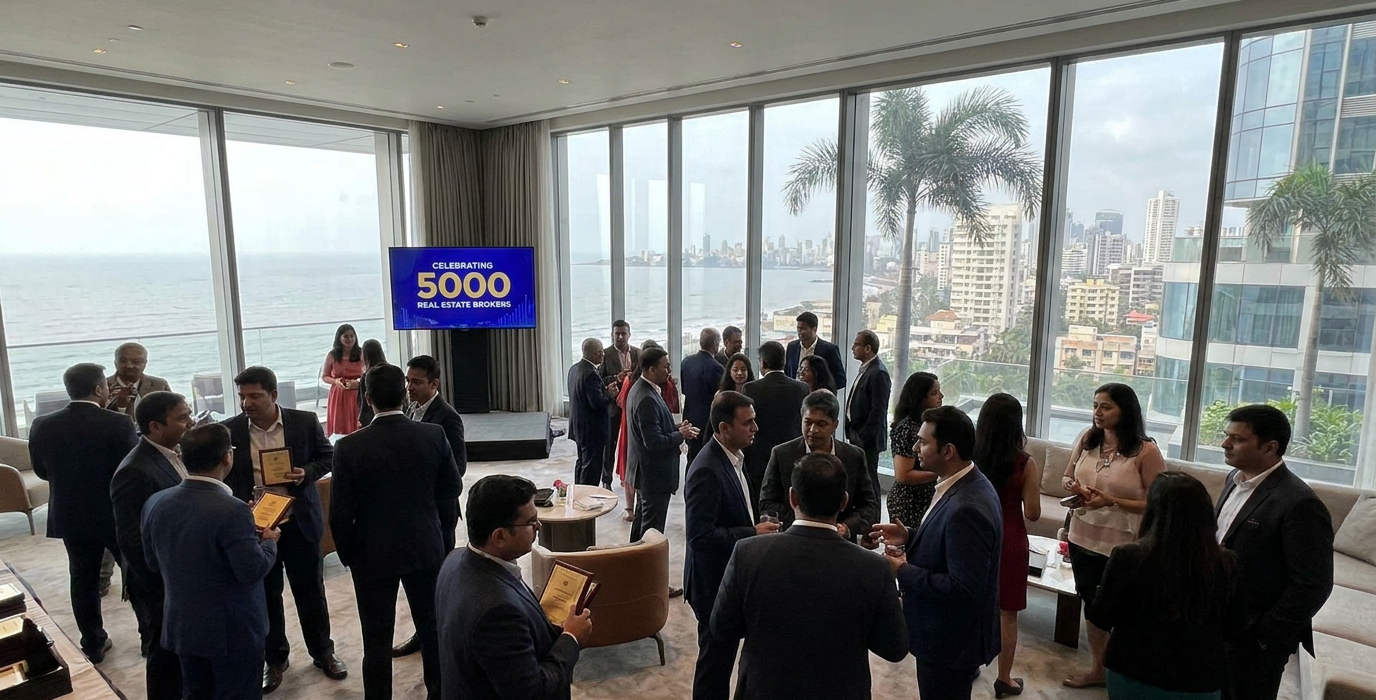
Group of professionals in suits networking at a coastal rooftop lounge with floor-to-ceiling windows and an ocean view.
CategoriesMarket Insights

Channel Partner Program in Real Estate: How to Build a 5,000+ Broker Network

TL;DR — KEY TAKEAWAYS

  • Channel partners drive 65–80% of residential real estate transactions in India, making a structured broker network the highest-leverage sales system available to developers.
  • A 5,000+ broker network is built in three phases — foundation (0–500 partners), activation (500–2,000 partners), and scaling (5,000+ partners) — each with distinct tactics.
  • Standard brokerage ranges from 1.5–3% of sale value, with Super CPs and NRI-focused brokers earning up to 3.5–4% based on volume.
  • Slow payouts, lead poaching, and product inconsistency are the three things that kill CP programs — reputation among brokers travels fast and is difficult to rebuild.

The most successful real estate developers in India don’t sell properties — they build broker armies that sell for them. A well-designed channel partner program is the single highest-leverage sales system in Indian real estate, capable of generating ₹100 crore+ in sales from a network that costs a fraction of a direct sales team. This guide breaks down exactly how to build, train, incentivise, and scale a 5,000+ broker network — drawn from THE EDGE Developments’ experience building one of MMR’s most active channel partner ecosystems across 45+ projects.

Reading time: 15 minutes | Last updated: July 2026 | Author: Girish Chhalwani, Founder & CEO, THE EDGE Developments

Channel partners (real estate brokers and agents) account for 65–80% of all residential real estate transactions in India’s tier-1 and tier-2 markets. In the Mumbai Metropolitan Region, developers with structured channel partner programs consistently outperform direct-sales-only models by 2–3x in sales velocity. A channel partner network of 5,000+ active brokers, when managed with proper incentive structures and regular engagement, can generate ₹200–500 crore in annual sales across a developer’s portfolio. — Source: ANAROCK Research 2024, CREDAI-MCHI Broker Survey 2024

Why Are Channel Partners the Backbone of Indian Real Estate Sales?

Channel partners convert faster and cost less than direct sales teams because they bring pre-existing buyer trust, wide market reach, and are paid only on success.

  • Trust intermediary: A local broker has an existing relationship with the buyer — built over years. That relationship converts.
  • Market reach: A 5,000-broker network collectively touches millions of potential buyers across geographies that no developer marketing team can replicate.
  • Cost efficiency: Brokerage (2–3% of sale value) is paid only on success. No salary, no fixed cost.
  • Speed: Activated broker networks can generate site visits within 48 hours of a new launch.

What Is the 5-Layer Channel Partner Ecosystem?

Layer Type Volume Role
1 Strategic Partners (Super CPs) 50–100 High-volume closers, exclusive territory, co-marketing budget
2 Active Partners 500–1,000 Regular site visits, consistent bookings, trained on all projects
3 Registered Partners 2,000–3,000 Registered in system, occasional referrals, event participants
4 Referral Associates 1,000–2,000 Informal referrers, friends/family of brokers, part-time
5 Digital/NRI Partners 500+ Online-only brokers, NRI-focused agents in UAE/UK/Singapore

How Do You Build the Foundation (0 to 500 Partners)?

The foundation phase requires three steps: building a compelling CP kit, setting the right commission structure, and hosting a broker launch event.

Step 1: Create a Compelling CP Kit

  • Project brochure (digital + print, premium quality)
  • Project walkthrough video (2–3 minutes, professional production)
  • Price list and payment plan (clear, no hidden clauses)
  • Commission structure in writing (brokerage %, timeline, payout process)
  • RERA registration number and all approvals
  • Developer credentials and track record

Step 2: Set the Right Commission Structure

Project Type Standard Brokerage Super CP Brokerage NRI Broker
Plotted development (NA plots) 2–2.5% 2.5–3% 3–3.5%
Luxury villas 2.5–3% 3–3.5% 3.5–4%
Commercial / industrial 1.5–2% 2–2.5% 2.5–3%

Step 3: Host a Broker Launch Event

  • Venue: Upscale hotel or the project site itself
  • Invite 200–300 active local brokers through association databases
  • On-spot registration with immediate digital CP ID
  • Lucky draw, early-bird bonus brokerage for first 50 bookings

Real estate broker launch events (CP meets) in the Mumbai Metropolitan Region typically attract 150–400 active brokers per event when hosted by established developers. Developers who invest ₹3–8 lakh in a high-quality broker launch event report 3–5x ROI within 90 days through resulting bookings. — Source: THE EDGE Developments Sales Data, MMR CP Network Analysis 2024

How Do You Activate the Network (500 to 2,000 Partners)?

Activation moves brokers through a four-stage funnel — registered, engaged, active, converting — driven primarily by disciplined WhatsApp broadcast communication.

The CP Activation Funnel

  1. Registered → Has CP ID, received kit, knows the project
  2. Engaged → Has attended site visit or CP meet, asked questions
  3. Active → Has brought at least one site visit in the last 30 days
  4. Converting → Has closed at least one booking

WhatsApp Broadcast Groups (The #1 Tool in India)

  • Create separate groups by geography (Mumbai North CPs, Pune CPs, NRI CPs)
  • Post fresh content 3x per week: site progress photos, booking updates, customer testimonials
  • Share “booking flashes” — when a booking happens, announce it (creates FOMO)
  • Never spam: 3 messages/week maximum; quality over quantity

How Do You Scale to 5,000+ Partners?

Scaling requires geographic expansion beyond the home market and a Super CP tier that rewards your top 1–2% of brokers disproportionately.

Geographic Expansion Strategy

Source Market Buyer Profile CP Strategy
Mumbai (Western suburbs) Working professionals, HNIs Local broker associations, IPC tie-ups
Pune IT professionals, NRI families Pune broker meets, digital campaigns
Dubai / Abu Dhabi NRI Gujaratis, Maharashtrians UAE broker partnerships, NRI expos
UK / Singapore / USA NRI professionals Digital-first NRI broker program

Super CP Program: The 80/20 of Your Sales

  • Higher brokerage (0.5–1% premium over standard)
  • Priority inventory access — first right to best units before general launch
  • Dedicated relationship manager from the developer team
  • Co-marketing support — joint ads, site visit funding
  • Annual recognition event with trophies and public recognition
  • International incentive trips for top closers (Dubai, Thailand, Europe)

What Are the 3 Things That Kill CP Programs?

Slow commission payouts, lead poaching, and product inconsistency are the three most common reasons broker networks collapse.

1. Slow Commission Payouts

Pay brokerage late once and that broker tells 50 others. Commit to a specific payout timeline and honour it.

2. Lead Poaching

If a broker registers a customer and the developer’s sales team closes the same customer while cutting the broker out of the brokerage, that broker is gone — and so is their network.

3. Product Inconsistency

Brokers stake their reputation when they refer customers. If the developer delays a project or fails to deliver what was promised, the broker faces the customer’s anger.

FAQs: Channel Partner Programs

What is a channel partner in real estate?
A channel partner (CP) is a licensed real estate broker or agent who markets and sells a developer’s properties in exchange for a brokerage commission (typically 2–3% of the sale value in India). Channel partners operate independently, bringing their own client relationships to the developer’s project.
How much brokerage do real estate channel partners earn in India?
Standard brokerage for channel partners in Indian real estate ranges from 1.5–3% of the sale consideration, paid by the developer. For premium plotted developments and luxury villas in the MMR corridor, brokerage is typically 2–3%. Super CPs or NRI-focused brokers may earn 3–4% based on volume commitments.
How many channel partners does a successful developer need?
For a mid-size developer with 2–5 projects active simultaneously in the MMR market, 500–1,000 active CPs (out of a registered base of 3,000–5,000) is the target. Quality of engagement matters more than total numbers.
What is a Super CP program?
A Super CP (Super Channel Partner) program is an exclusive tier within a developer’s broker network reserved for top-performing brokers who meet minimum booking volume thresholds. Benefits typically include higher brokerage rates, priority inventory access, co-marketing support, dedicated relationship managers, and recognition rewards including international incentive trips.

Partner With THE EDGE Developments

THE EDGE runs one of MMR’s most active channel partner programs across 45+ projects in Karjat, Khopoli, and the Mumbai 3.0 corridor. We offer competitive brokerage, fast payouts, dedicated CP support, and a Super CP program with international incentive trips.

Register as a CP: info@edgerea.com | +91-9664662938 | edgere.in
AQI Is the New Luxury
CategoriesEco Living Market Insights tips & tricks

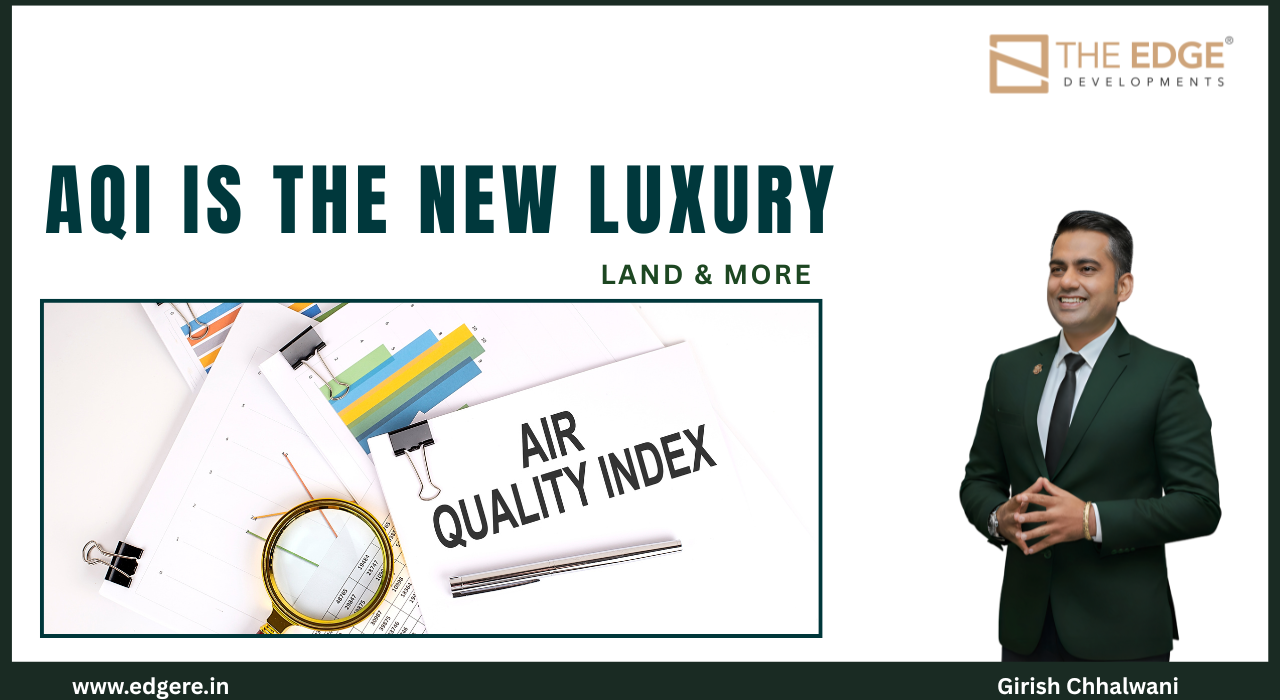
AQI Is the New Luxury

TL;DR — KEY TAKEAWAYS

  • Clean air is becoming the new marker of luxury in cities like Mumbai, where AQI alerts are now routine.
  • Regions like Karjat and Khopoli offer both improving connectivity and genuinely cleaner air, unlike distant retreats of the past.
  • Air quality is starting to affect property decisions directly, as buyers weigh long-term health alongside location and price.

For decades, luxury was defined by what you could see.
Sea views. Marble floors. Height, glass, scale.

Today, luxury is increasingly defined by what you cannot see — the air you breathe.

In a city like Mumbai, where air quality alerts have become routine, AQI numbers are quietly replacing pin codes as markers of privilege. Clean air has become scarce, and scarcity has a way of redefining value.

The photograph captures a simple moment — standing under an old banyan tree, surrounded by earth, shade, and silence. No skyline. No traffic. No honking. Just breathable air. And that is precisely the point.

Air used to be free.
Now, it is negotiated.

Urban life has normalised compromise. We accept air purifiers as furniture, masks as accessories, and respiratory issues as “part of city life.” Children grow up indoors not by choice, but by necessity. Morning walks are timed not to sunrise, but to pollution charts.

This is where the conversation around Mumbai 3.0 becomes relevant — not as a real estate headline, but as a lifestyle correction.

As infrastructure pushes outward and connectivity improves, regions like Karjat and Khopoli are no longer distant retreats. They are becoming natural extensions of Mumbai’s future — places where development and ecology still coexist. Better road and rail links are compressing distances, but what truly differentiates these regions is not accessibility alone — it is air quality, green cover, and breathing space.

This isn’t nostalgia.It’s data.

Medical costs linked to pollution are rising. Productivity is impacted. Lifestyle diseases are appearing earlier. Increasingly, homebuyers and land investors are asking a new question before committing capital:

“What will my lungs experience here over the next 20 years?”

Low-density developments, nature-led planning, and land parcels around Karjat–Khopoli are not indulgences anymore. They are long-term health decisions. Investments not just in real estate, but in respiration, immunity, and mental clarity.

Luxury was once about adding more.
Now it’s about removing what harms you.

Noise. Congestion. Pollution. Anxiety.

In the coming decade, the most premium developments will not be defined by height or hardware. They will be defined by AQI levels, wind flow, green buffers, water tables, and distance from urban stress.

Because when everything else is available,
clean air becomes the ultimate upgrade.

AQI isn’t just a number anymore.
It’s the new luxury benchmark.

⸻ THE EDGE – Real Estate Development’s
Girish Chhalwani 🧑🏻‍✈️
www.edgere.in

Author: Girish Chhalwani, Founder & CEO, THE EDGE Developments


Frequently Asked Questions

Why is AQI becoming a key factor in real estate decisions?

Air quality is now a measurable, data-driven variable that directly affects health outcomes, productivity, and quality of life. As awareness of pollution’s long-term costs rises, homebuyers and investors are increasingly prioritising AQI as a primary selection criterion.

Which areas near Mumbai offer better air quality for residential investment?

Regions on the southern and eastern periphery of MMR — particularly Karjat, Khopoli, Khalapur, Alibaug, and coastal Konkan — consistently record significantly lower AQI levels than Mumbai’s island city or inner suburbs, thanks to sea breezes, lower industrial density, and abundant green cover.

How does air quality affect property values in real estate markets?

In mature urban markets globally, properties in measurably cleaner-air zones command 15–30% premiums over comparable properties. In India, this premium is still forming, meaning early investors in clean-air regions can acquire land before the full health-conscious demand wave arrives.

mumbai 30 land investment
Mumbai's real estate future — land investment and development insights by THE EDGE Developments
CategoriesMarket Insights tips & tricks

A Billion-Dollar Signal to Mumbai’s Real Estate Future

TL;DR — KEY TAKEAWAYS

  • Reliance 4IR Realty has signed a $10 million development fee deal with the Trump Organization for a Trump-branded project in Mumbai.
  • Mumbai luxury home sales above ₹10 Cr roughly doubled between 2021–2024, and global brands like Four Seasons Residences and Ritz-Carlton Residences are already active in the city.
  • Branded luxury real estate targets NRIs, global citizens, and India’s top 1% — buyers paying for brand association and international perception, not just floor space.

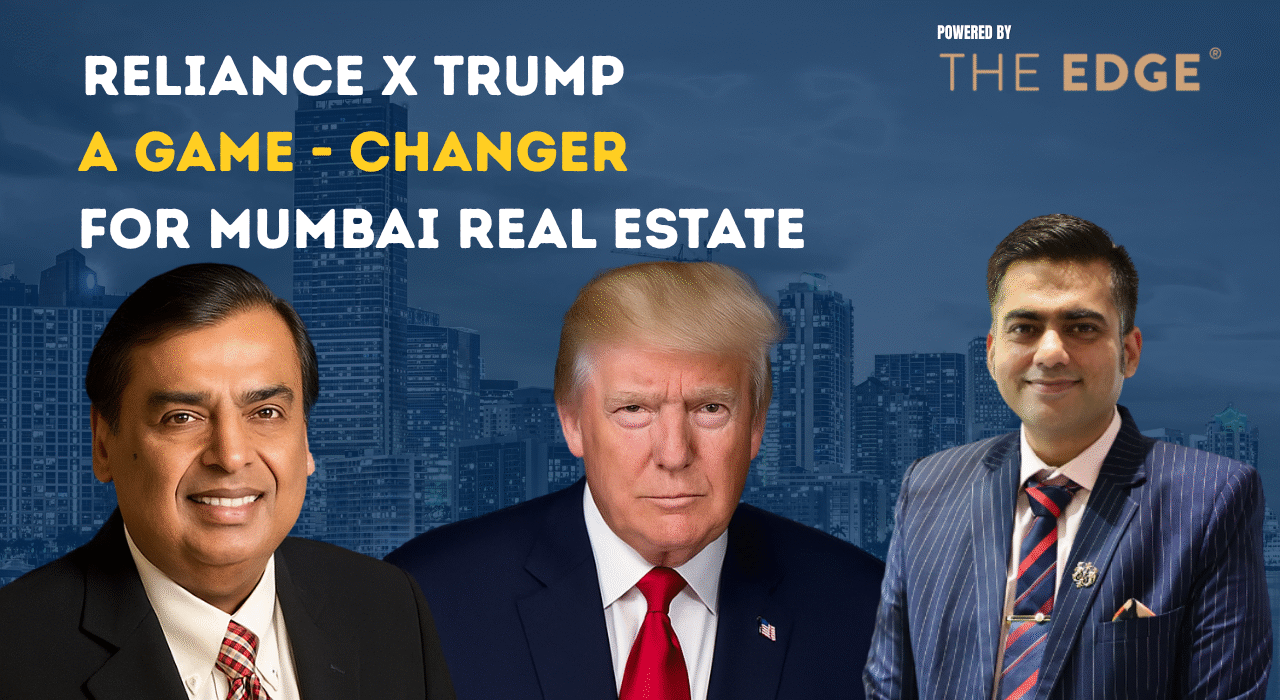
Reliance x Trump:”What happens when India’s most powerful conglomerate shakes hands with one of the world’s most polarizing luxury brands?

The Big News: Reliance + Trump Organization = A New Real Estate Narrative

Let’s start with the headlines. Reliance 4IR Realty (a Mukesh Ambani-backed arm of Reliance) is officially joining forces with the Trump Organization in a deal that has already sent ripples through the Indian real estate world.

➡️ A $10 million development fee has been inked for a Trump-branded project in Mumbai.

That’s right — the Trump brand, which has already marked its presence in Pune, Gurgaon, and Kolkata, is now stepping into India’s most lucrative real estate market, backed by the country’s most formidable business empire.


👀 Why Does This Deal Matter More Than It Seems?

This isn’t just a flashy brand move.

This deal signals the arrival of a new class of Indian real estate — one where branding, luxury, and international perception matter as much as floor space and location.

It’s a move where:

  • Reliance brings land, power, and trust
  • Trump brings aspiration, design legacy, and international luxury appeal

And Mumbai? It becomes the playground for what branded luxury real estate in India will look like over the next 10 years.

🧭 Where Is Mumbai’s Real Estate Market Headed?

Over the past decade, Mumbai has seen:

  • Soaring demand for ultra-premium homes post-pandemic
  • A 2x spike in luxury home sales above ₹10 Cr between 2021–2024
  • The rise of global brands like Four Seasons Residences, Ritz-Carlton Residences, and now… Trump Towers

Mumbai isn’t just India’s financial capital anymore — it’s becoming Asia’s next global residential icon. And every power brand wants a stake.

🎯 Why This Deal Hits Different

1. It’s Not Just Housing, It’s Identity

Buyers aren’t just buying a square foot; they’re buying a statement. Living in a Trump x Reliance tower isn’t just about amenities — it’s about status, brand association, and global lifestyle.

2. Reliance Is Entering Real Estate Big-League

Reliance has previously tested waters in commercial leasing (think Jio World Centre). But now, they’re entering the residential and branded luxury space — and they’re not starting small.

This signals a shift: from infrastructure players to lifestyle curators.

3. Trump Is Doubling Down on India

India is already Trump Org’s largest market outside the US — with completed and upcoming projects in:

  • Pune
  • Kolkata
  • Gurgaon
  • And now, Mumbai

Even as Trump’s brand draws criticism in some Western countries, in India it retains aspirational value — especially among affluent buyers.


🧠 What Should Industry Pros Take Away?

🔹 Developers: Welcome to the age of experience-led real estate. It’s no longer enough to offer premium specs — you need global positioning. 🔹 Brokers & Channel Partners: Branded inventory = higher margins. Learn to pitch brand story as much as ROI. 🔹 Investors: These projects tend to hold value better during market shifts due to built-in global appeal. 🔹 Homebuyers: You’re entering a space where perceived value will heavily shape resale and rental value.


📊 What Might This Look Like on the Ground?

Let’s speculate with insights:

  • Location: Likely a South or Central Mumbai redevelopment — given Reliance’s ongoing ties with older mill lands and real estate SPVs
  • Typology: Ultra-luxury residential towers + curated retail + maybe even a business centre
  • Pricing: Think ₹1.5–3 lakh/sq ft — if branded well and located smartly
  • Design Language: Grand lobbies, curated art, private concierge, sustainability integrations, international interior firms

⚖️ But Let’s Be Honest: Is This All Rosy?

Not entirely.

The Trump brand, while aspirational for many, also comes with political baggage globally.

Additionally, branded homes in India are still a niche. Not all buyers value international logos if fundamentals like maintenance, location, or community aren’t top-tier.

That said — this isn’t for the masses. It never was.

It’s aimed at:

  • NRIs
  • Global citizens
  • Dollar-earners
  • India’s top 1%

And they’re ready to pay for experience and association.


🧩 Final Thought: What’s Really at Stake?

This deal is not just about homes. It’s about redefining Mumbai’s international image.

It’s about turning Mumbai into a Dubai–Singapore–NYC hybrid, where global brands, Indian ambition, and architectural storytelling come together.

We’re watching the future of Indian real estate get stitched together — one branded skyscraper at a time.


📣 Your Turn

💬 What do you think of this Reliance-Trump deal? 💥 Do you believe branding is the next big thing in real estate? 🔁 Would you invest in a Trump-branded apartment in Mumbai?

Ride Mumbai’s Next Real Estate Wave — From the Karjat Corridor

As branded luxury reshapes Mumbai’s skyline, THE EDGE Developments offers land and second-home opportunities in the emerging Karjat–MMR corridor, positioned for the city’s next growth phase.

Contact: info@edgerea.com | +91-9664662938 | edgere.in

Realty Index H1 2025: What the Numbers Reveal About India’s Real Estate Cycle
CategoriesMarket Insights tips & tricks

Realty Index: India’s Real Estate Cycle 2025

TL;DR — KEY TAKEAWAYS

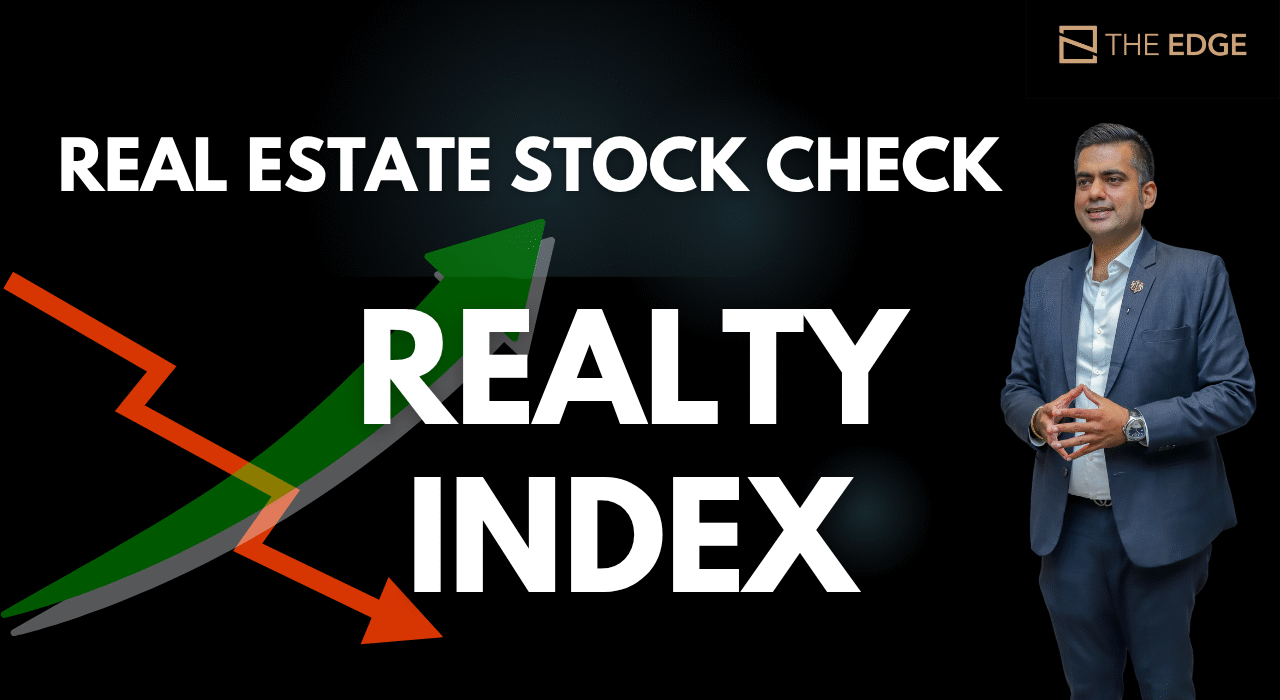
  • The Nifty Realty Index surged +20% since May 9, 2025, making realty the top-performing sector, driven by RBI rate cuts and improved credit/infra outlook.
  • Sobha Ltd posted 62% revenue growth and 481% YoY PAT increase in Q4 FY25, while Prestige Estates reported a 6% net loss despite stable top-line.
  • DLF, Lodha, Oberoi, and Godrej gained 15–30% over six months, riding sector momentum, while smart money is shifting into land aggregation, Grade A commercial, and plotted development.

1. Nifty Realty Index Snapshot

  • May–June Rally: +20% surge since May 9, 2025 — top-performing sector
  • June Month: +9.4%, compared to the broader Nifty’s +0.5%
  • 6-Month View (Dec–Jun): Holds steady (~990–1014 range) after volatility on rate-cut hopes

Market Takeaway: Two index drivers—RBI rate cuts (50 bps) and improved credit & infra outlook—ignited strong short-term rallies, even as volatility persists.

Why is this rally different? 🏘️ Inventory is drying up 🚃 Infra projects (Navi Mumbai Airport, metro lines, highways) are reshaping micro-markets 💸 NRI + institutional money is flowing in 📉 Interest rate stability adds more firepower

Is it the top? Or just the midpoint of a longer bull run? While some expect cooling, smart money is shifting into: – Land aggregation (Mumbai 3.0, NCR peripheries) – Grade A commercial spaces – Mid-income housing – Plotted development & second homes

🚀 2. How Did Developers Perform Between April and June 2025?

Developer 6-Month Return*Key Drivers

Prestige Estates–4.4%Q4 sales miss & cautious guidance despite long-term optimism

Sobha Ltd–3.4%After a 35% correction over six months; Q4 margin recovery lifted sentiment Others (DLF, Lodha, Oberoi, Godrej)+15–30%Riding sector-wide momentum and developer-specific wins

*Sobha and Prestige are the only mid/large players in the negative territory over six months. Others have shown 15–30% gains.


📰 3. What Were the Quarterly Highlights for Q4 FY25?

  • Prestige Estates reported a 6% net loss despitestable top-line; share price down due to cautious commentary
  • Sobha Ltd posted 62% revenue growth and 481% YoY PAT increase, lifting investor sentiment and a 10% monthly bounce
  • Phoenix Mills, DLF, Lodha, and Oberoi continued uptick on strong leasing, launch pipelines, and disciplined delivery.

💡 4. What Does This Data Tell Us?

  1. Liquidity & Rate Cuts Matter – RBI cuts in June released~₹2.5 tn liquidity, supporting realty beats
  2. Luxury & Residential Still Leading – Developers with strong mid-premium to luxury pipelines outperform.
  3. Organized Structure Wins – Listed players with financial discipline and transparent reporting are favorites, while Sobha and Prestige lag after short-term shocks.
  4. Volatility Exists – Rapid gains are possible—but QoQ caution can drag stocks even for top-tier players.

🎯 5. Strategic Takeaways

For Homebuyers & Investors:

  • ✅ Track stock performance of your builder before buying.
  • ✅ Spot volatility as opportunity—a dip may mean the best buying moment (e.g., Sobha, Prestige).
  • ✅ Look for quarterly recovery calls—Sobha’s Q4 result is textbook.

For Real Estate Professionals:

  • Use these data points in investor presentations and client advisories.
  • Highlight quarterly wins and sentiment-linked pricing cycles to clients.

✅ Final Reflections

The Nifty Realty Index and share-level performances don’t just track returns—they map real estate confidence, execution discipline, and strategic resilience in India’s evolving market.

Whether you’re buying a home or planning investment, aligning your moves with this data-backed realty cycle can make all the difference.


🗨️ What’s your take? Do you track realty stocks before buying a property? Which developer’s volatility surprised you? 👇 Comment below — let’s decode real estate beyond square feet

Align Your Investment With the Realty Cycle

As smart money shifts toward land aggregation and plotted development, THE EDGE Developments offers verified land opportunities in the Karjat–MMR corridor built for this stage of the cycle.

Contact: info@edgerea.com | +91-9664662938 | edgere.in