
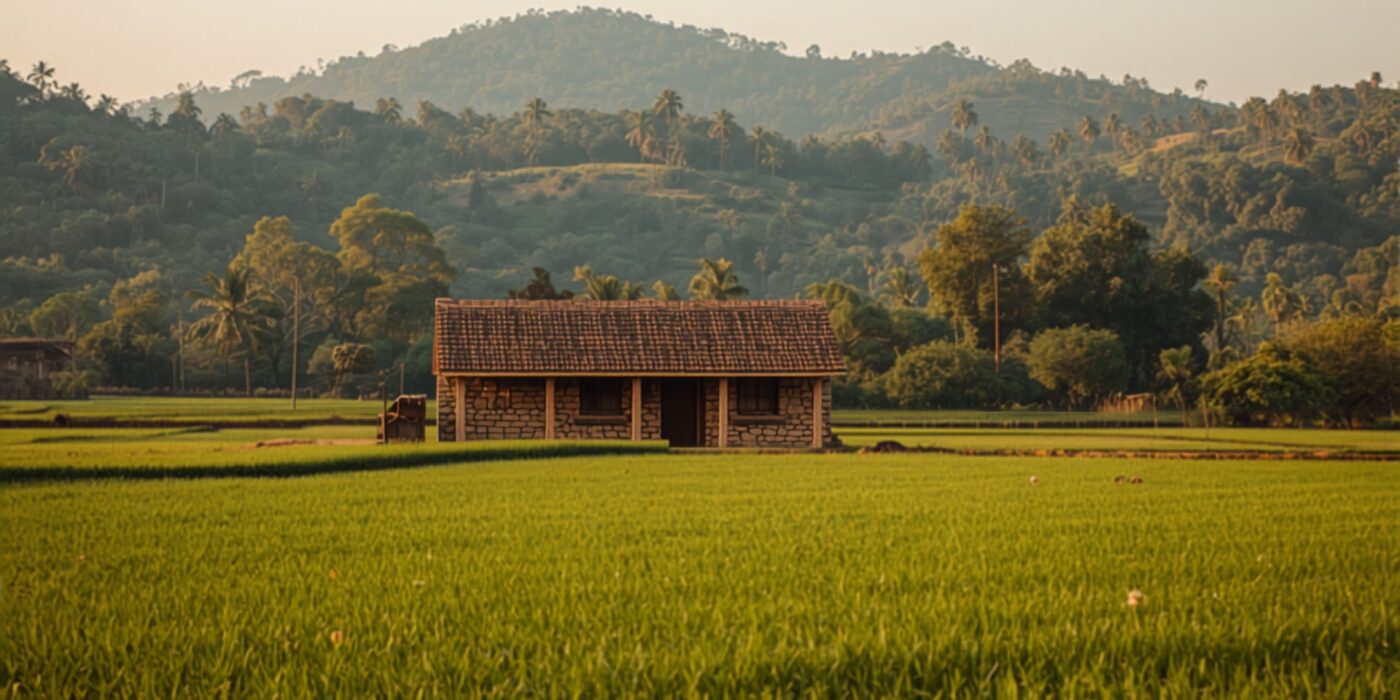
Direct answer: Yes — in Maharashtra you can build a farmhouse on agricultural land without converting it to non-agricultural (NA) use, but only as a “farm building” under Section 41 of the Maharashtra Land Revenue Code, 1966, and only inside strict limits: the holding must generally be at least 0.4 hectare, the residential plinth area cannot exceed 150 sq m, the structure is limited to ground floor and roughly 5 metres in height, and permission from the Collector (with Gram Panchayat / local body clearance) is required. Build beyond those limits and the land is legally deemed to have been put to non-agricultural use — which invites penalty, regularisation demands, or demolition.
Key Takeaways
- No NA conversion is needed for a genuine farm building — Section 41 of the MLRC, 1966 allows a land holder to erect farm buildings on agricultural land for the better cultivation or convenient agricultural use of that land.
- Minimum holding matters: permission is not to be granted where the agricultural holding is less than 0.4 hectare (about 1 acre is 0.4047 hectare).
- Residential plinth area is capped at 150 sq m irrespective of how large the holding is. For holdings above 0.6 hectare, the aggregate plinth area of all farm buildings cannot exceed one-fortieth of the holding or 400 sq m, whichever is less.
- Ground floor only: the Collector is not to permit a building whose height above plinth level exceeds 5 metres and which has more than a ground floor.
- Contravention is expensive: land used for a farm building in breach of Section 41 is deemed to have been used for a non-agricultural purpose, attracting consequences under Sections 43, 45 and 46 of the Code.
- A farm building is not a villa plot. If your intent is a weekend home you can freely design, extend, mortgage and resell, an NA plot in an approved layout is the cleaner instrument.
In the Karjat–Raigad second-home belt this is the single most misunderstood question we field at THE EDGE. Buyers are shown a green stretch of gat-number land, told “farmhouse allowed, no NA needed,” and they assume that means a 3,000 sq ft two-storey house with a pool. The law says something much narrower. Below is what Section 41 actually permits, what it does not, and how the risk profile compares with buying an NA plot.
What the law actually says: Section 41, MLRC 1966
Under the Maharashtra Land Revenue Code, 1966, a holder of land assessed or held for the purpose of agriculture is entitled to erect farm buildings, construct wells or tanks, and make other improvements on that land for its better cultivation or its more convenient use for agricultural purposes. That entitlement is the legal basis of the “farmhouse without NA” idea — but it is conditioned.
The conditions attached
- Holding size: permission is not to be granted if the agricultural holding on which the building is proposed is less than 0.4 hectare.
- Plinth area, 0.4 to 0.6 hectare holdings: the plinth area of all such buildings shall not exceed 150 sq m.
- Plinth area, holdings above 0.6 hectare: the aggregate plinth area shall not exceed one-fortieth of the holding area or 400 sq m, whichever is less.
- Residential sub-cap: where the farm building is to be used for the residence of the holder’s family members, servants or tenants, the plinth area shall not exceed 150 sq m — irrespective of the size of the holding.
- Height and floors: the Collector is not to grant permission where the height from plinth level exceeds 5 metres and the building has more than a ground floor.
- Number of buildings: permission is not to be granted for more than one farm building for each of the purposes covered by the definition of farm building.
Where more than one farm building is proposed, “plinth area” is read as the aggregate plinth area of all of them — you cannot split a large house into two structures to stay under the cap.
Verify before you build. Section 41 has been amended over the years, and its operation is supplemented by rules such as the Maharashtra Land Revenue Farm Building (Erection, Renewal, Reconstruction, Alteration, Additions, etc.) Rules, 1989, plus regional plan / Development Control Regulation provisions that may impose their own FSI, setback and zone conditions in a given taluka. Treat the figures above as the statutory framework, not as a site-specific entitlement. Confirm the current limits, the applicable regional plan zone and any local restriction with the office of the Collector and the Tehsildar for your taluka — and get it in writing — before you lay a single foundation.
Who can build a farmhouse on agricultural land?
The right under Section 41 belongs to the holder of the agricultural land. That has an important consequence: before you can build a farm building, you must lawfully own agricultural land, and in Maharashtra a person who is not an agriculturist faces restrictions on purchasing agricultural land. Non-agriculturist buyers typically require the Collector’s permission for such an acquisition — the eligibility tests and the penalties for ignoring them are set out in our guide to who can buy agricultural land in Maharashtra. Several “farmhouse scheme” offerings in the Karjat belt sidestep this by selling undivided shares, power-of-attorney rights or agreements-to-sell rather than a clean conveyed title — which is a title problem long before it is a construction problem.
Practical filter: if you are not an agriculturist and the seller has no answer for how you will be recorded as the holder on the 7/12 extract, the farmhouse conversation is premature.
Permissions: Collector, Tehsildar and Gram Panchayat
Three layers usually apply. They are not alternatives — you generally need the revenue-side clearance and the local-body clearance.
- Establish and verify your title. Obtain the 7/12 extract, 8A, mutation entries and a title search. Confirm the holding area, that the land is not restricted-tenure, and that no ceiling, tenancy or tribal-land restriction applies. A surviving Kul or tenancy entry is the classic hidden encumbrance on exactly this kind of parcel.
- Check the zone. Confirm under the applicable Regional Plan / Development Plan whether the land sits in an agricultural, green, no-development, eco-sensitive, forest-buffer or reservation zone. A Section 41 farm building does not override a zone prohibition.
- Apply to the Collector / Sub-Divisional Officer for permission to erect the farm building, with the site plan, building plan, plinth-area statement and holding details demonstrating compliance with the size, plinth, height and single-floor conditions.
- Obtain the Gram Panchayat NOC / building permission for the village in which the land falls. In non-municipal rural areas the Gram Panchayat is the local building-permission and property-tax authority; in some cases the Collector’s office routes the file through the Panchayat and the town planning department.
- Comply with any special-area law. In Scheduled Areas governed by the Panchayats (Extension to Scheduled Areas) Act, 1996, the Gram Sabha / Gram Panchayat has a statutory role in land transfers. Coastal, forest-adjacent and eco-sensitive zone parcels carry additional clearances.
- Build strictly to the sanctioned plan, and retain the sanction, the approved drawings and the completion record. Deviation is the most common trigger for later action.
We do not publish fee figures or processing timelines for these permissions, because they vary by district and are revised administratively. Ask the Tehsildar’s office for the current schedule rather than relying on any number circulating online.
Farmhouse on agricultural land vs building on an NA plot
The two are different products with different risk, financing and resale profiles. The full comparison of legal status, buyer eligibility, lending and liquidity is set out in NA vs agricultural land in Maharashtra: what actually changes; the table below covers the construction question specifically.
| Parameter | Farm building on agricultural land (Section 41) | House on an NA / NA-Residential plot |
|---|---|---|
| Land use status | Remains agricultural on the 7/12 | Converted to non-agricultural use |
| NA conversion needed | No, if within Section 41 limits | Yes — that is the defining step |
| Minimum holding | Generally 0.4 hectare and above | No agricultural holding threshold; plot size per layout approval |
| Built-up limit | Residential plinth capped at 150 sq m; aggregate capped at 400 sq m or 1/40th of holding, whichever is less | Governed by sanctioned FSI and DCR for the zone |
| Height / floors | Ground floor, roughly 5 m — no upper floors | As permitted by DCR / sanctioned plan |
| Who may buy | Agriculturist status issue for the buyer; Collector permission often required | Open to any buyer |
| Approving authority | Collector / SDO plus Gram Panchayat | Planning authority / Collector layout sanction plus local body |
| Home loan and resale liquidity | Typically harder — many lenders decline agricultural-land construction | Generally easier; standard mortgage product |
| Risk if you exceed limits | Deemed non-agricultural use, penalties under Sections 43/45/46, demolition risk | Deviation penalties under building law; usually compoundable within limits |
Common violations — and the demolition risk
The pattern we see repeatedly in the Karjat, Neral, Khopoli and Murbad belt:
1. Building two floors “because everyone does it”
A first floor added on a farm building breaches the ground-floor and height condition. The whole structure — not just the added floor — becomes vulnerable.
2. Exceeding 150 sq m of residential plinth
A 2,500–3,500 sq ft weekend home is well past the 150 sq m (roughly 1,615 sq ft) residential cap. Buyers often see the 400 sq m figure and assume it applies to the house; it does not, once the building is used for residence.
3. Splitting a large holding, then building
Sub-dividing a parcel into sub-0.4-hectare shares for multiple buyers and then building a “farmhouse” on each share fails the minimum-holding condition for each of them.
4. Building with a Panchayat receipt but no Collector permission
A Gram Panchayat property-tax receipt or assessment number is not construction sanction and is not a substitute for Section 41 permission. Many buyers treat it as proof of legality. It is not.
5. Selling “farmhouse plots” that are really unauthorised layouts
Where an agricultural gat has been informally carved into plots and sold, the buyer inherits a layout problem. Maharashtra’s Gunthewari regularisation framework exists precisely because of this pattern — and regularisation is discretionary, conditional and never guaranteed.
Where a structure is held to be in contravention, the land is deemed to have been used for a non-agricultural purpose, and the Code’s machinery under Sections 43, 45 and 46 comes into play — which can extend to penalty, restoration of the land to its original use, and removal of the offending structure. This is why we tell clients that on agricultural land, the honest question is not “what can I get away with?” but “what will survive a title search when I sell in 2035?”
THE EDGE view: when a farm building actually makes sense
A Section 41 farm building is a legitimate and useful instrument — for a genuine agricultural holding, with a modest single-storey structure supporting cultivation, held by someone who qualifies to hold agricultural land. It is a poor instrument for a leveraged second home you intend to flip. If income rather than occupation is the objective, the lawful alternatives — leasing, contract farming and agri-tourism among them — are set out in seven legal ways to use, lease or monetise agricultural land.
Our Land Intelligence work across the Karjat corridor consistently shows the same spread: buyers who paid a premium for a clean NA plot in a sanctioned layout transact faster and at better realisations than buyers who paid less for agricultural land with an “allowed farmhouse” story attached. The discount on the agricultural parcel is not a bargain; it is the market pricing in the permission risk you are about to inherit.
Decide which product you are actually buying before you fall in love with the view.
Frequently Asked Questions
Can I build a farmhouse on agricultural land in Maharashtra without NA conversion?
Yes, within limits. Section 41 of the Maharashtra Land Revenue Code, 1966 allows a land holder to erect farm buildings on agricultural land without converting it to non-agricultural use, provided the holding size, plinth area, height and single-floor conditions are met and the required permission is obtained. Exceed those limits and the land is deemed to have been used for a non-agricultural purpose.
What is the maximum built-up area allowed for a farmhouse on agricultural land?
Where the farm building is used for residence, the plinth area is capped at 150 square metres irrespective of the size of the holding. For holdings above 0.6 hectare the aggregate plinth area of all farm buildings must not exceed one-fortieth of the holding area or 400 square metres, whichever is less. Confirm the currently applicable figures with your Collector or Tehsildar before designing.
What is the minimum land holding needed to build a farmhouse?
Permission is not to be granted where the agricultural holding is less than 0.4 hectare, which is roughly one acre. Buyers of sub-divided shares smaller than this frequently discover the problem only when they apply for permission.
Is a Gram Panchayat NOC enough to build a farmhouse on agricultural land?
No. A Gram Panchayat assessment number, property-tax receipt or NOC does not replace permission under Section 41 from the Collector or Sub-Divisional Officer. In practice you need both the revenue-side permission and the local-body building permission, and in Scheduled Areas additional Gram Sabha requirements may apply.
Can a farmhouse built in violation of the rules be demolished?
Yes, that risk is real. Land used for a farm building in contravention of Section 41 is deemed to have been used for a non-agricultural purpose, which brings the penalty and restoration provisions of the Code into play, including action to remove the offending structure. Regularisation is discretionary and should never be assumed at the time of purchase.
Sources
- Section 41, Maharashtra Land Revenue Code, 1966 — erection of farm building (Indian Kanoon)
- The Maharashtra Land Revenue Code, 1966 — full bare Act (India Code, Government of India)
- Maharashtra Land Revenue Farm Building (Erection, Renewal, Reconstruction, Alteration, Additions, etc.) Rules, 1989
- MahaBhulekh — official 7/12 and 8A land records portal, Government of Maharashtra
Related Reading
- Pillar: Maharashtra Land Records Portals: The Complete Directory of Government Websites
- NA Conversion Process in Maharashtra: Cost, Timeline and Step-by-Step Guide
- Gunthewari Regularisation in Maharashtra: What It Means for Unauthorised Layouts
- First-Time Land Buyer’s Checklist: 10 Due Diligence Steps
- NA vs Agricultural Land in Maharashtra: What Actually Changes
- Who Can Buy Agricultural Land in Maharashtra: Rules, Eligibility and Penalties
- Land Zoning in MMR: R-Zone, Green Zone and No-Development Zone Explained
- Case study: Infrastructure-Triggered Land Appreciation: Karjat Corridor Case Study
- Talk to us: Contact THE EDGE
Before you buy that farmhouse parcel, get the land read properly
THE EDGE is a single premium master brand operating across four verticals — Land Development, Spotlight, Corporate Advisory and E-Learning — all powered by our shared Land Intelligence foundation. If you are evaluating an agricultural parcel in Karjat, Raigad or the wider MMR fringe and want an honest read on what you can legally build on it, talk to our team before you sign.
Written by Girish Chhalwani, Founder & CEO, THE EDGE — 20+ years in Maharashtra land development and land intelligence.
Disclaimer: This article is general information, not legal advice. Statutory limits and local requirements change and vary by district. Verify all conditions with the Collector, Sub-Divisional Officer and Tehsildar for your taluka, and consult a qualified property advocate before purchase or construction.