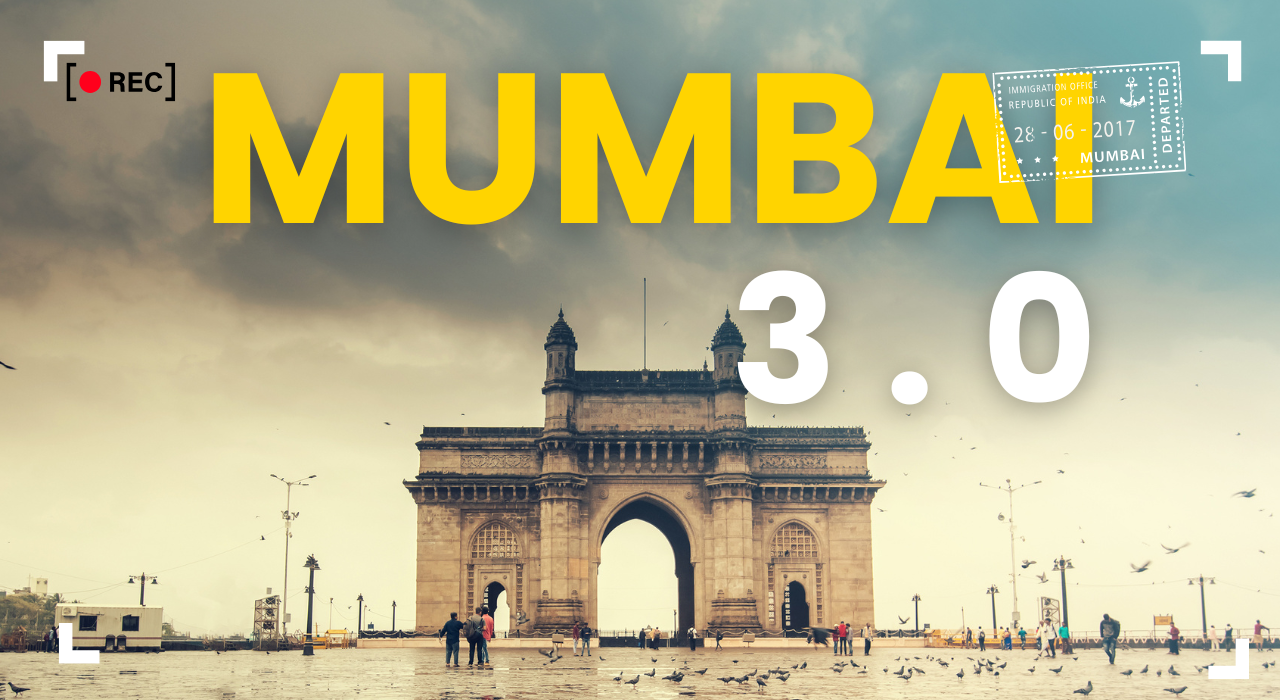
“Mumbai 3.0 future city concept with highways, green landscapes, and new development corridors in MMR.
CategoriesMumbai 3.0 tips & tricks

What is Third Mumbai or Mumbai 3.0?

Mumbai 3.0: When a City Learns to Breathe Again

For over a century, Mumbai grew by pushing inward.
More people, more buildings, more pressure — all packed into a narrow peninsula that powered India’s economy but slowly ran out of space to live, move, and breathe.

Every great city eventually faces this moment.

A moment where growth can no longer be vertical.
Where expansion must become intelligent.
Where the city must reinvent itself — not by growing taller, but by growing wiser.

That moment for Mumbai is called Mumbai 3.0.


The End of Old Mumbai Thinking

Mumbai 1.0 was about survival and trade.
Mumbai 2.0 was about density, finance, and speed.

Mumbai 3.0 is about balance.

Balance between:

  • Growth and livability

  • Infrastructure and ecology

  • Density and dignity

  • Capital and community

For the first time, Mumbai is not reacting to pressure —
it is planning for the future.


What Mumbai 3.0 Really Is (And What It Is Not)

Mumbai 3.0 is not just a new city.
It is not just Navi Mumbai.
It is not just an airport or a highway.

Mumbai 3.0 is a regional reset.

It is the deliberate expansion of the Mumbai Metropolitan Region (MMR) into a multi-nodal economic ecosystem, where:

  • Jobs are closer to homes

  • Homes are closer to nature

  • Infrastructure leads development

  • Growth is decentralised, not suffocating

At the heart of this transformation lies the Karnala–Sai–Chirner (KSC) New Town, spread across 323 sq. km — not as an extension of chaos, but as an antidote to it.


Infrastructure Didn’t Just Connect Mumbai — It Rewired It

Every city-changing story begins with infrastructure.

Mumbai 3.0 is being stitched together by projects that don’t just reduce travel time — they redefine geography:

  • Mumbai Trans Harbour Link (Atal Setu) collapsed distance between South Mumbai and Navi Mumbai.

  • Navi Mumbai International Airport unlocked a new economic axis.

  • Virar–Alibaug Multimodal Corridor created a spine for logistics, housing, and industry.

  • Rail and highway upgrades pulled peripheral regions into daily life, not just weekend visits.

What was once “too far” is now strategically central.


Why Mumbai 3.0 Is an Economic Decision, Not a Real Estate One

This shift is not driven by property.
It is driven by economics.

Mumbai 3.0 creates:

  • New business districts

  • Data centre hubs

  • Logistics clusters

  • Education and healthcare cities

  • Residential zones designed for the next generation

This is how global cities evolve —
by creating multiple centres of gravity, not one overloaded core.

In simple terms:
Mumbai is no longer one city.
It is becoming a system of cities.


The Silent Winners of Mumbai 3.0

The most powerful changes rarely happen in the spotlight.

The real winners of Mumbai 3.0 are:

  • Regions with land + connectivity

  • Locations near infrastructure nodes

  • Areas that can absorb growth sustainably

  • Places that offer lifestyle, not just returns

Karjat, Panvel, Pen, Uran, Khalapur, Khopoli —
these are not “outskirts” anymore.

They are the future addresses of Mumbai.


Why This Moment Is Different From Past Expansions

Mumbai has expanded before.
But this time, three forces are aligned:

  1. Infrastructure is arriving before mass construction

  2. Lifestyle preferences have fundamentally changed

  3. Policy and planning are proactive, not reactive

This alignment is rare.
And historically, it is during such phases that long-term wealth and urban stability are created.


Mumbai 3.0 Is About Living, Not Just Existing

The most important shift is philosophical.

Mumbai 3.0 asks a different question:

How should Indians live over the next 30 years?

With:

  • Cleaner air

  • More open space

  • Shorter commutes

  • Smarter cities

  • Stronger communities

It recognises that a city’s success is not measured only in GDP,
but in quality of life.


The Road Ahead

Mumbai 3.0 will not be built overnight.
There will be challenges — execution, environment, governance, alignment.

But the direction is clear.

Mumbai has chosen expansion over exhaustion.
Planning over pressure.
Vision over improvisation.

And that makes Mumbai 3.0 not just a project —
but a turning point in India’s urban story.
Mumbai 3.0 Land Investment
Second Mumbai–Pune Expressway: Impact on Karjat, Khalapur & Real Estate Growth
CategoriesLand Investment Mumbai 3.0 tips & tricks

Second Mumbai–Pune Expressway: Impact on Karjat, Khalapur & Real Estate Growth

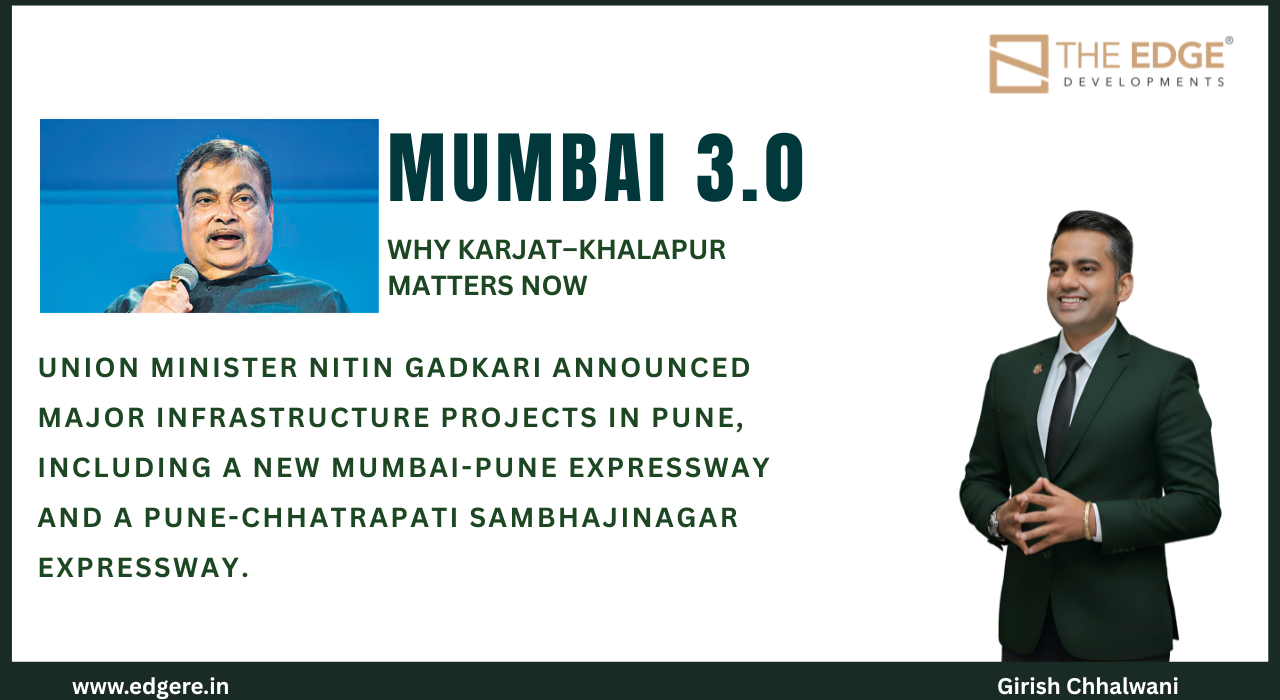
Second Mumbai–Pune Expressway: Why Karjat–Khalapur–Khopoli Is Emerging as Maharashtra’s Next Strategic Growth Corridor

By Girish Chhalwani
CEO, THE EDGE

Infrastructure announcements often dominate headlines for their scale and promised travel-time reductions. Yet their real significance unfolds far more quietly—through shifts in economic behaviour, land use patterns and long-term real estate cycles.

The announcement of a 130-km greenfield Mumbai–Pune Expressway, estimated to cost ₹15,000 crore, is one such moment. Planned to extend from the Atal Setu near JNPA to Pune’s Shivare Junction, this new corridor is set to run parallel to the existing Mumbai–Pune Expressway, which transformed regional development when it opened in 2002.

Beyond faster travel, the expressway is poised to redefine the importance of micro-markets lying between Mumbai and Pune, particularly Karjat, Khalapur and Khopoli.


What Has Been Announced

According to Union Minister for Road Transport and Highways Nitin Gadkari, the new expressway will significantly ease congestion on the existing corridor while preparing Maharashtra for future traffic volumes.

Key details include:

  • Length: Approximately 130 km

  • Estimated Cost: ₹15,000 crore

  • Alignment: Atal Setu (JNPA) → Pagote → Chowk (Panvel) → Shivare Junction (Pune)

  • Phase 1 Approved: Pagote to Chowk

  • Expected Travel Time: Mumbai–Pune in ~1.5 hours

  • Extended Connectivity: Pune–Mumbai–Bengaluru in ~5.5 hours

In addition, Gadkari also announced a greenfield expressway between Pune and Chhatrapati Sambhajinagar, estimated at ₹16,318 crore, which is expected to reduce travel time between the two cities to around two hours.


Why Karjat–Khalapur–Khopoli Matters Now

Infrastructure does not merely connect locations; it reorders regional priorities.

With the new expressway originating near JNPA–Pagote, the Karjat–Khalapur–Khopoli belt now sits at the intersection of three powerful drivers:

  • Port-led logistics expansion, supported by JNPA and allied freight infrastructure

  • Compressed Mumbai–Pune travel time, altering commuting psychology

  • Affordability compared to saturated urban markets

Historically, regions that benefit simultaneously from logistics access, residential viability and infrastructure investment tend to evolve into stable, multi-use growth corridors rather than speculative hotspots.


From Leisure Destination to Strategic Extension

For years, Karjat and its surrounding areas were discussed largely as weekend-home destinations—known for landscapes rather than long-term economic relevance.

However, this trajectory mirrors what occurred in Lonavala after the first Mumbai–Pune Expressway. Once connectivity stabilised, leisure-led demand gradually gave way to mixed-use development, including residential clusters, hospitality and commercial support services.

A similar pattern is now visible:

  • Khalapur and Chowk are emerging as logistics and warehousing anchors due to expressway access

  • Karjat is naturally suited for low-density residential formats such as plotted developments, villas and managed second homes

  • Khopoli acts as a connective industrial and residential link

Together, these micro-markets function as complementary nodes, not competitors.


Demand Will Change in Profile, Not Just Volume

One of the most important consequences of reduced travel time is not price appreciation—it is demand diversification.

The Karjat–Khalapur belt is likely to attract:

  • Professionals seeking larger homes within 90 minutes of Mumbai

  • Housing demand linked to logistics, warehousing and industrial employment

  • Investors focused on land-backed assets aligned with infrastructure timelines

As psychological distance between cities reduces, the definition of what constitutes “commutable” living expands, reshaping housing preferences.


What Developers and Investors Must Get Right

While infrastructure creates opportunity, outcomes depend on execution. Over multiple real estate cycles, a consistent pattern emerges: regions succeed when development aligns with infrastructure phasing and real demand.

For the Karjat–Khalapur–Khopoli corridor, this means:

  • Respecting zoning, environmental and planning norms

  • Phasing projects in sync with infrastructure milestones

  • Designing communities rather than focusing solely on plot monetisation

This is a corridor where planning discipline will outperform aggressive promotion.


A Long-Term Value Curve

The Second Mumbai–Pune Expressway is not an overnight catalyst. It represents a 10–15 year growth curve, unfolding gradually as infrastructure, logistics and residential demand align.

Karjat and Khalapur currently sit at an inflection point—early enough to be meaningful, mature enough to be credible.

For stakeholders across real estate and infrastructure, the key question is no longer whether this belt will grow, but how thoughtfully that growth is shaped.

In real estate, the most enduring returns are rarely created at the peak of attention.
They are built just before it arrives.

The Karjat opportunity is here now: Edge County Estate — 6 exclusive eco-luxury Mediterranean villas by THE EDGE Developments, strategically positioned in Karjat at the heart of this expressway growth corridor. Clear-title NA plots, RERA compliant. View the project →


What is the Second Mumbai–Pune Expressway?

It is a proposed 130-km greenfield expressway running parallel to the existing Mumbai–Pune Expressway, aimed at reducing congestion and improving intercity connectivity.

How much will the new expressway cost?

The project is estimated to cost around ₹15,000 crore.

What will be the Mumbai–Pune travel time after completion?

The expected travel time is approximately 1.5 hours.

Which areas will benefit most from the new expressway?

Regions such as Karjat, Khalapur, Chowk and Khopoli are expected to see long-term benefits due to improved connectivity and logistics access.

Is this expressway good for real estate investment?

Infrastructure-led corridors typically support long-term value creation, provided development is phased and aligned with demand rather than speculation.


About the Author

Girish Chhalwani is the CEO of THE EDGE, is a real estate land development based out of mumbai.


mumbai 30 land investment
AQI Is the New Luxury
CategoriesEco Living Market Insights tips & tricks

AQI Is the New Luxury

TL;DR — KEY TAKEAWAYS

  • Clean air is becoming the new marker of luxury in cities like Mumbai, where AQI alerts are now routine.
  • Regions like Karjat and Khopoli offer both improving connectivity and genuinely cleaner air, unlike distant retreats of the past.
  • Air quality is starting to affect property decisions directly, as buyers weigh long-term health alongside location and price.

For decades, luxury was defined by what you could see.
Sea views. Marble floors. Height, glass, scale.

Today, luxury is increasingly defined by what you cannot see — the air you breathe.

In a city like Mumbai, where air quality alerts have become routine, AQI numbers are quietly replacing pin codes as markers of privilege. Clean air has become scarce, and scarcity has a way of redefining value.

The photograph captures a simple moment — standing under an old banyan tree, surrounded by earth, shade, and silence. No skyline. No traffic. No honking. Just breathable air. And that is precisely the point.

Air used to be free.
Now, it is negotiated.

Urban life has normalised compromise. We accept air purifiers as furniture, masks as accessories, and respiratory issues as “part of city life.” Children grow up indoors not by choice, but by necessity. Morning walks are timed not to sunrise, but to pollution charts.

This is where the conversation around Mumbai 3.0 becomes relevant — not as a real estate headline, but as a lifestyle correction.

As infrastructure pushes outward and connectivity improves, regions like Karjat and Khopoli are no longer distant retreats. They are becoming natural extensions of Mumbai’s future — places where development and ecology still coexist. Better road and rail links are compressing distances, but what truly differentiates these regions is not accessibility alone — it is air quality, green cover, and breathing space.

This isn’t nostalgia.It’s data.

Medical costs linked to pollution are rising. Productivity is impacted. Lifestyle diseases are appearing earlier. Increasingly, homebuyers and land investors are asking a new question before committing capital:

“What will my lungs experience here over the next 20 years?”

Low-density developments, nature-led planning, and land parcels around Karjat–Khopoli are not indulgences anymore. They are long-term health decisions. Investments not just in real estate, but in respiration, immunity, and mental clarity.

Luxury was once about adding more.
Now it’s about removing what harms you.

Noise. Congestion. Pollution. Anxiety.

In the coming decade, the most premium developments will not be defined by height or hardware. They will be defined by AQI levels, wind flow, green buffers, water tables, and distance from urban stress.

Because when everything else is available,
clean air becomes the ultimate upgrade.

AQI isn’t just a number anymore.
It’s the new luxury benchmark.

THE EDGE – Real Estate Development’s
Girish Chhalwani 🧑🏻‍✈️
www.edgere.in

Author: Girish Chhalwani, Founder & CEO, THE EDGE Developments


Frequently Asked Questions

Why is AQI becoming a key factor in real estate decisions?

Air quality is now a measurable, data-driven variable that directly affects health outcomes, productivity, and quality of life. As awareness of pollution’s long-term costs rises, homebuyers and investors are increasingly prioritising AQI as a primary selection criterion.

Which areas near Mumbai offer better air quality for residential investment?

Regions on the southern and eastern periphery of MMR — particularly Karjat, Khopoli, Khalapur, Alibaug, and coastal Konkan — consistently record significantly lower AQI levels than Mumbai’s island city or inner suburbs, thanks to sea breezes, lower industrial density, and abundant green cover.

How does air quality affect property values in real estate markets?

In mature urban markets globally, properties in measurably cleaner-air zones command 15–30% premiums over comparable properties. In India, this premium is still forming, meaning early investors in clean-air regions can acquire land before the full health-conscious demand wave arrives.

Mumbai 3.0 Land Investment
Discover why Karjat’s land prices are booming. Airport influence, better connectivity, luxury projects, and strong rentals make it a high-growth MMR hotspot.
CategoriesEco Living Land Investment tips & tricks

Karjat Property Growth Explained: Infrastructure, Demand & ROI

Karjat: The New Epicentre of Land Growth in MMR

Karjat is emerging as one of the fastest-growing land investment destinations in the Mumbai Metropolitan Region (MMR). Backed by major infrastructure upgrades, rising demand for second homes, and a growing preference for sustainable, nature-led living, the region is witnessing unprecedented appreciation across land categories — from agricultural plots to premium villa estates.

Over the last decade, Karjat has transitioned from a quiet weekend getaway to a high-return investment hotspot, with farmland prices increasing by over 1,100%, and residential development demand hitting record highs. Its strategic location, scenic environment, and enhanced connectivity have positioned Karjat as a prime zone for both investors and lifestyle buyers.


Key Drivers of Karjat’s Land Growth

1. Massive Infrastructural Development

Karjat’s real transformation is powered by large-scale infrastructure projects that are redefining mobility and accessibility:

  • Navi Mumbai International Airport (NMIA):
    The airport’s influence zone extends deep into Karjat, creating demand for hospitality, rentals, second homes, and plotted development.

  • Enhanced Road Connectivity:
    New highway upgrades and the upcoming Karjat–Bhimashankar Road are strengthening Karjat’s link to Panvel, Navi Mumbai, and Pune.

  • Improved Rail Access:
    The Panvel–Karjat double-tracking and frequency upgrades are making Karjat more accessible for daily commuters and long-term residents.

These enhancements are turning Karjat into a seamlessly connected micro-city, directly benefiting land valuations.


2. Rising Demand for Second Homes & Rentals

Karjat’s natural beauty, lower pollution levels, and peaceful surroundings have sparked a boom in:

  • Weekend homes

  • Farmhouses

  • Airbnb-friendly properties

  • Boutique resorts

  • Wellness retreats

Investors are increasingly drawn by high rental yields, especially during weekends, holidays, and festive seasons. For many, Karjat is now the go-to destination for passive income through rentals.


3. Growth in Luxury & Sustainable Developments

Karjat is witnessing an influx of premium and eco-friendly residential projects:

  • Luxury villas

  • Gated communities

  • Resort-style developments

  • Sustainable estates with solar energy and rainwater harvesting

  • Nature-integrated homes with landscaped gardens and private pools

This upscale development trend is attracting HNIs, NRIs, and Mumbai families seeking a healthy, low-density lifestyle without compromising on comfort.


4. Affordability With Strong Appreciation Potential

Compared to Mumbai, Navi Mumbai, and Thane, Karjat offers:

  • Lower entry prices

  • Larger plots

  • Higher appreciation potential

  • Better long-term value

With development accelerating and land supply limited, appreciation is expected to continue rising for the next decade.


Investment Outlook: Why Karjat Is a Smart Bet

  • Over 1100% appreciation in farmland prices over the past 10 years.

  • Continuous demand from investors, second-home buyers, and weekend travelers.

  • Low supply of premium land parcels, leading to future price pressure.

  • Ideal for long-term capital growth and short-term rental income.

  • Perfect for hybrid living, sustainable communities, and luxury villa projects.

Karjat’s rare combination of affordability, appreciation, natural environment, and infrastructure-backed growth makes it one of the strongest land investment markets in MMR right now.


Final Word

Karjat is no longer just a serene escape — it is a high-growth, long-term investment corridor aligned with Mumbai 3.0’s future development blueprint. With connectivity improving, demand rising, and lifestyle shifts accelerating, the region is primed for sustained expansion.

For investors looking to build wealth through land, Karjat is not just an opportunity —
it is one of the smartest investment decisions of this decade.

Looking to invest in Karjat? Explore Edge County Estate — 6 exclusive Mediterranean-inspired eco-luxury villas in Karjat by THE EDGE Developments. Clear-title NA plots, RERA compliant, 55 minutes from Navi Mumbai Airport. View the project →


Mumbai 3.0 Land Investment
“Is the Financial Capital Shifting? Mumbai 3.0 and the Next Growth Story”
CategoriesMumbai 3.0 tips & tricks

Is the Financial Capital Shifting? Mumbai 3.0

THE EDGE — DIRECT ANSWER

Mumbai 3.0—the emerging corridor spanning Karjat, Khopoli, Alibaug, Pen, and Raigad—represents the next frontier of urban growth beyond saturated Mumbai 1.0 (island city + suburbs) and developed Mumbai 2.0 (Navi Mumbai). Three mega-infrastructure catalysts are reshaping investment potential: the VAMC (Virar–Alibaug Multimodal Corridor), the operational NMIA (Navi Mumbai International Airport), and the Second Expressway widening. Land prices in Mumbai 3.0 areas are 70–80% cheaper than Navi Mumbai, with projected 14–20% CAGR through 2028–2031. Early investors in Mumbai 3.0 today will replicate the Navi Mumbai playbook—dismissed as “too far” decades ago, now commanding premium prices. The 2026 entry window is critical before infrastructure completion drives prices beyond reach.

Home

Market Insights

Is the Financial Capital Shifting? Mumbai 3.0

KEY TAKEAWAYS

  • Mumbai 3.0 spans Karjat, Khopoli, Alibaug, Pen, and Raigad — the next frontier beyond saturated Mumbai and developed Navi Mumbai.
  • Three infrastructure catalysts converging 2026–2028: VAMC, NMIA, Second Expressway widening.
  • Land 70–80% cheaper than Navi Mumbai with 14–20% CAGR potential through 2031.
  • Early-mover advantage: Navi Mumbai was dismissed as “too far” decades ago; same cycle unfolding in Mumbai 3.0 now.

For decades, Mumbai has been India’s city of dreams — from the island city to its suburban sprawl. But with limited land, soaring prices, and strained infrastructure, the question arises: Where does Mumbai grow next?

The answer lies in what I call Mumbai 3.0.

The Three Eras of Mumbai

🔹 Mumbai 1.0 – The Original City

  • The island city and suburbs — from Colaba to Borivali, Chembur to Mulund.
  • The financial capital, Bollywood hub, and India’s nerve center.
  • But today, Mumbai 1.0 is saturated: rising costs, limited land, traffic congestion.

🔹 Mumbai 2.0 – The Navi Mumbai Story

  • Conceived in the 1970s as a planned twin city.
  • Wide roads, open spaces, and emerging corporate centers like Vashi, Belapur, and Panvel.
  • The upcoming Navi Mumbai International Airport is set to transform it.
  • Yet, even Navi Mumbai faces limits as growth pushes further outward.

Mumbai 3.0 – The Next Frontier

This is where the future unfolds.

  • Regions: Karjat, Khopoli, Alibaug, Pen, Uran, and parts of Raigad.
  • Mega Infrastructure Driving Growth:
    • Virar–Alibaug Multimodal Corridor (VAMC) — ₹80,000 crore, Phase 1 completion 2027–2028
    • Navi Mumbai International Airport (NMIA) — operational 2026–27, 60M passenger capacity
    • Second Mumbai–Pune Expressway widening — 6 to 8 lanes, reduced congestion

These projects are not just reducing travel time — they are reshaping investment potential.

Why Mumbai 3.0 Matters

  • Affordable land compared to Mumbai & Navi Mumbai.
  • Perfect for weekend homes, plotted developments, and long-term investments.
  • Early-mover advantage, similar to how Navi Mumbai was undervalued decades ago but commands premiums today.

My Perspective

Having spent over two decades in real estate and generating over $1 billion in sales, I’ve seen Mumbai evolve through multiple phases.

Just as Navi Mumbai was once dismissed as “too far,” today it thrives. The same cycle is unfolding for Mumbai 3.0. Investors and developers who recognize this early will be part of the city’s next big growth story.

Final Thought

Mumbai 3.0 is not just geography — it is the future of urban living, investment, and growth. The question is: Will you be a spectator, or a participant in shaping this chapter?

🔥 What are your thoughts on Mumbai 3.0? Do you see Karjat, Alibaug, and Raigad as the next big hubs?

About the Author — Girish Chhalwani

Girish Chhalwani is the Founder & CEO of THE EDGE Developments, a RERA-registered plotted-development company in the Karjat–MMR corridor. With 20+ years in Maharashtra land acquisition, NA conversion, and infrastructure-led land investment, he advises HNI and NRI investors on land strategy near Mumbai.

 ·  About THE EDGE Developments

Explore RERA-Registered Plots in the Karjat–MMR Corridor

THE EDGE Developments offers legally clear, NA-converted plotted developments in Mumbai 3.0 — the next frontier of urban growth. Speak with our team for current pricing and a guided site visit.

Book a Consultation →