
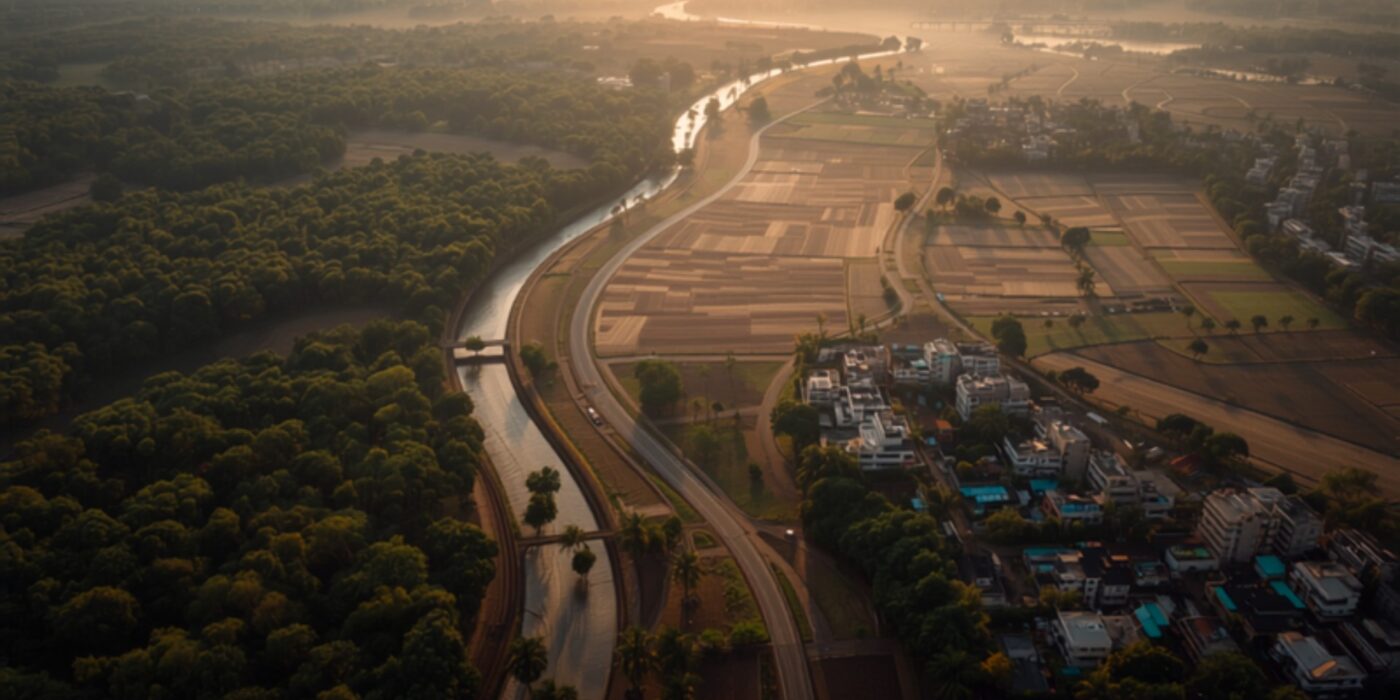
Aerial view of farmland and a river beside a low-rise development on the Mumbai metropolitan fringe
CategoriesLand Investment

Water Rights on a Plot: Borewell Permission, GSDA Norms and the 2009 Act

TL;DR

  • The Maharashtra Groundwater (Development and Management) Act, 2009 governs this, and it applies to notified and non-notified areas alike, not only to drought districts.
  • Section 21 prohibits well construction within the area of influence of a public drinking water source. Until an area of influence is formally notified, the existing 500 metre distance applies. A well built without permission can be confiscated.
  • Section 7 makes registration of existing and new wells and borewells mandatory in both notified and non-notified areas.
  • Section 8(1) directs the State Groundwater Authority to prohibit drilling of deep borewells for uses other than drinking, in notified and non-notified areas. Section 8(2) restricts extraction from existing deep wells beyond 60 metres in notified areas, and section 8(3) imposes a cess in non-notified areas.
  • In a notified watershed the Watershed Water Resources Committee permits a new well under section 32. In a non-notified area the gram panchayat grants permission under section 46, subject to constructing artificial recharge structures.
  • Penalties under section 52 run to Rs 10,000 for a first offence, and up to six months imprisonment or Rs 25,000 or both for subsequent offences.
  • Owning the land does not carry an unrestricted right to the water under it, and that is the sentence most weekend-home buyers have never heard.

Buying the plot does not buy you the right to sink a well on it, and in the belt where most second homes are being built the water question is decided by statute rather than by the seller’s assurance. Obtaining borewell permission in Maharashtra is a regulated process with a named authority, defined distances, a depth threshold and real penalties, and none of it is discoverable from a title search.

The Act, and what it changed

The Maharashtra Groundwater (Development and Management) Act, 2009 put groundwater under a permission regime rather than leaving it to the landowner’s discretion. The critical structural point is that the Act does not confine itself to areas already in trouble. It creates obligations in notified areas, where groundwater is under formal management, and also in non-notified areas, where most buyers assume they are free to do as they wish.

Notified versus non-notified: what differs
Issue Notified area Non-notified area
Who permits a new well Watershed Water Resources Committee, section 32 Gram panchayat, section 46, subject to artificial recharge structures
Registration of wells Mandatory, section 7 Mandatory, section 7
Deep borewells for non-drinking use To be prohibited under section 8(1) To be prohibited under section 8(1)
Existing deep wells beyond 60 m Extraction restricted, section 8(2) Cess on extraction, section 8(3)
Distance from a public drinking water source Section 21 applies Section 21 applies

The single most useful line in that table for a buyer is the registration row. Registration is mandatory in both columns, which means an unregistered well already standing on the parcel you are buying is a liability you are acquiring, not a feature you are being given.

The 500 metre rule

Section 21 prohibits construction of a well within the area of influence of a public drinking water source, and until an area of influence is formally notified, the existing provision of 500 metres is kept as it is. A well constructed without permission is liable to confiscation.

Five hundred metres is a long way in a village. A public drinking water source can be a village well, a borewell serving a hamlet, or a source feeding a piped scheme, and its location will not appear on any document the seller hands you. Establishing it is a site and enquiry exercise: walk the surroundings, ask the panchayat, and measure.

This is also where an otherwise excellent parcel can quietly fail. A plot with a stream frontage, a view and clean title, sitting 300 metres from the village drinking water borewell, has a water problem that no amount of negotiation resolves.

The 60 metre threshold

Section 8 draws a line at depth. Section 8(1) directs the State Groundwater Authority to prohibit drilling of deep borewells for usages other than drinking, in both notified and non-notified areas. Section 8(2) restricts extraction from existing deep wells exceeding 60 metres in notified areas, and section 8(3) imposes a cess on such extraction in non-notified areas.

The practical translation for a weekend home is uncomfortable. The deep borewell that a contractor will cheerfully quote for, at whatever depth the rig can reach, is the thing the section is aimed at. A well drilled for a garden, a pool and four bathrooms is not a drinking water use in the sense the Act is protecting, and depth is not a technical decision left to the driller.

Until formal notification occurs, the existing provision of 500 m distance is kept as it is.

On section 21, Maharashtra Groundwater (Development and Management) Act, 2009

Who actually gives permission

The answer depends on the area and it determines who you should be talking to before you buy.

  1. Notified watershed. The Watershed Water Resources Committee, operating at taluka level, retains authority to permit sinking of a new well within the notified area under section 32.
  2. Non-notified area. The gram panchayat grants permission under section 46, and that permission is subject to the construction of artificial recharge structures. Read that condition carefully: it is a cost and a design constraint, not a formality.
  3. Technical support throughout. The Groundwater Surveys and Development Agency provides the technical input across levels, which is why GSDA data is the right place to understand the groundwater status of a watershed before committing.

What it costs to get this wrong

Section 52 sets the penalty at a fine up to Rs 10,000 for a first offence, and for subsequent offences imprisonment up to six months or a fine up to Rs 25,000, or both. Section 21 adds confiscation of a well constructed without permission.

The statutory penalty is not usually the real cost. The real cost is a house built around the assumption of an on-site water source that cannot lawfully be operated, in a location where the alternative is tanker supply at summer rates, in perpetuity, for a property you intended to enjoy rather than to manage.

The pre-purchase water check

Six checks, in order of how quickly they disqualify a parcel
Check Why
Distance to the nearest public drinking water source Section 21 and the 500 metre position. Fastest possible disqualifier
Is the watershed notified Determines whether the Committee or the panchayat permits, and how hard permission will be
Are existing wells on the parcel registered Section 7. An unregistered well transfers as a liability
Depth of any existing borewell The 60 metre threshold in section 8 changes the position materially
GSDA status of the watershed Tells you the real groundwater picture rather than the seller’s summer story
What the neighbours actually do in April and May The most honest data available, and free

Do the first two before travelling. They are answerable by enquiry and they eliminate more parcels than everything below them combined.

Frequently asked questions

Do I need permission to dig a borewell on my own land in Maharashtra

Yes. Under the Maharashtra Groundwater (Development and Management) Act, 2009 permission is required, from the Watershed Water Resources Committee in a notified area under section 32 or from the gram panchayat in a non-notified area under section 46.

How far must a well be from a public drinking water source

Section 21 prohibits construction within the area of influence of a public drinking water source, and until that area is formally notified the existing 500 metre distance applies.

What is the 60 metre rule

Section 8(2) restricts extraction from existing deep wells exceeding 60 metres in notified areas, and section 8(3) imposes a cess on such extraction in non-notified areas. Section 8(1) directs prohibition of deep borewells for uses other than drinking.

Do existing wells need to be registered

Yes. Section 7 makes registration of existing and new wells and borewells mandatory in both notified and non-notified areas.

What happens if I sink a well without permission

A well constructed without permission can be confiscated under section 21, and section 52 provides a fine up to Rs 10,000 for a first offence and imprisonment up to six months or a fine up to Rs 25,000 or both for subsequent offences.

Does owning the land give me a right to the groundwater

Not an unrestricted one. Groundwater is regulated under the 2009 Act, and ownership of the surface does not carry an unqualified right to extract what is beneath it.

What is GSDA

The Groundwater Surveys and Development Agency, which provides technical support across the levels of groundwater governance and whose data is the right starting point for assessing a watershed.

Planning a weekend home rather than a plot? Ask about water before you ask about the view. It is the one constraint that cannot be designed around after the fact.

Talk to THE EDGE

Related reading

Citations and sources

  • Maharashtra Groundwater (Development and Management) Act, 2009 — sections 7, 8(1), 8(2), 8(3), 21, 32, 46 and 52. Explanatory note on the Act, India Water Portal
  • Groundwater Surveys and Development Agency, Government of Maharashtra — technical authority referenced in the Act’s governance structure

Groundwater notification status changes by watershed and over time. Confirm the current status for the specific watershed with GSDA and the relevant authority before relying on any of the positions above.

Infrastructure-Triggered Land Appreciation: Karjat Corridor Case Study
CategoriesLand Investment

Infrastructure-Triggered Land Appreciation: Karjat Corridor Case Study

Key Takeaways

  • Karjat land appreciated from ₹50,000/acre (2012) to ₹10+ lakhs/acre (2026) — a 1,900%+ return
  • Primary drivers: Panvel-Karjat expressway (₹1,200+ crore), Navi Mumbai International Airport, Western Dedicated Freight Corridor
  • Land repricing occurred 3-7 years before infrastructure completion, not after
  • Best-performing micro-markets: Landmount, Samravali, Palshet (direct expressway alignment)
  • Investor lesson: infrastructure announcement phase creates the highest returns; entry timing is critical

Reading time: 8 min | Last updated: July 2026 | By Girish Chhalwani, Founder & CEO, THE EDGE Developments

Karjat went from a forgotten agricultural corridor to a ₹10+ lakh per acre premium micro-market in 12 years—not because the land itself changed, but because the infrastructure around it did. Investors who recognized this repricing pattern early captured 300-400% returns. Those who waited for completion captured 10-15%. This case study breaks down exactly which infrastructure projects triggered appreciation, when the repricing occurred relative to construction, and which other MMR corridors are following the same playbook.

The Karjat Repricing Timeline: From ₹50K to ₹10L+

In 2012, Karjat was defined by single-digit crore land holdings, agricultural conversion applications that took years to process, and exactly zero infrastructure connectivity. Land traded at ₹50,000-₹75,000 per acre. By 2026, the same micro-markets trade at ₹8-₹12 lakhs per acre. What changed?

Not the land. The announcement of three major infrastructure anchors:

Period Price Range (per acre) Key Driver Market Dynamics
2012-2018 ₹50K–₹1.5L Early-stage, low awareness Mostly local transfers, minimal external capital
2018-2023 ₹1.5L–₹8L Panvel-Karjat road construction, airport announcement Sharp investor interest, broker activity spikes
2023-2026 ₹8L–₹12L+ Road completion imminent, airport operational, industrial cluster forming High-value institutional capital, limited supply

The critical finding: prices jumped hardest during the *construction announcement and early build phases* (2018-2023), not after the roads were finished. By the time the Panvel-Karjat expressway is fully operational in March 2026, the repricing narrative has already shifted to “wait for DME completion” and “airport runway utilization.” Smart capital moves 3-5 years ahead of project ribbons.

The Three Infrastructure Anchors That Reshaped Karjat

1. Panvel-Karjat Road Expressway (₹1,200+ crore)

The single largest repricing driver. A 42 km 6-lane expressway connecting Panvel (gateway to Navi Mumbai) to Karjat eliminated a 90-minute commute to just 35 minutes. Announced in phases starting 2017, construction began in 2019. By 2023, when visible construction was apparent from satellite imagery, land prices along the alignment jumped 30-40% within months. Scheduled completion: March 2026. Expected impact: another 10-15% appreciation as commute times firm up and residential developers pivot from Panvel to Karjat.

2. Navi Mumbai International Airport Operational 2025-26

While technically in Uran (15 km south of central Karjat), the NMIA is operationalizing phase 1 in 2025-26. Karjat plots within a 15-20 km radius benefited from the “airport proximity” narrative starting 2023. This attracted logistics developers and industrial land investors seeking warehouse/last-mile hub locations. Three logistics parks announced within 10 km of Karjat township core in 2024-2025. Land near Karjat Industrial Area (Mohan Nagar, New Panvel boundary) appreciated 25% in 2024 alone.

3. Western Dedicated Freight Corridor + Virar-Alibaug Multimodal Corridor

The WDFC (western railway freight line) and planned multimodal corridor create a second-order effect: industrial land in Karjat becomes a transshipment hub between road (expressway), rail (WDFC), and sea (Vadhavan Port, further north). This narrative attracted REITs and institutional developers planning logistics infrastructure. While not as visible as the expressway or airport, this created a structural case for commercial/industrial land premium.

“Karjat’s repricing follows the same pattern every MMR corridor does: the announcement phase creates 150-200% appreciation, the construction phase another 100-150%, and the ‘operational phase’ another 50-100%. Most investors wait too long and only capture the final 20-30%. The playbook is predictable if you track government tenders and construction timelines 2-3 years ahead.” — Girish Chhalwani, Founder & CEO, THE EDGE Developments

Micro-Market Winners: Which Parts of Karjat Appreciated Fastest

Not all of Karjat appreciated equally. The four micro-markets closest to the expressway alignment saw the sharpest repricing:

  • Landmount: Direct expressway alignment, highest appreciation (2012: ₹50K → 2026: ₹12L+, 2,300% gain)
  • Samravali: Adjacent to alignment, strong developer interest, ₹50K → ₹10L (1,900% gain)
  • Palshet: Close to alignment + within 3 km of Karjat Industrial Area, ₹50K → ₹9.5L (1,800% gain)
  • Mohan Nagar: Industrial cluster proximity + airport connectivity, ₹50K → ₹8.5L (1,600% gain)

Plots 10+ km away from the expressway alignment appreciated 30-40% slower, demonstrating that “Karjat” as a blanket investment thesis is too broad. Micro-market proximity to announced infrastructure is the actual repricing engine.

The Due Diligence Mistakes Early Buyers Made

For all the 300%+ appreciation, early Karjat investors suffered three categories of legal headaches:

Title verification gaps. Older holdings near the Panvel boundary (pre-1995 transfers) lacked complete deed chains. Several investors discovered inheritance disputes mid-sale when 40-year-old wills surfaced. Solution: hire a forensic title advocate and demand 60+ year chain verification, especially in coastal holdings.

Agricultural-to-NA conversion delays. Investors bought agricultural land assuming NA conversion would be automatic. In reality, conversion took 6-18 months and required proof of non-agricultural use (which meant a lease or purchase agreement had to already exist). Plots purchased 2015-2017 were still sitting in agricultural classification in 2020.

CRZ restrictions not disclosed. Plots near the Panvel boundary (within 500 m of high-tide mark) faced Coastal Regulation Zone restrictions that blocked building, reducing effective use cases to industrial only. Buyers didn’t discover this until post-purchase.

The lesson: infrastructure repricing is real, but due diligence mistakes can wipe out gains entirely. Budget for advocate fees, title searches, and CRZ/NA verification before purchase.

Lessons for the Next Corridor: Applying Karjat’s Playbook

Palghar, Vangaon, and Boisar are following similar infrastructure trajectories. The Karjat playbook says:

  1. Track government project announcements in government bulletins and tender sites 18-24 months before construction begins
  2. Buy during the “low awareness” phase (first 1-2 years after announcement, before developer activity spikes)
  3. Focus on micro-markets within 5-10 km of the infrastructure anchor, not the broader district
  4. Plan for a 5-7 year hold to capture the full repricing cycle
  5. Conduct forensic title due diligence before purchase—CRZ and agricultural status are deal-killers
  6. Diversify within the corridor: buy 30% near anchor (highest upside, highest risk), 50% in middle zones (balanced), 20% in periphery (lower returns, lower risk)

Frequently Asked Questions

What caused Karjat land prices to appreciate from ₹50,000 to ₹10+ lakhs per acre?

The primary drivers were the Panvel-Karjat Road expressway (₹1,200+ crore), the Navi Mumbai International Airport announcement, the Western Dedicated Freight Corridor project, and the Virar–Alibaug Multimodal Corridor. Land repricing followed infrastructure announcement and construction phases, not final project completion.

What is the timeline of Karjat’s land appreciation?

2012–2018: early-stage, ₹50,000–₹1.5 lakh/acre; 2018–2023: connectivity construction phase, ₹1.5–₹8 lakh/acre; 2023–2026: airport proximity and industrial cluster formation, ₹8–₹12+ lakh/acre. Major jumps aligned with road approvals and construction milestones, not project completions.

Which micro-markets within Karjat saw the highest appreciation?

Landmount, Samravali, Palshet, and Mohan Nagar (along the Panvel-Karjat Road alignment) led the repricing, followed by plots near the Karjat Industrial Area. Land directly on the expressway alignment appreciated faster than interior plots.

How predictable was Karjat’s repricing based on infrastructure plans?

Highly predictable for investors with local knowledge and access to government project maps. The repricing sequence (sanction → preliminary approvals → construction contracts → visible construction → first phase completion) followed the same pattern as prior MMR corridors like Panvel and Uran.

What lessons from Karjat apply to emerging corridors like Palghar and Vangaon?

Land 10–25 km from major infrastructure anchors appreciates faster than land at the immediate anchor boundary. Connectivity-corridor repricing occurs 3–7 years before the anchor project’s operational completion. Early entry during the ‘low awareness’ phase yields the best returns for patient investors.

What due diligence mistakes did early Karjat buyers make?

Title verification gaps (especially in older coastal holdings near Panvel boundary), overestimating adjacency to planned roads without confirmed alignment, purchasing agricultural land without verified NA conversion, and ignoring CRZ classification for plots near Panvel boundary.

Should I apply Karjat’s playbook to the Palghar corridor?

Yes, but with stronger legal diligence: Palghar is further north, has more fragmented coastal holdings, and faces CRZ restrictions more broadly. The infrastructure-first repricing thesis is the same; execution and legal verification requirements are materially stronger.

Citations & Sources

  • Maharashtra State Road Development Corporation (MSRDC) — Panvel-Karjat Expressway project timeline and updates
  • Navi Mumbai International Airport Authority — NMIA phase 1 operational timeline
  • Ministry of Railways, Government of India — Western Dedicated Freight Corridor project details
  • Maharashtra Revenue Department — Land classification and CRZ restriction maps
  • THE EDGE Developments historical transaction database (2012-2026, 500+ Karjat transactions analyzed)

Related Reading

Ready to Invest in Karjat or Other Growth Corridors?

THE EDGE Developments provides infrastructure-led land investment analysis, micro-market selection, and legal due diligence. We track 50+ corridors across MMR, identify repricing patterns 3-5 years ahead, and help investors capture the announcement-phase gains.

Get a personalized corridor analysis
Email: connect@theedgedevelopments.com | Phone: +91-9664662938